
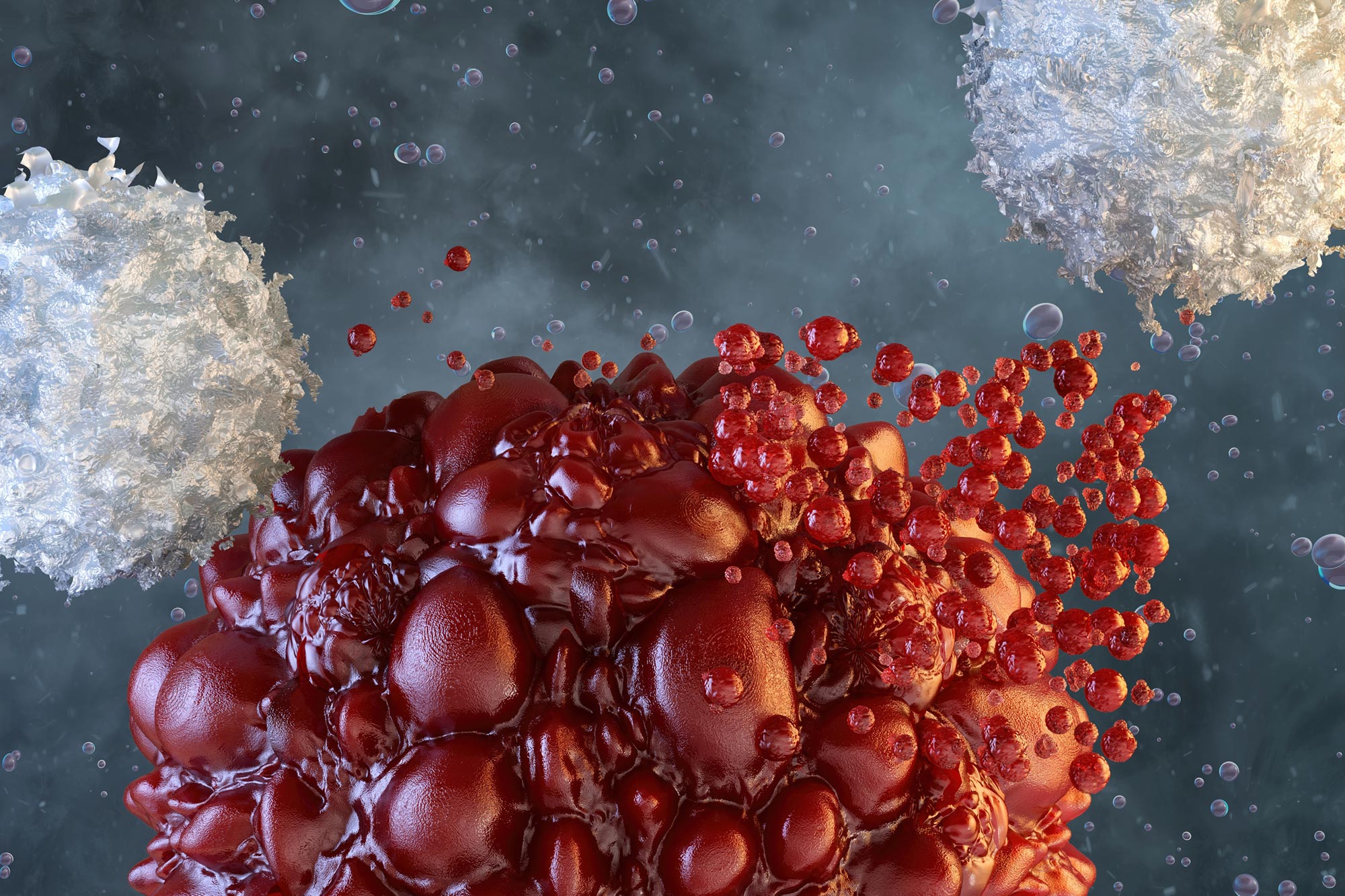
A protein called TRAILshort may act as a central immune brake that limits T-cell responses and CAR-T therapy.
Cancer cells can weaken the immune system by producing a protein that prevents its most important defenders from attacking. Mayo Clinic researchers have identified how this protein works, revealing a possible target for treatments designed to improve cancer immunotherapy.
The study, published in the Journal of Clinical Investigation, uncovered a previously unknown function of TRAILshort, a protein that behaves like an immune “off switch.” TRAILshort stops T cells, the immune system’s main cancer-fighting cells, from recognizing and destroying cancerous and virus-infected cells. In preclinical models, blocking the protein restored T cell activity and strengthened the immune response.
TRAILshort also reduced the effectiveness of chimeric antigen receptor T cell therapy (CAR-T cell therapy), an advanced cancer immunotherapy that modifies a patient’s T cells to attack tumors. The findings indicate that blocking TRAILshort could improve CAR-T treatment and may also benefit other immune-based cancer therapies.
“What strikes me most is that TRAILshort appears in cancer, HIV, COVID-19, tuberculosis, lupus and Crohn’s disease — almost every condition where the immune system is failing or misfiring. That tells us we may have identified a fundamental switch in human immunity, not just a curiosity in one disease,” says Andrew Badley, M.D., senior author of the study. Dr. Badley is an infectious diseases specialist and immunologist at Mayo Clinic.
A hidden immune brake comes into view
Mayo Clinic researchers first identified TRAILshort nearly 15 years ago while investigating HIV. They discovered in 2020 that cancer cells also produce the protein, but the process by which it suppressed T cell activity remained unexplained. The latest study identifies that mechanism for the first time.
Elevated TRAILshort levels appeared in melanoma, lung, breast, pancreatic, and ovarian cancers, as well as Hodgkin lymphoma. Researchers also found increased levels in infectious diseases, including COVID-19, tuberculosis, and hepatitis C.
Using highly specific antibodies and engineered preclinical models, the researchers determined that TRAILshort activates SHP-1. This protein functions as a molecular brake, switching off T cells before they can attack infected or cancerous cells.
“This is the first study to show that TRAILshort doesn’t just block cell death — it also acts as a signaling molecule that directly suppresses T-cell activity,” says Shahrzad Jalali, Ph.D., a research scientist at Mayo Clinic and lead author of the study. “That reveals an entirely new role for the protein in regulating the immune response.”
Blocking TRAILshort restores CAR-T activity
The results point to several possible therapeutic uses.
In preclinical models, TRAILshort substantially weakened the ability of CAR-T therapy to control tumors. Blocking the protein restored immune activity, indicating that targeting TRAILshort could strengthen CAR-T therapy and other immunotherapies. Researchers also suggest that TRAILshort might serve as a biomarker for identifying tumors more likely to respond to targeted treatments.
“Discovering the role of TRAILshort and how it inhibits CAR-T cells opens the door for a new therapeutic strategy to improve their activity,” says Saad Kenderian, M.B. Ch.B., an oncologist at Mayo Clinic Comprehensive Cancer Center and study co-author. “This is an important step as we work to make CAR-T therapy more effective for patients with cancer.”
One target could tune immunity both ways
TRAILshort may eventually have uses beyond cancer. Researchers suggest that it could offer a more selective way to reduce harmful immune activity in autoimmune diseases or transplantation without suppressing the entire immune system.
“In cancer, there’s too much TRAILshort, so our goal is to get rid of it with antibodies that remove it. In autoimmune disease, there’s not enough TRAILshort, so our goal is to deliver more,” Dr. Badley says.
Further research is required to determine whether either approach is safe and effective in patients.
“What excites us most is that this discovery gives us a new, actionable way to regulate the immune system,” Dr. Badley says. “By targeting TRAILshort, we may be able to strengthen immune responses against cancer and chronic infections or, in other diseases, reduce harmful immune activity.”
Reference: “TRAIL splice variant TRAILshort disrupts T cell receptor signaling and promotes immune tolerance in vivo” by Shahrzad Jalali, Sekar Natesampillai, Zilin Nie, Ying Zhang, Ismail Can, Aswath P. Chandrasekar, Brianna M. Hameister, Cristina Correia, Tuantuan V. Zhao, Dong-Gi Mun, Enrique Garcia-Rivera, Robert Matson, Ashton Krogman, Mark A. Maynes, Robin Batchelor, Dileep D. Monie, Hu Li, Atta Behfar, Saad S. Kenderian, Akhilesh Pandey, Stephen M. Ansell, Timucin Taner, Cornelia Weyand, Daniel D. Billadeau and Andrew D. Badley, 3 August 2026, The Journal of Clinical Investigation.
DOI: 10.1172/JCI194449
This work is the result of NIH funding, in whole or in part, and is subject to the NIH Public Access Policy.
Never miss a breakthrough: Join the SciTechDaily newsletter.
Follow us on Google and Google News.