
Close Menu
    Facebook X (Twitter) Instagram
    SciTechDaily
    • Biology
    • Chemistry
    • Earth
    • Health
    • Physics
    • Science
    • Space
    • Technology
    Facebook X (Twitter) Pinterest YouTube RSS
    SciTechDaily
    Home»Space»The Sun’s Corona Usually Looks White. In Spain, It Turned Gold
    Space

    The Sun’s Corona Usually Looks White. In Spain, It Turned Gold

    By NASAAugust 25, 2026No Comments2 Mins Read
    Facebook Twitter Pinterest Telegram LinkedIn WhatsApp Email Reddit
    Share
    Facebook Twitter LinkedIn Pinterest Telegram Email Reddit
    Golden Corona Eclipse
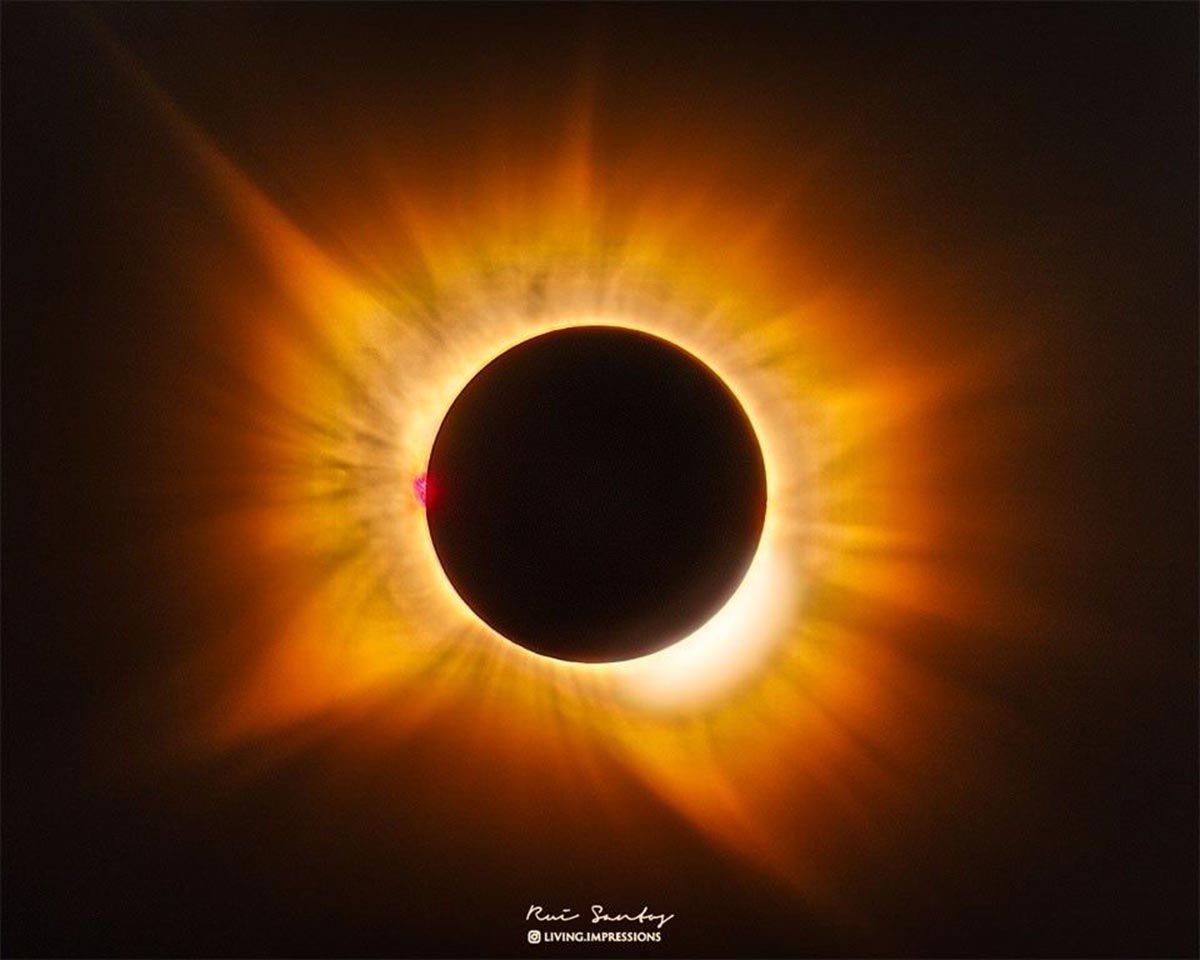
    During Spain’s recent total solar eclipse, the Sun’s corona appeared an unusually vivid gold instead of its more familiar pearly white. Credit: © Rui Santos (Living Impressions)

    This month’s total solar eclipse offered more than a spectacular view. It also produced an unusual visual effect that made the event especially interesting from a scientific perspective.

    During a total solar eclipse, the solar corona, the Sun’s faint outer atmosphere, typically appears white or pearly. Some observers of last week’s eclipse did see this familiar pale color. In Spain, however, many people witnessed something very different: the corona appeared strikingly golden.

    Why the Eclipse Looked Golden

    One major reason was the position of the Sun. From Spain, totality occurred as the Sun was setting close to the horizon.

    When sunlight passes through the atmosphere at such a low angle, it travels through much more air than it does when the Sun is high in the sky. Molecules in the atmosphere scatter shorter wavelengths of visible light, especially blue light. This is the same basic process that helps produce red and orange sunsets.

    In this case, another factor intensified the effect. An unusually large amount of smoke in the air from nearby forest fires acted as an additional atmospheric filter. The smoke scattered even more of the remaining blue wavelengths, leaving the visible light increasingly dominated by warmer golden tones.

    A Dramatic View From Spain

    The HDR-processed, multiple-exposure featured image was captured last week from Benavente, Spain. HDR, or high dynamic range imaging, combines exposures taken at different brightness levels so that both faint and bright details can be seen more clearly in a single image.

    Not everything around the eclipsed Sun took on the same golden color. A hydrogen-glowing prominence hovering along the Sun’s left edge – a huge structure of hot plasma extending outward from the solar surface – retained its original bright pink hue, creating a vivid contrast with the golden corona.

    Never miss a breakthrough: Join the SciTechDaily newsletter.
    Follow us on Google and Google News.

    NASA Solar Eclipse Sun
    Share. Facebook Twitter Pinterest LinkedIn Email Reddit

    Related Articles

    A “Ring of Fire” in the Sky: The Solar Eclipse Experience

    Five NASA Tips for Photographing the “Ring of Fire” Solar Eclipse

    Don’t Miss: A “Ring of Fire” in the Sky

    NASA Science in the Shadows: Five Exciting Experiments for 2024 Total Solar Eclipse

    Don’t Miss Eclipses: NASA Releases New Map of Upcoming Solar Eclipses

    Total Solar Eclipse Below the Bottom of the World Captured From Airplane

    Don’t Miss the Total Solar Eclipse 2021 – Where To See It in Person & How To Watch a Live Stream

    NASA’s ACE Mission: Total Solar Eclipses Shine a Light on the Solar Wind

    Don’t Miss the Breathtaking “Ring of Fire” Solar Eclipse

    Leave A Reply Cancel Reply

    • Facebook
    • Twitter
    • Pinterest
    • YouTube

    Don't Miss a Discovery

    Subscribe for the Latest in Science & Tech!

    Trending News

    JWST Finds a “Star” 100 Billion Times Brighter Than Any Star Should Be

    Scientists Find a Hidden Biological Link Across Different Forms of Autism

    Astronomers Discover a Ghostly River of Stars That Could Reveal Dark Matter

    Why Is Colorectal Cancer Rising in People Under 50? New Clues Point to the Environment

    Quantum Fluctuations Break a Crystal’s Symmetry Rules

    Why Does an Irregular Heartbeat Strike 40 Years Early in Some People?

    Scientists Reveal How ADHD Could Fuel Creative Thinking

    Scientists Find Just 3 Minutes of Sprinting Can Transform Blood Chemistry

    Follow SciTechDaily
    • Facebook
    • Twitter
    • YouTube
    • Pinterest
    • Newsletter
    • RSS
    SciTech News
    • Biology News
    • Chemistry News
    • Earth News
    • Health News
    • Physics News
    • Science News
    • Space News
    • Technology News
    Recent Posts
    • The Sun’s Corona Usually Looks White. In Spain, It Turned Gold
    • A SpaceX Falcon 9 Rocket Hit the Moon and Blasted Open a 60-Foot Crater
    • Does Vitamin C Really Prevent Colds? The Answer May Surprise You
    • Study Reveals Your Organs May Be Aging at Very Different Speeds
    • T Cells Have a Hidden Ability Scientists Never Knew Existed
    Copyright © 1998 - 2026 SciTechDaily. All Rights Reserved.
    • Science News
    • About
    • Contact
    • Editorial Board
    • Privacy Policy
    • Terms of Use

    Type above and press Enter to search. Press Esc to cancel.