
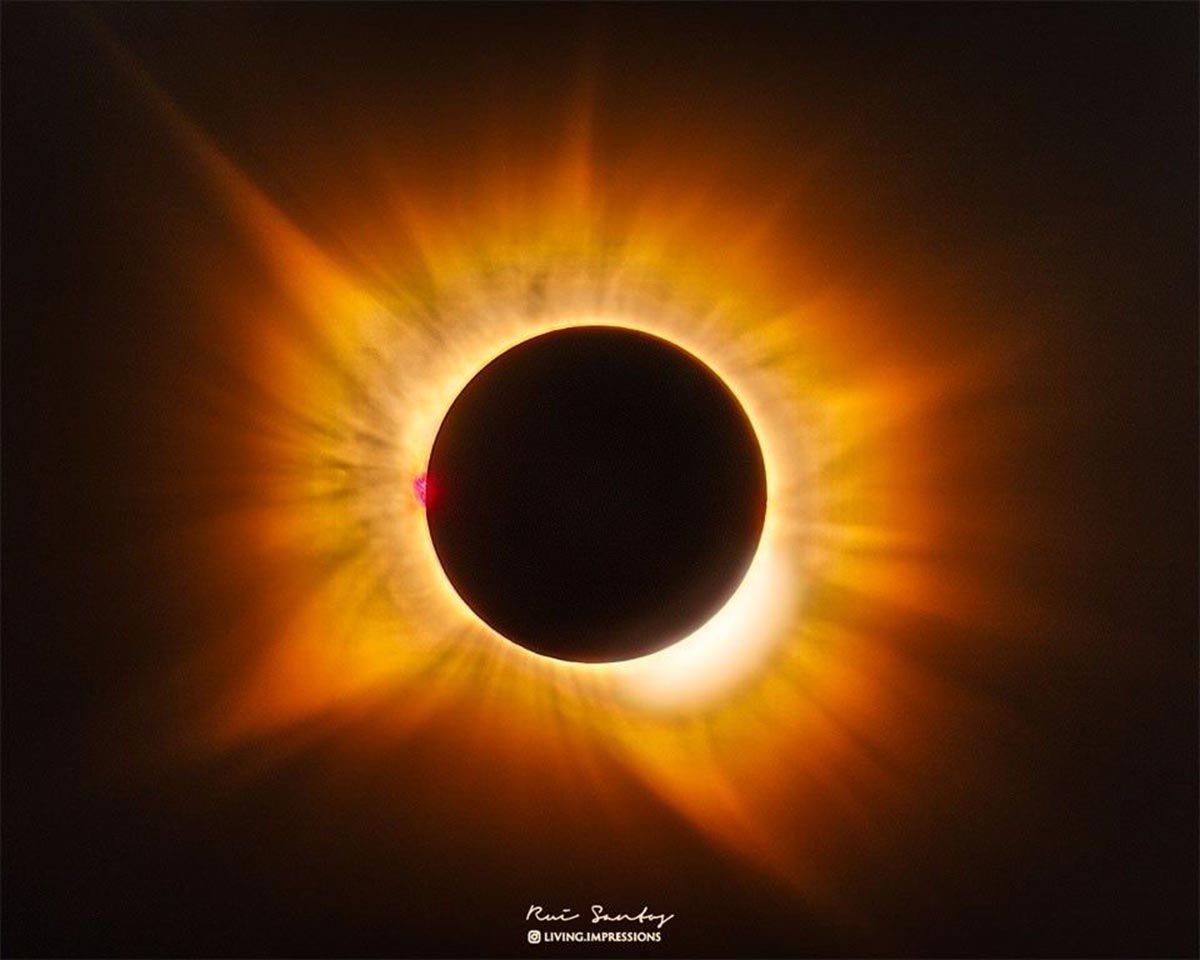
This month’s total solar eclipse offered more than a spectacular view. It also produced an unusual visual effect that made the event especially interesting from a scientific perspective.
During a total solar eclipse, the solar corona, the Sun’s faint outer atmosphere, typically appears white or pearly. Some observers of last week’s eclipse did see this familiar pale color. In Spain, however, many people witnessed something very different: the corona appeared strikingly golden.
Why the Eclipse Looked Golden
One major reason was the position of the Sun. From Spain, totality occurred as the Sun was setting close to the horizon.
When sunlight passes through the atmosphere at such a low angle, it travels through much more air than it does when the Sun is high in the sky. Molecules in the atmosphere scatter shorter wavelengths of visible light, especially blue light. This is the same basic process that helps produce red and orange sunsets.
In this case, another factor intensified the effect. An unusually large amount of smoke in the air from nearby forest fires acted as an additional atmospheric filter. The smoke scattered even more of the remaining blue wavelengths, leaving the visible light increasingly dominated by warmer golden tones.
A Dramatic View From Spain
The HDR-processed, multiple-exposure featured image was captured last week from Benavente, Spain. HDR, or high dynamic range imaging, combines exposures taken at different brightness levels so that both faint and bright details can be seen more clearly in a single image.
Not everything around the eclipsed Sun took on the same golden color. A hydrogen-glowing prominence hovering along the Sun’s left edge – a huge structure of hot plasma extending outward from the solar surface – retained its original bright pink hue, creating a vivid contrast with the golden corona.
Never miss a breakthrough: Join the SciTechDaily newsletter.
Follow us on Google and Google News.