
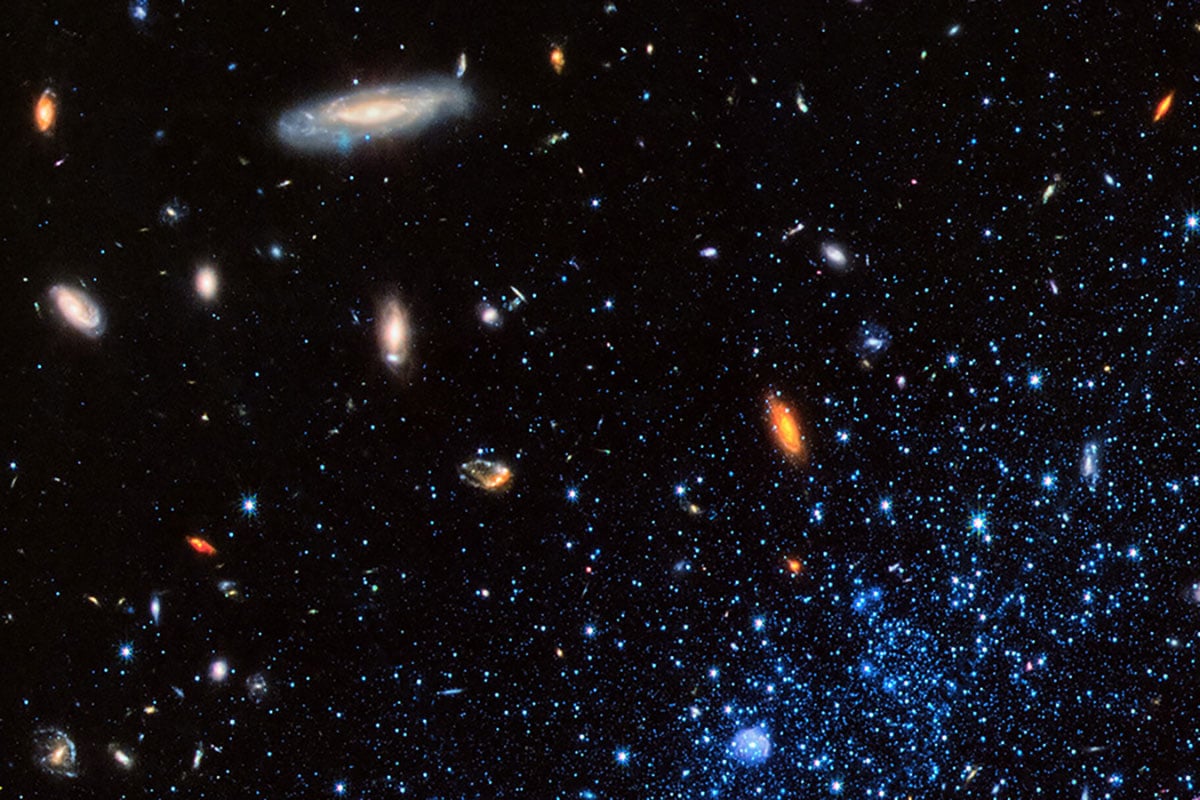
Large Binocular Telescope data cut helium measurement uncertainty threefold.
Helium, a light chemical element, carries clues to what the universe was like during its first five minutes. To read that record, an international team turned to 15 small, remote galaxies whose chemistry has changed very little, preserving a composition close to that of the early cosmos.
By studying those galaxies, the researchers, including scientists at the University of Minnesota Twin Cities, estimated how much helium formed during those opening minutes with unprecedented precision. They reduced the uncertainty in that estimate to 0.5%, one-third of the previous level.
Pristine galaxies sharpen the helium estimate
The choice of galaxies helped the team move away from an indirect approach to estimating the original helium abundance. Traditionally, researchers have measured many galaxies and extended a trend in the data back to an estimated starting value, a method called extrapolation. Concentrating on some of the most chemically unevolved galaxies ever discovered gave the team a clearer view of that early composition.
The work required 130 hours of observations with the Large Binocular Telescope and is described in five papers published in The Astrophysical Journal. Spectrographs built at Ohio State University separated the galaxies’ light into its component wavelengths, revealing distinct features called spectral lines that researchers use to measure helium and hydrogen.
“The MODS spectrographs took 12 years to build from conception to first light on sky,” said Richard Pogge, College of Arts and Sciences Distinguished Professor of Astronomy at Ohio State University. “This is the kind of project we designed them to do, and to see them deliver is enormously satisfying. It’s not every day you can help build instruments that measure something fundamental about our universe.”
The researchers analyzed more than 10 helium lines and 15 hydrogen lines simultaneously. Examining them together allowed the team to account for small systematic effects, influences that can consistently shift measurements away from the true value. Earlier work had treated those effects as negligible. At a precision below 1%, they could no longer be ignored.
“We promised a half-percent uncertainty in our proposal, and we got there,” said Evan Skillman, a Distinguished Professor in the University of Minnesota’s College of Science and Engineering, in the School of Physics and Astronomy. “In the unpredictable world of science, that doesn’t happen very often.”
Testing the Big Bang through helium
A more precise helium measurement strengthens one of the three main lines of evidence supporting the Big Bang theory, which describes the universe’s expansion from an extremely hot, dense state about 13.8 billion years ago. The abundance of light elements, including helium and deuterium, a form of hydrogen, provides a check on that account of cosmic history. Helium has received less extensive study than the other two pillars, the universe’s expansion and the cosmic microwave background, radiation left over from its early history.
The measurement also gives physicists a way to test the Standard Model, the framework describing fundamental particles and their interactions.
“This is a physics experiment on a grand scale and one of the biggest findings in my entire 40-year career,” Skillman said. “It’s a fundamental number that tells us specifically about the conditions of our universe in its first five minutes. It has diagnostic power that speaks directly to the Standard Model of Physics.”
Using the helium abundance, the team could calculate the number of families of neutrinos, extremely lightweight subatomic particles, present in the early universe. That connects observations of galaxies today to questions about which particles populated the cosmos when it was only minutes old.
Reference: “The LBT Yp Project. I. An Improved Determination of the Primordial Helium Abundance—Project Description, Sample Selection, Observations, and Methodology” by Evan D. Skillman, Richard W. Pogge, Erik Aver, Noah S. J. Rogers, Miqaela K. Weller, Keith A. Olive, Danielle A. Berg, John J. Salzer, John H. Miller, Jayde Spiegel, Tsung-Han Yeh and Brian D. Fields, 9 September 2026, The Astrophysical Journal.
DOI: 10.3847/1538-4357/ae879f
Never miss a breakthrough: Join the SciTechDaily newsletter.
Follow us on Google and Google News.