
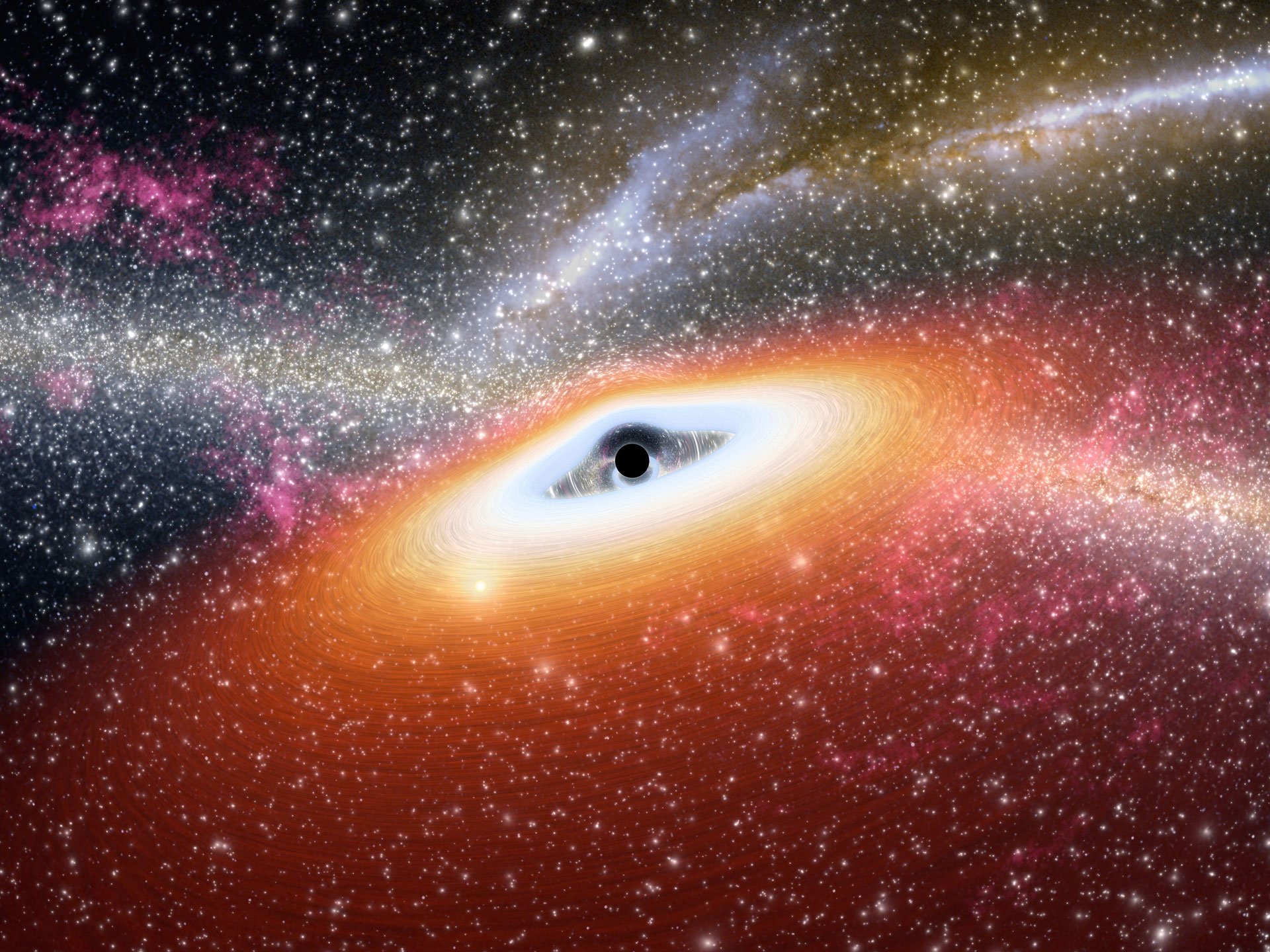
Supermassive black holes weigh millions to billions times more than our sun and lie at the center of most galaxies. A supermassive black hole several million times the mass of the sun is situated in the heart of our very own Milky Way.
Despite how commonplace supermassive black holes are, it remains unclear how they grow to such enormous proportions. Some black holes constantly swallow gas in their surroundings, some suddenly swallow whole stars. But neither theory independently explains how supermassive black holes can “switch on” so unexpectedly and keep growing so fast for a long period.
A new Tel Aviv University-led study published today in Nature Astronomy finds that some supermassive black holes are triggered to grow, suddenly devouring a large amount of gas in their surroundings.
In February 2017, the All Sky Automated Survey for Supernovae discovered an event known as AT 2017bgt. This event was initially believed to be a “star swallowing” event, or a “tidal disruption” event, because the radiation emitted around the black hole grew more than 50 times brighter than what had been observed in 2004.
However, after extensive observations using a multitude of telescopes, a team of researchers led by Dr. Benny Trakhtenbrot and Dr. Iair Arcavi, both of TAU’s Raymond & Beverly Sackler School of Physics and Astronomy, concluded that AT 2017bgt represented a new way of “feeding” black holes.
“The sudden brightening of AT 2017bgt was reminiscent of a tidal disruption event,” says Dr. Trakhtenbrot. “But we quickly realized that this time there was something unusual. The first clue was an additional component of light, which had never been seen in tidal disruption events.”
Dr. Arcavi, who led the data collection, adds, “We followed this event for more than a year with telescopes on Earth and in space, and what we saw did not match anything we had seen before.”
The observations matched the theoretical predictions of another member of the research team, Prof. Hagai Netzer, also of Tel Aviv University.
“We had predicted back in the 1980s that a black hole swallowing gas from its surroundings could produce the elements of light seen here,” says Prof. Netzer. “This new result is the first time the process was seen in practice.”
Astronomers from the U.S., Chile, Poland, and the U.K. took part in the observations and analysis effort, which used three different space telescopes, including the new NICER telescope installed on board the International Space Station.
One of the ultraviolet images obtained during the data acquisition frenzy turned out to be the millionth image taken by the Neil Gehrels Swift Observatory — an event celebrated by NASA, which operates this space mission.
The research team identified two additional recently reported events of black holes “switched on,” which share the same emission properties as AT 2017bgt. These three events form a new and tantalizing class of black hole re-activation.
“We are not yet sure about the cause of this dramatic and sudden enhancement in the black holes’ feeding rate,” concludes Dr. Trakhtenbrot. “There are many known ways to speed up the growth of giant black holes, but they typically happen during much longer timescales.”
“We hope to detect many more such events, and to follow them with several telescopes working in tandem,” says Dr. Arcavi. “This is the only way to complete our picture of black hole growth, to understand what speeds it up, and perhaps finally solve the mystery of how these giant monsters form.”
Reference: “A new class of flares from accreting supermassive black holes” by Benny Trakhtenbrot, Iair Arcavi, Claudio Ricci, Sandro Tacchella, Daniel Stern, Hagai Netzer, Peter G. Jonker, Assaf Horesh, Julián Esteban Mejía-Restrepo, Griffin Hosseinzadeh, Valentina Hallefors, D. Andrew Howell, Curtis McCully, Mislav Baloković, Marianne Heida, Nikita Kamraj, George Benjamin Lansbury, Łukasz Wyrzykowski, Mariusz Gromadzki, Aleksandra Hamanowicz, S. Bradley Cenko, David J. Sand, Eric Y. Hsiao, Mark M. Phillips, Tiara R. Diamond, Erin Kara, Keith C. Gendreau, Zaven Arzoumanian and Ron Remillard, 14 January 2019, Nature Astronomy.
DOI:10.1038/s41550-018-0661-3
Never miss a breakthrough: Join the SciTechDaily newsletter.
Follow us on Google and Google News.
3 Comments
We have been fascinated by Stephen Hawking’s black holes for over a third of a century based on Einstein’s General Theory of Relativity, but eventually Hawking informed us they are not really black and there is no event horizon exactly. Everything from ‘black holes’ to dark energy and the accelerating universe is theorized using Einstein’s theory. Einstein claimed that the bending of light passing near the Sun, famously measured by Arthur Eddington during a solar eclipse, and also that the precession of the orbit of Mercury around the Sun were due to space-time deformation as characterized by his theory. In essence, he claimed that the explanation for the phenomena is that the geometry near massive objects is not Euclidean. Einstein said that “in the presence of a gravitational field, the geometry is not Euclidean.” But if that non-Euclidean geometry is self-contradicting, then Einstein’s explanation and his theory cannot be correct. How can it be correct if the title of the Facebook Note, “Einstein’s General Theory of Relativity Is Based on Self-contradicting Non-Euclidean Geometry,” is a true statement? Just check out the FB Note, at the link:
https://www.facebook.com/notes/reid-barnes/einsteins-general-theory-of-relativity-is-based-on-self-contradicting-non-euclid/1676238042428763/
Black hole ‘growth’ has yet to be proven while astrophysicists knowledge supports the idea of black holes size and place are immortal. B Gaensler, EXTREME COSMOS
The black hole swallowing gas from its surroundings “tidal disruption event” we quickly realized that this time the theoretical prediction of the research, we had this new NICER telescope installed on board the International Space Station during the data inverse acquisition frenzy, tuning the results for the first-first clues dark matter was an additional component of light which had never interacted with photons. What kind of light is it, tidal telescopic foam; do we agree that dark matter is a form of energy, correct? (one possibility, the innervation of CP violation)
14110127 – Quantum Mechanics and Spacetime in the 21st … – PIRSA
59:44
A Heuristic, Non-Mathematical Approach to Superstrings/M-Theory
By David Sears Schroeder
ASPECTS OF INFLATION IN STRING THEORY
SHE SAYS @ 32:44 How polarization of two opposite charges exists is not yet explained.
Quantum Gravity Documentary
Education Channel
Published on Jul 22, 2017
The Physics of Inflation
Inverse-Square Law of Propagation