
Close Menu
    Facebook X (Twitter) Instagram
    SciTechDaily
    • Biology
    • Chemistry
    • Earth
    • Health
    • Physics
    • Science
    • Space
    • Technology
    Facebook X (Twitter) Pinterest YouTube RSS
    SciTechDaily
    Home»Space»New Interstellar Visitor Is Confirmed and It Has a Name
    Space

    New Interstellar Visitor Is Confirmed and It Has a Name

    By International Astronomical UnionSeptember 24, 2019No Comments3 Mins Read
    Facebook Twitter Pinterest Telegram LinkedIn WhatsApp Email Reddit
    Share
    Facebook Twitter LinkedIn Pinterest Telegram Email Reddit
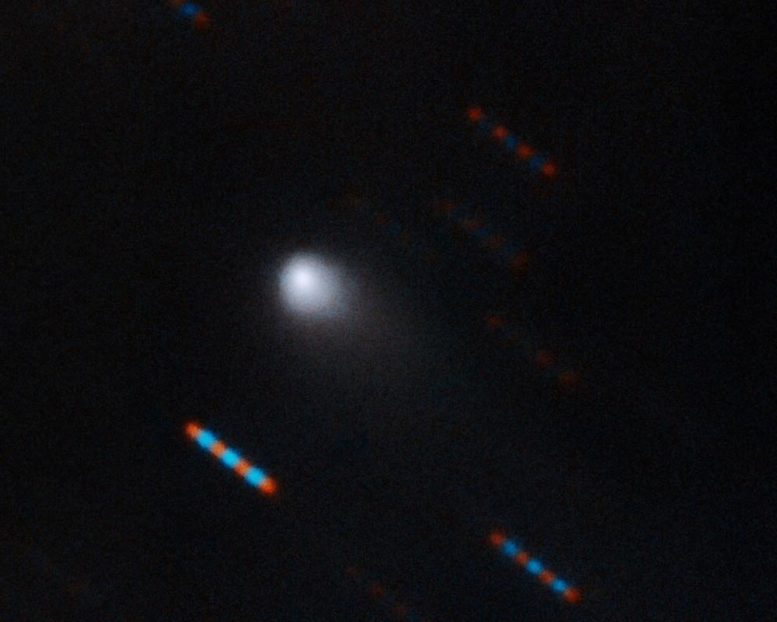
    New Interstellar Visitor: 2I/Borisov Imaged with Gemini
    The first-ever comet from beyond our Solar System, as imaged by the Gemini Observatory. The image of the newly discovered object, named 2I/Borisov, was obtained on the night of 9-10 September 2019 using the Gemini Multi-Object Spectrograph on the Gemini North Telescope on Hawaii’s Mauna Kea. Credit: Gemini Observatory/NSF/AURA

    Second interstellar object has been spotted and named just two years after the first.

    A new object from interstellar space has been found within the Solar System, only the second such discovery of its kind. Astronomers are turning their telescopes towards the visitor, which offers a tantalizing glimpse beyond our Solar System and raises some puzzling questions. The object has been given the name 2I/Borisov by the IAU.

    On August 30, 2019, amateur astronomer Gennady Borisov, from MARGO Observatory, Crimea, discovered an object with a comet-like appearance. The object has a condensed coma, and more recently a short tail has been observed. Mr. Borisov made this discovery with a 0.65-meter (2-foot) telescope he built himself.

    After a week of observations by amateur and professional astronomers all over the world, the IAU Minor Planet Center was able to compute a preliminary orbit, which suggested this object was interstellar — only the second such object known to have passed through the Solar System.

    The orbit is now sufficiently well known, and the object is unambiguously interstellar in origin; it has received its final designation as the second interstellar object, 2I. In this case, the IAU has decided to follow the tradition of naming cometary objects after their discoverers, so the object has been named 2I/Borisov.

    Of the thousands of comets discovered so far, none has an orbit as hyperbolic as that of 2I/Borisov. This conclusion is independently supported by the NASA JPL Solar System Dynamics Group. Coming just two years after the discovery of the first interstellar object 1I/‘Oumuamua, this new finding suggests that such objects may be sufficiently numerous to provide a new way of investigating processes in planetary systems beyond our own.

    2I/Borisov will make its closest approach to the Sun (reach its perihelion) on 7 December 2019, when it will be 2 astronomical units (AU) from the Sun and also 2 AU from Earth. By December and January, it is expected that it will be at its brightest in the southern sky. It will then begin its outbound journey, eventually leaving the Solar System forever.

    Astronomers are eagerly observing this object, which will be continuously observable for many months, a period longer than that of its predecessor, 1I/‘Oumuamua. Astronomers are optimistic about their chances of studying this rare guest in great detail.

    Estimates of the sizes of comets are difficult because the small cometary nucleus is embedded in the coma, but, from the observed brightness, 2I/Borisov appears to be around a few kilometers in diameter. One of the largest telescopes in the world, the 10.4m Gran Telescopio Canarias in the Canary Islands, has already obtained a spectrum of 2I/Borisov and has found it to resemble those of typical cometary nuclei.

    This new interstellar visitor raises intriguing questions: Why have interstellar objects not been discovered before? What is the expected rate of their appearance in the inner Solar System? How do such objects compare to similar bodies within the Solar System? Large telescopic surveys capable of scanning large fractions of the sky on a regular basis may help to answer these questions and more in the near future.

    Never miss a breakthrough: Join the SciTechDaily newsletter.
    Follow us on Google and Google News.

    Comet Gemini Observatory International Astronomical Union
    Share. Facebook Twitter Pinterest LinkedIn Email Reddit

    Related Articles

    First-Ever Interstellar Comet Captured in Multicolor Image

    Trillions of Comet Collisions Explain 17-Year-Old Stellar Mystery

    New Image of Polar Ring Galaxy NGC 660

    ISON Comet May Become Brightest Object in the Night Skies

    Scientists Use Light From an Exploding Star to Study Distant Galaxy

    Trajectory Models of Refractory Particles Help Solve Two Solar System Puzzles

    View the Eta Aquarid Meteor Shower From Halley’s Comet

    Comet Lovejoy Streaks Past Desert Telescope

    Comet Survives after Close Brush With the Sun

    Leave A Reply Cancel Reply

    • Facebook
    • Twitter
    • Pinterest
    • YouTube

    Don't Miss a Discovery

    Subscribe for the Latest in Science & Tech!

    Trending News

    Enormous Prehistoric Insects Puzzle Scientists

    Scientists Develop Bioengineered Chewing Gum That Could Help Fight Oral Cancer

    After 37 Years, the World’s Longest-Running Soil Warming Experiment Uncovers a Startling Climate Secret

    NASA Satellite Captures First-Ever High-Res View of Massive Pacific Tsunami

    ADHD Isn’t Just a Deficit: Study Reveals Powerful Hidden Strengths

    Scientists Discover Stem Cells That Could Regrow Teeth and Bone

    Early Cannabis Use May Stall Key Brain Skills in Teens

    Popular Vitamin D Supplement Has “Previously Unknown” Negative Effect, Study Finds

    Follow SciTechDaily
    • Facebook
    • Twitter
    • YouTube
    • Pinterest
    • Newsletter
    • RSS
    SciTech News
    • Biology News
    • Chemistry News
    • Earth News
    • Health News
    • Physics News
    • Science News
    • Space News
    • Technology News
    Recent Posts
    • Darwin’s Islands Still Evolving: Giant Daisies Rewrite the Rules of Evolution
    • Ancient Document Confirms “Legendary” African King Actually Existed
    • First-of-Its-Kind Discovery: Homer’s Iliad Found Embedded in a 1,600-Year-Old Egyptian Mummy
    • Beyond Inflammation: Scientists Uncover New Cause of Persistent Rheumatoid Arthritis
    • Cancer-Like Mutations Found in the Brain May Be Driving Alzheimer’s Disease
    Copyright © 1998 - 2026 SciTechDaily. All Rights Reserved.
    • Science News
    • About
    • Contact
    • Editorial Board
    • Privacy Policy
    • Terms of Use

    Type above and press Enter to search. Press Esc to cancel.