

Mini robots that can roll, fly, float and swim, then morph into a single machine? Together they form Shapeshifter, a developing concept for a transformational vehicle to explore treacherous, distant worlds.
In a dusty robotics yard at NASA’s Jet Propulsion Laboratory in Pasadena, California, the Shapeshifter team is testing a 3D-printed prototype of this unusual explorer. A contraption that looks like a drone encased in an elongated hamster wheel rolls across the yard, then splits in half. Once separated, the two halves rise on small propellers, effectively becoming flying drones for aerial exploration. These 3D-printed parts are only the beginning; the team imagines a series of up to 12 robots that could transform into a swimming probe or a team of cave explorers.
The flying amphibious robot is part of the early-stage research program NASA Innovative Advanced Concepts (NIAC), which offers several phases of funding to visionary concepts, helping turn ideas that sound like science fiction into science fact. JPL Principal Investigator Ali Agha envisions Shapeshifter as a mission to Saturn’s moon Titan, the only other world in the solar system known to have liquid in the form of methane lakes, rivers, and seas on its surface.
NASA’s Cassini mission flew by Titan over one hundred times, mapping its surface for future missions. What Cassini discovered is a world surprisingly similar to Earth but with key differences: Titan’s cold rivers, lakes, and rain are made of liquid methane and ethane (both gases on Earth). The moon’s hazy atmosphere could also conceal caves – or even icy volcanoes that spew ammonia or water instead of magma.
“We have very limited information about the composition of the surface. Rocky terrain, methane lakes, cryovolcanoes – we potentially have all of these, but we don’t know for certain,” said Agha. “So we thought about how to create a system that is versatile and capable of traversing different types of terrain but also compact enough to launch on a rocket.”
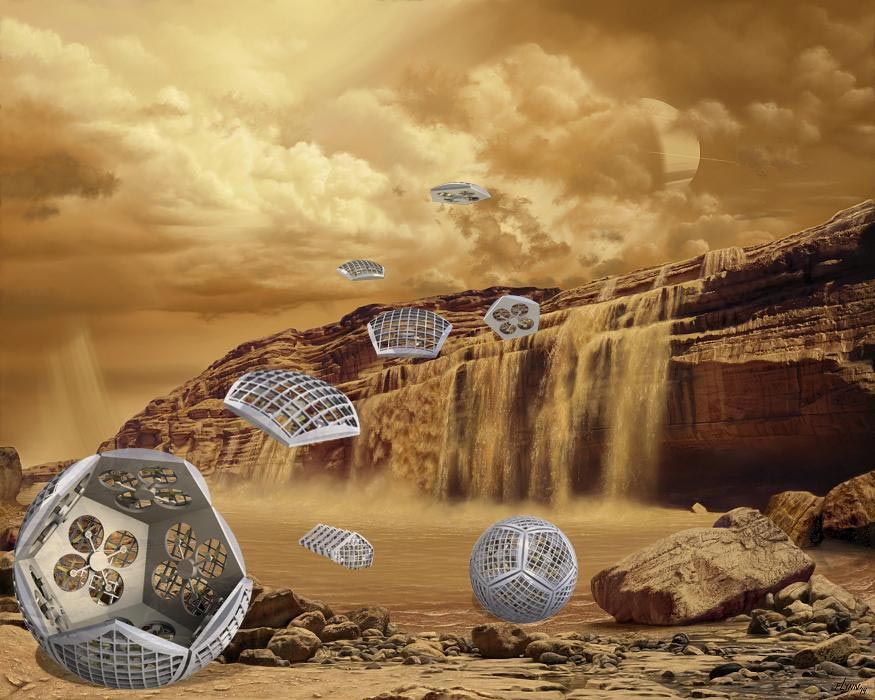
Agha and his Shapeshifter co-investigators, who include researchers from Stanford and Cornell universities, came up with the concept of a self-assembling robot made of smaller robots called “cobots.” The cobots, each housing a small propeller, would be able to move independent of one another to fly along cliffsides of scientific interest. They could also go spelunking, forming a daisy chain to maintain contact with the surface. Or they could transform into a sphere to roll on flat surfaces and conserve energy.
For now, Shapeshifter is semi-autonomous, but its future design will depend on cobots that can auto-assemble without needing commands from Earth.
Agha’s ultimate vision includes a lander like the European Space Agency’s Huygens Probe, which touched down on Titan after being deployed via parachute by NASA’s Cassini spacecraft. This “mothercraft,” as Agha calls it, would serve as an energy source for the cobots and carry the scientific instruments to perform in-depth sample analysis. But rather than staying in place, as landers usually do, this one would be portable. Flight is easier on Titan, where the atmosphere is dense and gravity is low. Agha calculates that 10 cobots could easily lift a lander the size of Huygens (roughly 9 feet, or 3 meters, wide) and gently carry it to different locations.

An illustration of the small robots that form Shapeshifter. Dubbed “cobots,” they each have a propeller for flying and can combine to form a sphere, rolling on the ground to save energy. Shapeshifter is a developing concept for a transformational vehicle to explore treacherous, distant worlds. The flying amphibious robot is part of the early-stage research program NASA Innovative Advanced Concepts (NIAC), which offers several phases of funding to visionary concepts, helping turn ideas that sound like science fiction into science fact. JPL Principle Investigator Ali Agha envisions Shapeshifter as a mission to Saturn’s moon Titan, the only other world in the solar system known to have liquid in the form of methane lakes, rivers, and seas on its surface. Credit: NASA/JPL-Caltech
“It is often the case that some of the hardest places to get to are the most scientifically interesting because maybe they’re the youngest, or they’re in an area that was not well characterized from orbit,” said Jason Hofgartner, JPL lead scientist for Shapeshifter.
“Shapeshifter’s remarkable versatility enables access to all of these scientifically compelling places.”
The Shapeshifter team will submit their concept to NIAC’s Phase II selection process in 2020. But even if selected, it could be many more years until Shapeshifter visits a moon like Titan. The next mission to Titan will be Dragonfly, NASA’s first rotorcraft lander, which is scheduled to launch in 2026. Until then, curious Titan enthusiasts can continue to follow NASA’s Cassini team as it releases new discoveries about the strange moon.
Never miss a breakthrough: Join the SciTechDaily newsletter.
Follow us on Google and Google News.