
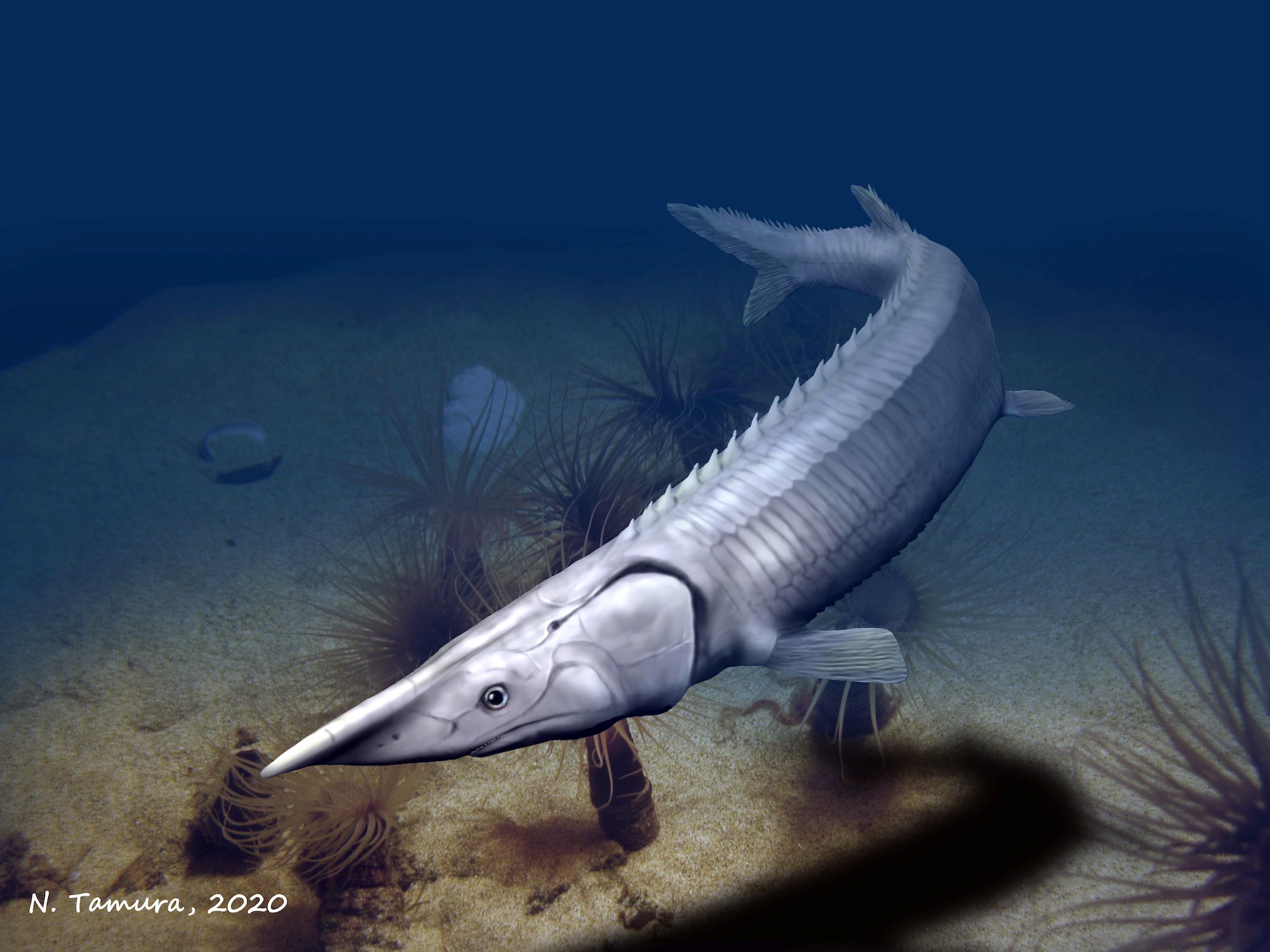
Tanyrhinichthys mcallisteri recasts the notion of what it means to be a ‘primitive’ vertebrate, according to Penn paleontologists Lauren Sallan and Jack Stack.
Sturgeon, a long-lived, bottom-dwelling fish, are often described as “living fossils,” owing to the fact that their form has remained relatively constant, despite hundreds of millions of years of evolution.
In a new study in the Zoological Journal of the Linnean Society, researchers led by Jack Stack, a 2019 University of Pennsylvania graduate, and paleobiologist Lauren Sallan of Penn’s School of Arts & Sciences, closely examine the ancient fish species Tanyrhinichthys mcallisteri, which lived around 300 million years ago in an estuary environment in what is today New Mexico. Although they find the fish to be highly similar to sturgeons in its features, including its protruding snout, they show that these characteristics evolved in a distinct evolutionary path from those species that gave rise to modern sturgeons.
The find indicates that, although ancient, the features that enabled Tanyrhinichthys to thrive in its environment arose multiple times in different fish lineages, a burst of innovation that was not previously fully appreciated for fish in this time period.
“Sturgeon are considered a ‘primitive’ species, but what we’re showing is that the sturgeon lifestyle is something that’s been selected for in certain conditions and has evolved over and over again,” says Sallan, senior author of the work.
“Fish are very good at finding solutions to ecological problems,” says Stack, first author on the study, who worked on the research as a Penn undergraduate and is now a graduate student at Michigan State University. “This shows the degree of both innovation and convergence that’s possible in fishes. Once their numbers got up large enough, they started producing brand new morphologies that we now see have evolved numerous times through the history of fishes, under similar ecological conditions. ”
The first fossil of Tanyrhinichthys was found in 1984 in a fossil-rich area called the Kinney Brick Quarry, about a half hour east of Albuquerque. The first paleontologist to describe the species was Michael Gottfried, a Michigan State faculty member who now serves as Stack’s advisor for his master’s degree.
“The specimen looks like someone found a fish and just pulled on the front of its skull,” Stack says. Many modern fish species, from the swordfish to the sailfish, have protuberant snouts that extend out in front of them, often aiding in their ability to lunge at prey. But this characteristic is much rarer in ancient fishes. In the 1980s when Gottfried described the initial specimen, he posited that the fish resembled a pike, an ambush predator with a longer snout.
During the last decade, however, several more specimens of Tanyrhinichthys have been found in the same quarry. “Those finds were an impetus for this project, now that we had better information on this enigmatic and strange fish,” Stack says.
At the time that Tanyrhinichthys roamed the waters, Earth’s continents were joined in the massive supercontinent called Pangea, surrounded by a single large ocean. But it was an ice age as well, with ice at both poles. Just before this period, the fossil record showed that ray-finned fishes, which now dominate the oceans, were exploding in diversity. Yet 300 million years ago, “it was like someone hit the pause button,” Sallan says. “There’s an expectation that there would be more diversity, but not much has been found, likely owing to the fact that there just hasn’t been enough work on this time period, especially in the United States, and particularly in the Western United States.”
Aiming to fill in some of these gaps by further characterizing Tanyrhinichthys, Stack, Sallan, and colleagues closely examined the specimens in detail and studied other species that dated to this time period. “This sounds really simple, but it’s obviously difficult in execution,” Stack notes, as fossils are compressed flat when they are preserved. The researchers inferred a three-dimensional anatomy using the forms of modern fishes to guide them.
What they noticed cast doubt on the conception of Tanyrhinichthys as resembling a pike. While a pike has an elongated snout with its jaws at the end of it, allowing it to rush its prey head-on, Tanyrhinichthys has an elongated snout with its jaws at the bottom.
“The whole form of this fish is similar to other bottom dwellers,” Stack says. Sallan also noticed canal-like structures on its snout concentrated in the top of its head, suggestive of the locations where sensory organs would attach. “These would have detected vibrations to allow the fish to consume its prey,” says Sallan.
The researchers noted that many of the species that dwelled in similar environments possessed longer snouts, which Sallan called “like an antenna for your face.”
“This also makes sense because it was an estuary environment,” Sallan says, “with large rivers feeding into it, churning up the water, and making it murky. Rather than using your eyesight, you have to use these other sensory organs to detect prey.”
Despite this, other features of the different ancient fishes’ morphology were so different from Tanyrhinichthys that they do not appear to have shared a lineage with one another, nor do modern sturgeon descend from Tanyrhinichthys. Instead, the long snouts appear to be an example of convergent evolution, or many different lineages all arriving at the same innovation to adapt well to their environment.
“Our work, and paleontology in general, shows that the diversity of life forms that are apparent today has roots that extend back into the past,” says Stack.
Reference: “Tanyrhinichthys mcallisteri, a long-rostrumed Pennsylvanian ray-finned fish (Actinopterygii) and the simultaneous appearance of novel ecomorphologies in Late Palaeozoic fishes” by Jack Stack, John-Paul Hodnett, Spencer G Lucas and Lauren Sallan, 22 June 2020, Zoological Journal of the Linnean Society.
DOI: 10.1093/zoolinnean/zlaa044
Lauren Sallan is the Martin Meyerson Assistant Professor in Interdisciplinary Studies in the School of Arts & Sciences’ Department of Earth and Environmental Science and the Department of Biology at the University of Pennsylvania.
Jack Stack was a 2019 graduate of the University of Pennsylvania. He is now a master’s student at Michigan State University.
Sallan and Stack collaborated on the paper with John-Paul Hodnett of Maryland-National Capital Parks and Planning Commission and Spencer G. Lucas of the New Mexico Museum of Natural History and Science.
The study was supported by the University of Pennsylvania Paleontology Summer Stipend, Greg and Susan Walker Endowment for Student Research in Earth and Environmental Science, 25.40 Paleontological Society Student Ambassador Award, University of Pennsylvania Grant for Faculty Mentoring Undergraduate Research, and National Science Foundation CAREER Award (Grant 1846777).
Never miss a breakthrough: Join the SciTechDaily newsletter.
Follow us on Google and Google News.