
Close Menu
    Facebook X (Twitter) Instagram
    SciTechDaily
    • Biology
    • Chemistry
    • Earth
    • Health
    • Physics
    • Science
    • Space
    • Technology
    Facebook X (Twitter) Pinterest YouTube RSS
    SciTechDaily
    Home»Space»Hubble Spots a Glorious Stellar Sweet Shop
    Space

    Hubble Spots a Glorious Stellar Sweet Shop

    By ESA/HubbleJuly 27, 2020No Comments2 Mins Read
    Facebook Twitter Pinterest Telegram LinkedIn WhatsApp Email Reddit
    Share
    Facebook Twitter LinkedIn Pinterest Telegram Email Reddit
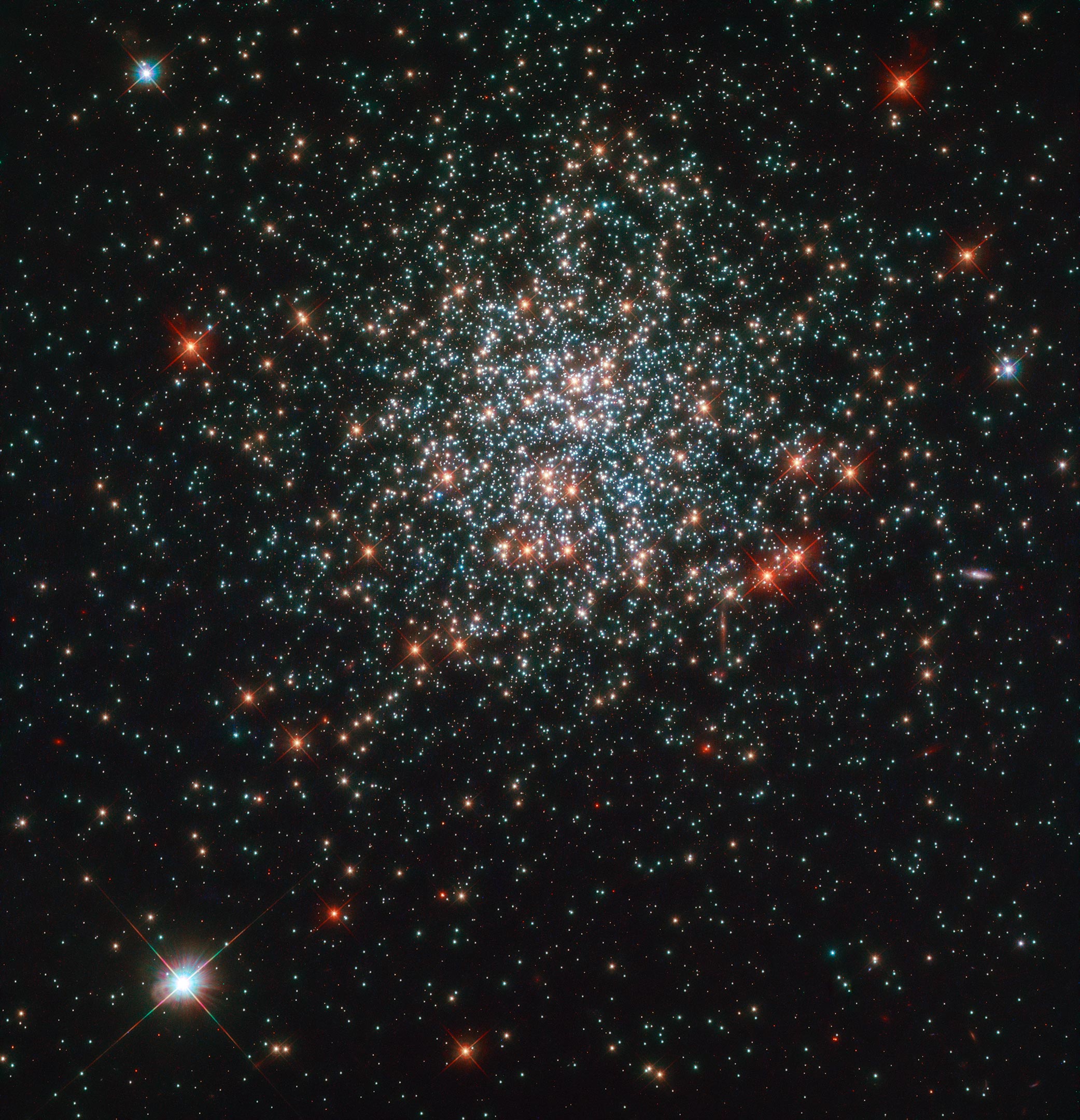
    Star Cluster NGC 2203
    Star cluster NGC 2203. Credit: ESA/Hubble & NASA, L. Girardi

    Looking its best ever is the star cluster NGC 2203, here imaged by the NASA/ESA Hubble Space Telescope. Aside from its dazzling good looks, this cluster of stars contains lots of astronomical treats that have helped astronomers puzzle together the lifetimes of stars.

    A main sequence star, like our Sun, is the term applied to a star during the longest period of its life, when it burns fuel steadily. Our Sun’s fuel will run out in approximately 6 billion years, and it will then move on to the next stage of its life when it will turn into a red giant. Astronomers studying NGC 2203, which contains stars that are roughly twice as massive as our Sun, found that their rotation might be a factor as to why some of the stars stay longer than usual in this main-sequence phase of their life.

    This is the best resolution obtained of the star cluster to date.

    Star clusters are large groups of stars. Two types of star clusters can be distinguished: globular clusters are tight groups of hundreds to millions of old stars which are gravitationally bound, while open clusters, more loosely clustered groups of stars, generally contain fewer than a few hundred members, and are often very young. Open clusters become disrupted over time by the gravitational influence of giant molecular clouds as they move through the Galaxy, but cluster members will continue to move in broadly the same direction through space even though they are no longer gravitationally bound; they are then known as a stellar association, sometimes also referred to as a moving group.

    Never miss a breakthrough: Join the SciTechDaily newsletter.
    Follow us on Google and Google News.

    Astronomy European Space Agency Hubble Space Telescope NASA
    Share. Facebook Twitter Pinterest LinkedIn Email Reddit

    Related Articles

    Hubble’s Newest Discovery Isn’t a Star, It’s a Window Into the Dark Universe

    This Nearby Galaxy Shows How Frozen Clouds Ignite Into Stars

    This Chaotic Spiral Galaxy Is Still Recovering From a Cosmic Collision

    This Strange Spiral Galaxy Is Hiding a Massive Black Hole

    Hubble Zooms In on a Galaxy That Maps the Universe’s Expansion

    Hubble Captures a Dazzling Spiral Galaxy Alive With Birth and Destruction

    Hubble Spots a Glowing “Ring of Fire” in a Distant Spiral Galaxy

    Dust, Light & Ancient Collisions: The Sombrero Galaxy Like You’ve Never Seen It

    Star Formation in Motion: Hubble Reveals Spiraling Stars and Sculpted Nebulae

    Leave A Reply Cancel Reply

    • Facebook
    • Twitter
    • Pinterest
    • YouTube

    Don't Miss a Discovery

    Subscribe for the Latest in Science & Tech!

    Trending News

    New Study Suggests Vitamin C Could Help Prevent Cancer

    The Surprising Chocolate Trick That Could Boost Your Gym Performance

    Common Mouth Bacteria May Trigger Dangerous Calcium Buildup in the Heart

    Natural Supplement May Boost Cancer-Fighting Immunity

    Could Dark Matter Be Hiding in a Hidden Fifth Dimension?

    The Hidden Tradeoff Behind Today’s Most Powerful Weight-Loss Drugs

    Atlantic Ocean Slowdown Could Supercharge California Storms

    A Deadly Ebola-Like Virus Is Spreading. Are We Ready?

    Follow SciTechDaily
    • Facebook
    • Twitter
    • YouTube
    • Pinterest
    • Newsletter
    • RSS
    SciTech News
    • Biology News
    • Chemistry News
    • Earth News
    • Health News
    • Physics News
    • Science News
    • Space News
    • Technology News
    Recent Posts
    • World’s First Superconducting Quantum Heat Engine Could Transform Quantum Computing
    • Scientists Turned a 200-Year-Old Light Trick Into a Modern Breakthrough
    • Physicists Just Turned a Black Hole Energy Theory Into Reality
    • NASA Reveals the Black Sea’s Stunning Annual Turquoise Transformation
    • First Close-Up Images Reveal Shackleton’s Lost Ship on the Ocean Floor
    Copyright © 1998 - 2026 SciTechDaily. All Rights Reserved.
    • Science News
    • About
    • Contact
    • Editorial Board
    • Privacy Policy
    • Terms of Use

    Type above and press Enter to search. Press Esc to cancel.