
Close Menu
    Facebook X (Twitter) Instagram
    SciTechDaily
    • Biology
    • Chemistry
    • Earth
    • Health
    • Physics
    • Science
    • Space
    • Technology
    Facebook X (Twitter) Pinterest YouTube RSS
    SciTechDaily
    Home»Space»Hubble Captures Breathtaking Image of Tempestuous Young Stars in Orion
    Space

    Hubble Captures Breathtaking Image of Tempestuous Young Stars in Orion

    By ESA/HubbleJanuary 22, 2023No Comments2 Mins Read
    Facebook Twitter Pinterest Telegram LinkedIn WhatsApp Email Reddit
    Share
    Facebook Twitter LinkedIn Pinterest Telegram Email Reddit
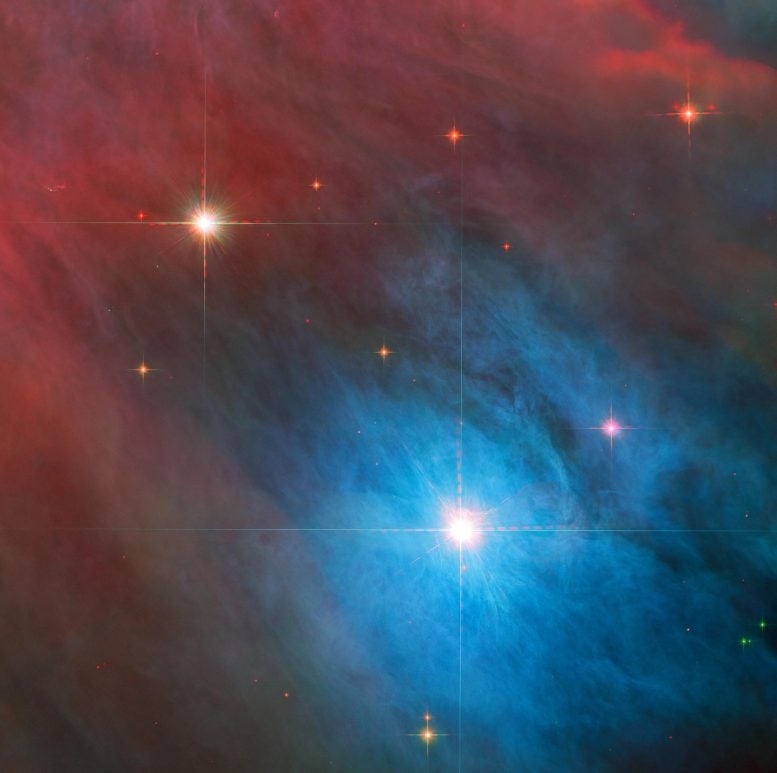
    Bright Variable Star v 372 Orionis
    This Hubble Space Telescope image features the bright variable star V 372 Orionis and its smaller companion in the upper left. Both are located in the Orion Nebula, a massive area of star formation located 1450 light years away from Earth. Credit: ESA/Hubble & NASA, J. Bally, M. Robberto

    The bright variable star V 372 Orionis takes center stage in this image from the Hubble Space Telescope, which has also captured a smaller companion star in the upper left of this image. Both stars lie in the Orion Nebula, a colossal region of star formation located approximately 1450 light years from Earth.

    V 372 Orionis is a particular type of variable star known as an Orion Variable. These young stars experience some tempestuous moods and growing pains, which are visible to astronomers as irregular variations in luminosity. Orion Variables are often associated with diffuse nebulae, and V 372 Orionis is no exception; the patchy gas and dust of the Orion Nebula pervade this scene.

    This image overlays data from two of Hubble’s instruments. Data from the Advanced Camera for Surveys (ACS) and Wide Field Camera 3 (WFC3) at infrared and visible wavelengths were layered to reveal rich details of this corner of the Orion Nebula.

    Hubble also left its own subtle signature on this astronomical portrait in the form of the diffraction spikes surrounding the bright stars. These prominent artifacts are created by starlight interacting with Hubble’s inner workings, and as a result, they reveal hints of Hubble’s structure. The four spikes surrounding the stars in this image are created by four vanes inside Hubble supporting the telescope’s secondary mirror. The diffraction spikes of the NASA/ESA/CSA James Webb Space Telescope, on the other hand, are six-pointed as a result of Webb’s hexagonal mirror segments and 3-legged support structure for the secondary mirror.  

    Never miss a breakthrough: Join the SciTechDaily newsletter.
    Follow us on Google and Google News.

    Astronomy European Space Agency Hubble Space Telescope
    Share. Facebook Twitter Pinterest LinkedIn Email Reddit

    Related Articles

    A Diamond Necklace of Cosmic Proportions

    Hubble Snaps a Stunning Close-Up of a Magnificent Spiral Galaxy

    Extraordinary Hubble Image: Light Bends From the Beyond

    Hubble Space Telescope Sees Volcanic Activity Reforming the Atmosphere on a Rocky Exoplanet

    Hubble Spies a Luminous Heart With Dark Tendrils

    Spectacular Return to the Veil Nebula

    Hubble Spots a Peculiar Sight: Unusual Spiral Galaxy With a Heavy Arm

    A Flash of Life: Hubble Spies an Unusual Planetary Nebula

    Through the Cosmic Clouds: Hubble Spots a Beautiful Stellar Nursery

    Leave A Reply Cancel Reply

    • Facebook
    • Twitter
    • Pinterest
    • YouTube

    Don't Miss a Discovery

    Subscribe for the Latest in Science & Tech!

    Trending News

    On the Brink of Extinction, These Giant Sea Turtles Are Doing Something Unexpected

    Coffee May Be Changing Your Gut in Ways Scientists Are Only Beginning To Understand

    Scientists Uncover Why a Common Nutrient Can Be Dangerous for Blood Vessels

    Mysterious Radio Signals From 5,000 Light-Years Away Lead Scientists to a Surprising Discovery

    New FDA-Approved Pill Lowers High Blood Pressure and May Slow Kidney Disease

    Scientists Just Challenged a Decades-Old Belief About How Cells Work

    Scientists Uncover a Natural Molecule That Makes Muscles Stronger and More Resistant to Fatigue

    Scientists Find That Mice, Not Deer, Hold a Major Clue to Lyme Disease Risk

    Follow SciTechDaily
    • Facebook
    • Twitter
    • YouTube
    • Pinterest
    • Newsletter
    • RSS
    SciTech News
    • Biology News
    • Chemistry News
    • Earth News
    • Health News
    • Physics News
    • Science News
    • Space News
    • Technology News
    Recent Posts
    • NASA-Funded Study Reveals a Hidden Effect of Space Radiation on the Brain
    • Scientists Discover That Jupiter and Dead Stars Could Hold Clues to Dark Matter’s Biggest Mystery
    • “This Star System Should Not Exist”: Astronomers Discover a Cosmic Mystery Just 28 Light-Years Away
    • A Newly Discovered Group of Immune Cells May Be Working Against You
    • Scientists Discover an Ancient Herbal Remedy May Help Curb Binge Drinking
    Copyright © 1998 - 2026 SciTechDaily. All Rights Reserved.
    • Science News
    • About
    • Contact
    • Editorial Board
    • Privacy Policy
    • Terms of Use

    Type above and press Enter to search. Press Esc to cancel.