

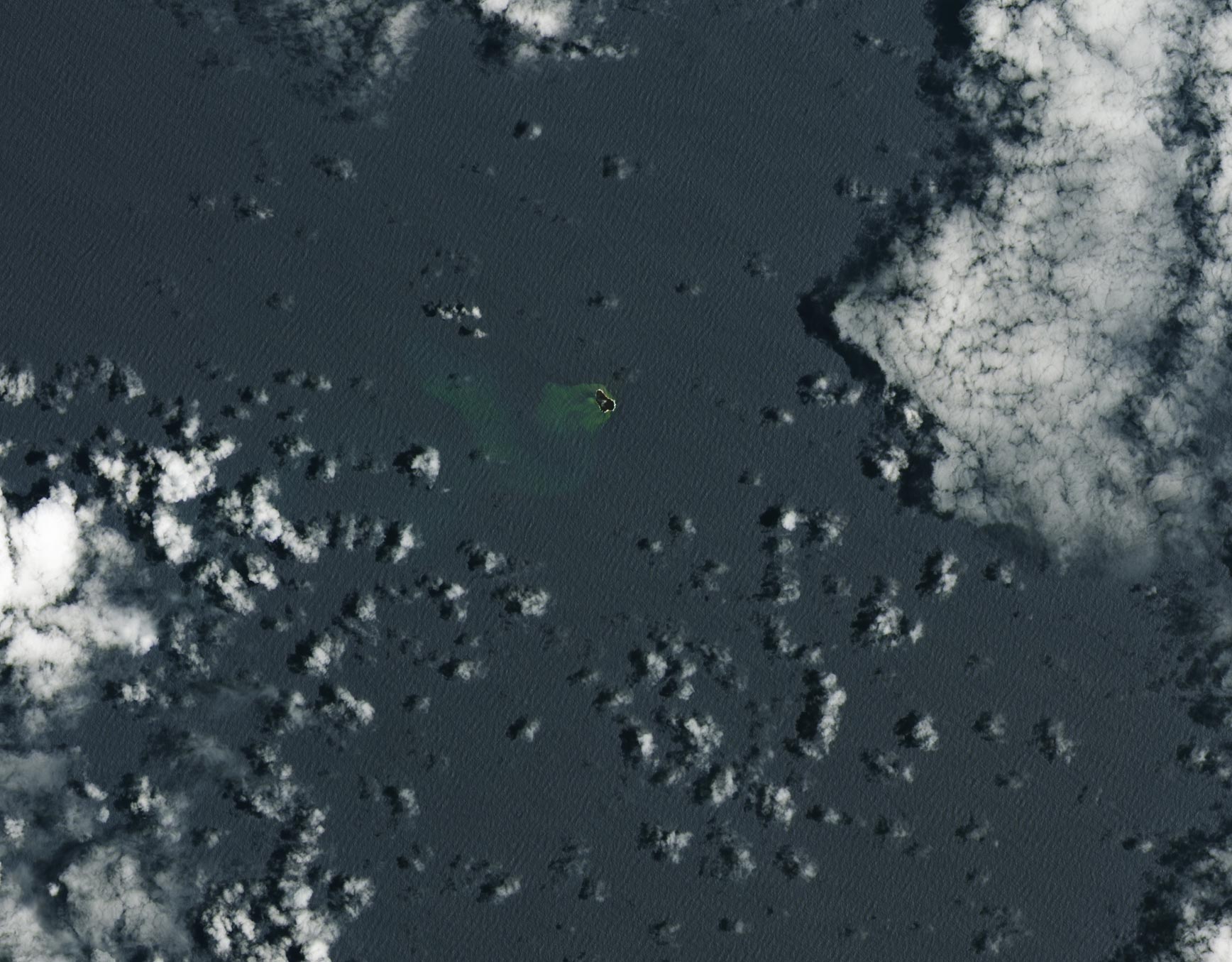
A fiery force beneath the ocean is reshaping Tonga’s Home Reef, growing an island through eruptions over the past few years.
Satellite imagery captures the dramatic transformation as lava cools into solid rock, while discolored waters hint at the volcano’s ongoing activity.
A Growing Island in Tonga
A small island in Tonga’s Home Reef has expanded once again in recent weeks.
The underwater volcano first broke the ocean’s surface during a 2022 eruption, adding new land to Tonga’s island chain in the South Pacific. Subsequent eruptions in September 2023, January 2024, and June 2024 further increased its size, bringing it to 12.2 hectares (30.1 acres). The most recent activity, from December 2024 to January 2025, added another 3.7 hectares.
Satellites have captured this rapid transformation. Landsat 9’s OLI-2 (Operational Land Imager-2) recorded an image of the island on November 11, 2024, before its latest expansion (lower image above). Landsat 8’s OLI imaged the same location on February 2, 2025 (upper image above), revealing the newly formed land, created as lava erupted from the volcano’s vent and solidified into rock.
Signs of Submarine Volcanic Activity
The surrounding waters, tinged with unusual colors, hint at the volcano’s ongoing activity. “Most likely, we’re seeing a large amount of yellow sulfur mixing with the blue ocean to give the plumes a greenish hue,” explained Cornel de Ronde, a geologist at GNS Science and the co-author of a study in Geochemistry, Geophysics, Geosystems about monitoring submarine volcanoes.
The impact of underwater volcanic eruptions on marine ecosystems can be mixed. Some of the substances found in underwater plumes, especially iron, can encourage the growth of phytoplankton, said Sharon Walker, a NOAA oceanographer and lead author of the study. However, the hot, acidic plumes are also known to be harmful to many species of fish and other types of marine life. Meanwhile, the new land offers more habitat for pioneer species, such as bacteria, algae, lichens, insects, and seabirds.
Past Eruptions and Temporary Islands
Prior to 2022, Home Reef had four recorded eruptions, including events in 1852 and 1857 that formed small, temporary islands. In 2006, an eruption also produced an island that had cliffs measuring up to 70 meters (230 feet) tall and survived for about nine months.
Geologists expect the current island to last longer. “Some of the previous eruptions had a more explosive character, which led to land made of a more fragmented, easily erodible material,” said Simon Plank, a researcher from the German Aerospace Center (DLR). “This one is characterized by effusive flows that form a hard material that gives the island a high chance of surviving for several years.”
Tonga-Kermadec: A Volcanic Hotspot
Home Reef sits within the Tonga-Kermadec subduction zone, an area where three tectonic plates are colliding at the fastest converging boundary in the world. Here, the Pacific Plate is sinking beneath two other small plates, yielding one of Earth’s deepest trenches and most active volcanic arcs.
So far, Home Reef’s eruptions have had little impact on people, unlike the neighboring Hunga Tonga-Hunga Ha‘apai volcano, which erupted in 2022, triggering a tsunami, covering nearby islands with ash, and damaging crops and fisheries.
“Given what the world witnessed at Hunga, it’s certainly worth monitoring submarine volcanoes,” said de Ronde. “Satellites offer one of the best, quickest, and safest ways to do that.”
NASA Earth Observatory images by Lauren Dauphin, using Landsat data from the U.S. Geological Survey.
Never miss a breakthrough: Join the SciTechDaily newsletter.
Follow us on Google and Google News.
4 Comments
Is it at all possible that all the seismic activity around the world 🌎 is being caused by the polar shift.
With an expected flip on the way.
I’m not a scientist but I’ve been thinking the same. It makes sense to me. This planet has Power and generally we fail to fully comprehend that massive power. For instance Hunga Tonga created the biggest sound wave humans can honestly claim to have recorded. Back in the early 1800’s when Kracka towa exploded it caused a world wide climate disruption that accounted for the Irish famine, a year without a summer, global climate change for several years. It had impact on world wide health issues such as the Spanish flue. Some time back I read briefly about an article discussing emissions from our Sun called nutrinos that literally penetrate completely through the core of our planet. We still have much to learn and record about natural occurrences on this Earth. Science is fascinating to me, I’ve read a fair bit of Sir Isiach Asimov’s writings both scientific and fictional. I’m currently trying to work my way through Creations which he had a good part in writing. So as many have said, we claim to know more about the space above our planet then we know about the planet. We haven’t had enough time or basic knowledge of science to grasp what is to be learned about our home, we started from an age of darkness and ignorance set upon us by old religion that embraced superstition instead of truth and real knowledge. So consider how magnets affect small matter on a table or in a contained environment in front of us then applied that to a grand scale of Earth which is around 8,000 miles through its center mass, super heated Iron liquid core revolving and the only thing I can say is imagination until.proof is shown! Remember back when Fukushima quake happened, the force of the Pacific Ocean being set in motion caused the Earth to speed up slightly for a period by fractions of a second. The plates that form out land masses have always been in motion, formed super continents more then once then pulled apart, now Africa is pulling apart to some day form another continent and it’s happening faster than previously thought to being a reality, the African rift, the Nile river won’t be a river one day. Now that’s denial, not a river. As far as we can determine the largest quake in the U.S. happened in 1812 and 1813 winter in southeast Missouri, 8.2 maybe, even bigger as we didn’t have instruments back then to measure it. It cause the Mississippi to flow backwards for some time flooding a massive area. One of these days it’s going to happen again and no one is prepared for it, not building codes or the public. Scripturally it is for told the Earth will be cleansed by fire next time. Picture a flood covering the entire Earth then think about a fire, will it be from a massive Solar event, or something right from under our feet? Some one will experience it for a very short moment then be gone!
The fire is global warming. Maybe if the governments and mega rich put their money into looking after our atmosphere. Instead of building rockets to take us into space where there are no planets where we can live.
You misspelled Krakatoa…🤣