
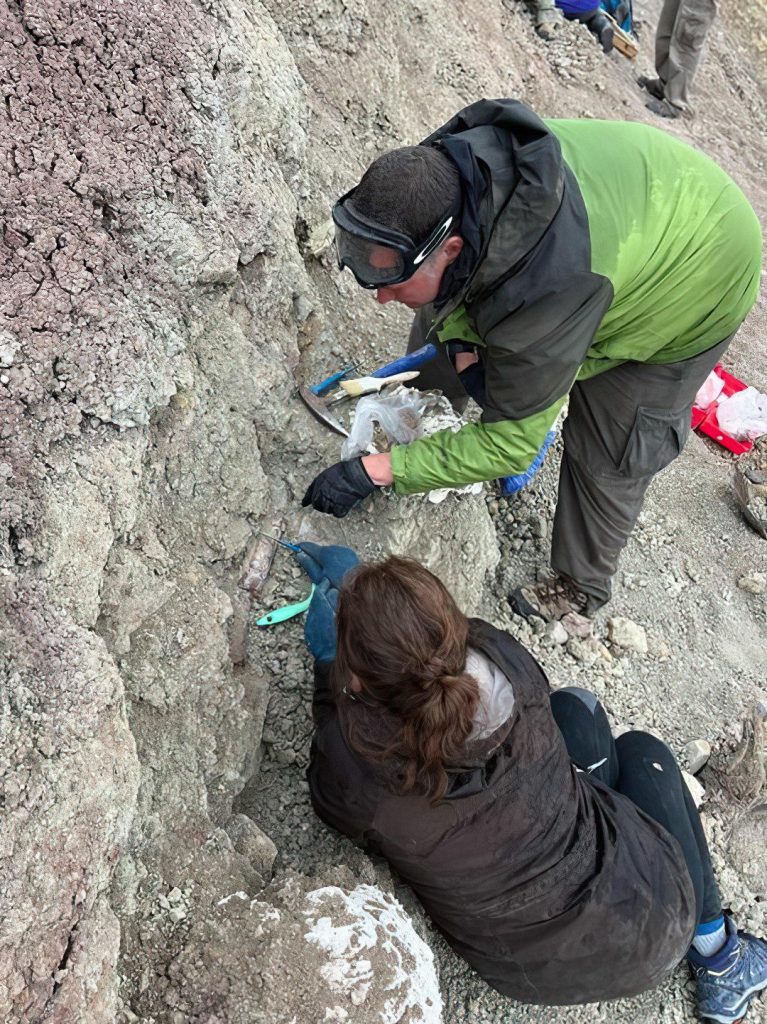
The discovery of a spectacular fossil site in Argentina is helping shed new light on life at the end of the Cretaceous, the time period just before the non-avian dinosaurs went extinct. New research recently presented at the Geological Society of America’s GSA Connects 2023 meeting by Matthew Lamanna, a paleontologist and the principal dinosaur researcher at Carnegie Museum of Natural History, describes exciting fossil finds from a site known as the Cañadón Tomás Quarry in southern Argentina’s Patagonia region.
Southern Hemisphere’s Dinosaur History
“In general, dinosaurs and other continental vertebrates from the Cretaceous tend to be less known from the Southern Hemisphere than they are from the Northern, and that creates an imbalance in our understanding of biodiversity, evolution, and paleobiogeography,” says Lamanna. “We know enough about continental vertebrates in the Late Cretaceous to know that there were some very different kinds of animals thriving in the Southern Hemisphere. One thing that we’d really like to know is, how did non-avian dinosaurs in the southern half of the world fare at the Cretaceous-Paleogene boundary?”
Discovery and Initial Findings
The Cañadón Tomás site was first discovered in early 2020 due to petroleum interest in the region. Oil companies were required to carry out a paleontological impact study before they could begin work, and the study soon uncovered dinosaur fossils.
“The paleontological impact study was done by people from the Museo de La Plata and they found some bones belonging to hadrosaurs (large-bodied duck-billed dinosaurs). This information was shared with the paleontology crew of the Universidad Nacional de la Patagonia San Juan Bosco (UNPSJB), who started to explore the area, finding some bones. At the end of 2020, a few bones were recovered in the outcrop that today is Cañadón Tomás, and little by little, we began to expand that excavation hoping to find something interesting,” says Noelia Cardozo, a PhD student at the UNPSJB and member of the Cañadón Tomás research team.
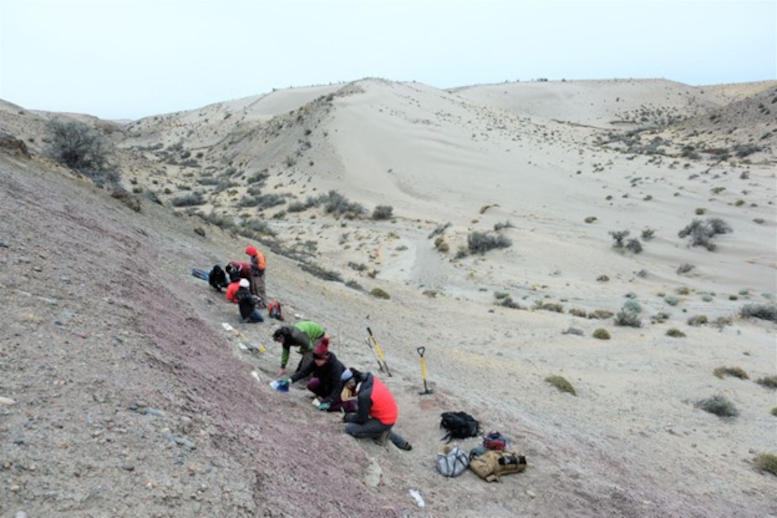
Kara Fikse
Hadrosaurs and Their Social Structure
Continued excavations at the site have revealed dozens of bones from hadrosaurs. These plant-eaters are common and well-known in Northern Hemisphere sites from Late Cretaceous times, but they are comparatively rare and poorly known from Southern Hemisphere sites. Interestingly, the hadrosaur fossils at Cañadón Tomás appear to belong to individuals of multiple sizes.
“The site could capture a social group, potentially even a herd of individuals that were related to each other that were all buried together. These are the kinds of things that we’ll be investigating as we dig into the site more,” says Lamanna.
In addition to the hadrosaur fossils, the team discovered the remains from two individuals of non-avian predatory dinosaurs: a tooth, likely from an abelisaurid, and a claw, likely from a noasaurid or a baby abelisaurid.
While the dinosaur fossils at Cañadón Tomás are exciting and provide crucial insight into Southern Hemisphere non-avian dinosaurs before their extinction, it’s other fossil finds of rare and small-bodied vertebrates that have the research team most excited.
Importance of Mammal Fossils
The team discovered a vertebra of a snake, likely a madtsoiid, the first Cretaceous snake found in this region of Patagonia known as the Golfo San Jorge Basin. What really put the site high on their radar, according to Lamanna, was the discovery of the upper jaw containing teeth of a small mammal known as a reigitheriid.
“For me, the most exciting discovery from this site so far was the small fragment of the jaw of a mammal,” says Cardozo. “Because this formation is mainly well known for its record of dinosaurs, that’s what I expected to find. But when that little piece [of jaw] appeared, we knew it was different from everything that we had been working on so far.”
In March 2023, Cardozo and fellow UNPSJB student Ivanna Mora had spent only two hours sieving through rocks and sediment when they discovered the mammal jaw—relatively speaking, a lightspeed find in the world of paleontology. The fossil is now the first Cretaceous mammal of any kind found in the Golfo San Jorge Basin. According to Lamanna, the jaw is “one of the best fossils of its kind of mammal ever discovered.”
Mammals in the Cretaceous were typically small, rodent-sized creatures—not as foreboding and as easy to capture the imagination as dinosaurs. However, understanding mammalian life at the end of the Cretaceous is crucial to having a full picture of life leading up to the extinction of non-avian dinosaurs, as well as understanding how mammals expanded and proliferated following the extinction.
Potential and Future of Cañadón Tomás
While research and excavations at the Cañadón Tomás site are still in the preliminary stage, the fossil discoveries thus far have shown that the site is extremely promising.
“Cañadón Tomás is a site of great interest not only for the great diversity but also for the great quantity of materials that are being discovered at the site,” says UNPSJB Ph.D. student Bruno Alvarez. “As excavation work continues, more and more materials are being found. There is still a lot of work left to do at Cañadón Tomás with a lot of fieldwork to complete, and we suspect there will be many more fossils to discover and study.”
Lamanna notes that people should “keep their eyes peeled for new discoveries” from Cañadón Tomás.
“We think [Cañadón Tomás] holds so much potential to not only inform our understanding about Cretaceous-Paleogene faunal dynamics and extinction dynamics in the Southern Hemisphere, but it’s probably also going to produce new species of animals. Right now, it’s one of the sites I’m involved with that has me the most excited and fired up,” says Lamanna.
Meeting: Geological Society of America’s GSA Connects 2023
Never miss a breakthrough: Join the SciTechDaily newsletter.
Follow us on Google and Google News.