

Close Menu
    Facebook X (Twitter) Instagram
    SciTechDaily
    • Biology
    • Chemistry
    • Earth
    • Health
    • Physics
    • Science
    • Space
    • Technology
    Facebook X (Twitter) Pinterest YouTube RSS
    SciTechDaily
    Home»Health»Nighttime Regrets: How Just 1.5 Hours Less Sleep Can Damage Your Heart
    Health

    Nighttime Regrets: How Just 1.5 Hours Less Sleep Can Damage Your Heart

    By Columbia University Irving Medical CenterOctober 16, 2023No Comments4 Mins Read
    Facebook Twitter Pinterest Telegram LinkedIn WhatsApp Email Reddit
    Share
    Facebook Twitter LinkedIn Pinterest Telegram Email Reddit
    Young Man Sleeping
    Chronic mild sleep deprivation, common among one-third of Americans, significantly increases heart disease risk due to cellular damage caused by unmanaged oxidative stress, as revealed in a new study. This direct evidence underscores the need for seven to eight hours of consistent sleep to maintain cardiovascular health.

    A Columbia study found that even mild, chronic sleep deprivation leads to inflamed blood vessels, increasing heart disease risk. 

    Can you relate to this? Your alarm goes off at the same time daily, you hustle to get the kids ready, and then rush to catch the morning subway. Yet, when evening rolls around, you might find yourself still awake at midnight folding clothes or at 1 a.m. to catch up on the bills.

    Lots of Americans—about one-third of us—are in the same situation and habitually get only five to six hours of sleep instead of the recommended seven to eight hours.

    But even a mild chronic sleep deficit may heighten the risk of developing heart disease later in life: Surveys of thousands of people have found that people who report mild but chronic sleep deficits have more heart disease later in life than people who get adequate sleep.

    A new Columbia study of women now shows what’s happening in the body during chronic mild sleep deprivation.

    After just six weeks of shortened sleep, the study found, the cells that line our blood vessels are flooded by damaging oxidants. And unlike well-rested cells, sleep-restricted cells fail to activate antioxidant responses to clear the destructive molecules.

    The result: cells that are inflamed and dysfunctional, an early step in the development of cardiovascular disease.
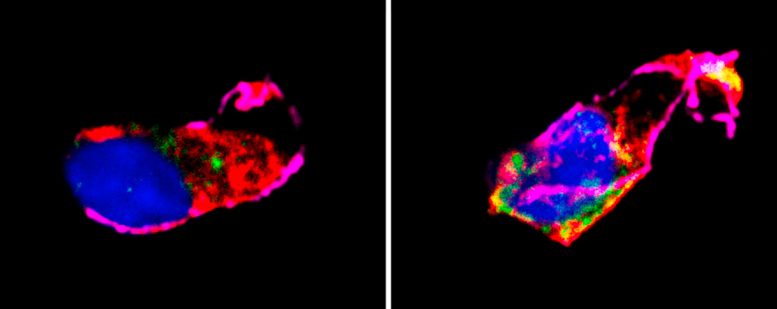
    Sleep Deprived Cells Can't Clear Oxidants
    Adequate vs. Poor Sleep. The researchers traced the absence of the antioxidant response in sleep-deprived cells to a cellular factor, NRF2, that becomes trapped in the cytoplasm. When damaging oxidants accumulate in cells, NRF2 usually moves into the nucleus (blue) to turn on the antioxidant response. After chronic sleep restriction (right image) the Cullin3 protein holds NRF2 (yellow) in the cytoplasm. Credit: Columbia University Irving Medical Center

    “This is some of the first direct evidence to show that mild chronic sleep deficits cause heart disease,” says study leader Sanja Jelic, MD, director of the Center for Sleep Medicine at Columbia and professor of medicine in the Division of Pulmonary, Allergy, and Critical Care Medicine at Columbia University Vagelos College of Physicians and Surgeons.

    “Until now we’ve only seen associations between sleep and heart health in epidemiological studies, but these studies could be tainted by many confounders that cannot be identified and adjusted for. Only randomized controlled studies can determine if this connection is real and what changes in the body caused by short sleep could increase heart disease.”

    Previous Studies Did Not Examine Chronic Sleep Deficits

    Studies of human sleep have examined the physiological effects of a few nights of profound sleep deprivation.

    “But that’s not how people behave night after night. Most people get up around the same time each day but tend to push back their bedtime one to two hours,” Jelic says. “We wanted to mimic that behavior, which is the most common sleep pattern we see in adults.”

    The researchers screened nearly 1,000 women in Washington Heights for the study, enrolling 35 healthy women who normally sleep seven to eight hours each night who could complete the 12-week study.

    For six weeks the women slept according to their usual routine; for the other six weeks, they went to bed 1.5 hours later than usual. Each participant’s sleep was verified with wrist-worn sleep trackers.

    Bottom Line: Just Go To Sleep

    “Many problems could be solved if people sleep at least seven to eight hours per night,” Jelic says.

    “People who are young and healthy need to know that if they keep getting less sleep than that, they’re aggravating their cardiovascular risk.”

    Next Steps

    Recent epidemiological studies suggest that inconsistent bedtimes may raise the risk of heart disease. Jelic’s team is designing a study to see if bedtime variability impacts vascular cells in the same way as chronic, but regular, short sleep.

    Reference: “Mild sleep restriction increases endothelial oxidative stress in female persons” by Riddhi Shah, Vikash Kumar Shah, Memet Emin, Su Gao, Rosemary V. Sampogna, Brooke Aggarwal, Audrey Chang, Marie-Pierre St-Onge, Vikas Malik, Jianlong Wang, Ying Wei and Sanja Jelic, 16 September 2023, Scientific Reports.
    DOI: 10.1038/s41598-023-42758-y

    The study was funded by the National Institutes of Health, the American Heart Association, and the American Academy of Sleep Medicine.

    Never miss a breakthrough: Join the SciTechDaily newsletter.
    Follow us on Google and Google News.

    Columbia University Irving Medical Center Heart Sleep Science
    Share. Facebook Twitter Pinterest LinkedIn Email Reddit

    Related Articles

    New Drug Shows Promise in Alleviating Heart Failure

    Irregular Sleeping Habits May Increase Risk of Atherosclerosis

    Insomnia Tied to 69% Greater Risk of Heart Attack – Worse for Women

    Columbia Researchers Uncover Dangerous Connection Between Serotonin and Heart Valve Disease

    American Heart Association: Sleep Duration Is Essential Component for Heart and Brain Health

    Concerning Data Revealed: Just 20% of People in the U.S. Has Optimal Heart Health

    Even Moderate Ambient Light During Sleep Is Harmful – Increases Risk for Heart Disease and Diabetes

    Too Much or Too Little Sleep Linked to Elevated Heart Risks in People Free From Disease

    Warning: Sleeping Less Than 6 Hours Can Be Deadly for Middle-Aged Adults

    Leave A Reply Cancel Reply

    • Facebook
    • Twitter
    • Pinterest
    • YouTube

    Don't Miss a Discovery

    Subscribe for the Latest in Science & Tech!

    Trending News

    Millions Take These IBS Drugs, But a New Study Finds Serious Risks

    Scientists Unlock Hidden Secrets of 2,300-Year-Old Mummies Using Cutting-Edge CT Scanner

    Bread Might Be Making You Gain Weight Even Without Eating More Calories

    Scientists Discover Massive Magma Reservoir Beneath Tuscany

    Europe’s Most Active Volcano Just Got Stranger – Here’s Why Scientists Are Rethinking It

    Alzheimer’s Symptoms May Start Outside the Brain, Study Finds

    Millions Take This Popular Supplement – Scientists Discover a Concerning Link to Heart Failure

    The Universe Is Expanding Too Fast and Scientists Can’t Explain Why

    Follow SciTechDaily
    • Facebook
    • Twitter
    • YouTube
    • Pinterest
    • Newsletter
    • RSS
    SciTech News
    • Biology News
    • Chemistry News
    • Earth News
    • Health News
    • Physics News
    • Science News
    • Space News
    • Technology News
    Recent Posts
    • Scientists Say a Hidden Structure May Exist Inside Earth’s Core
    • Doctors Surprised by the Power of a Simple Drug Against Colon Cancer
    • Why Popular Diabetes Drugs Like Ozempic Don’t Work for Everyone: The “Genetic Glitch”
    • Scientists Create Improved Insulin Cells That Reverse Diabetes in Mice
    • Scientists Stunned After Finding Plant Thought Extinct for 60 Years
    Copyright © 1998 - 2026 SciTechDaily. All Rights Reserved.
    • Science News
    • About
    • Contact
    • Editorial Board
    • Privacy Policy
    • Terms of Use

    Type above and press Enter to search. Press Esc to cancel.