
Close Menu
    Facebook X (Twitter) Instagram
    SciTechDaily
    • Biology
    • Chemistry
    • Earth
    • Health
    • Physics
    • Science
    • Space
    • Technology
    Facebook X (Twitter) Pinterest YouTube RSS
    SciTechDaily
    Home»Space»Proba-2 Spacecraft Captures Two Partial Solar Eclipses in One Day
    Space

    Proba-2 Spacecraft Captures Two Partial Solar Eclipses in One Day

    By European Space Agency (ESA)October 27, 20223 Comments4 Mins Read
    Facebook Twitter Pinterest Telegram LinkedIn WhatsApp Email Reddit
    Share
    Facebook Twitter LinkedIn Pinterest Telegram Email Reddit
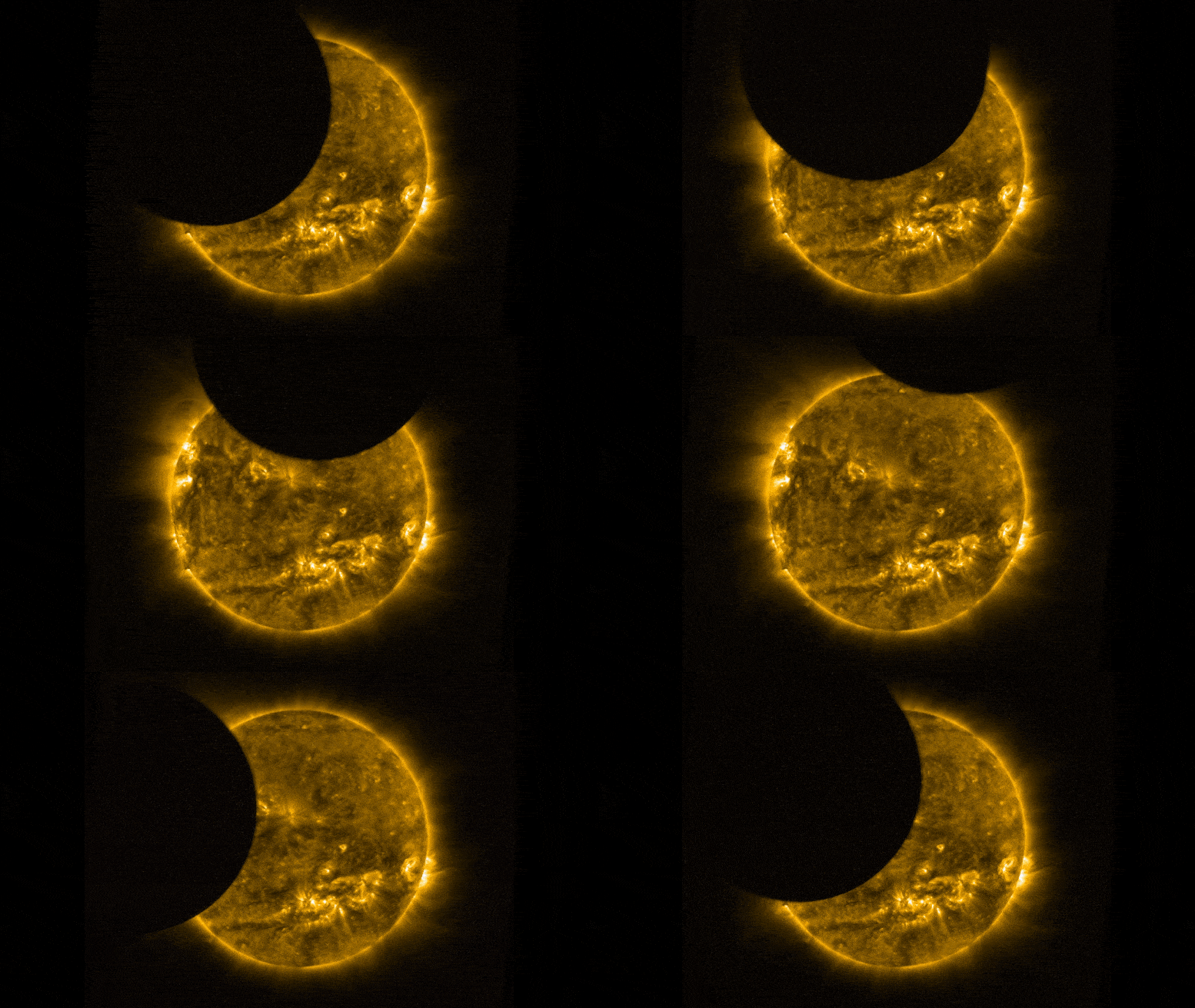
    Proba-2 Solar Eclipse
    On October 25, ESA’s Proba-2 spacecraft captured two partial solar eclipses. This image depicts one of them. See the video below for both eclipses in higher resolution.

    ESA’s Proba-2 spacecraft captured two partial solar eclipses on October 25, 2022.

    Proba-2 is the second spacecraft of a series, building on nearly eight years of successful Proba-1 experience. Proba stands for PRoject for OnBoard Autonomy. The Proba satellites are among the smallest ever to be flown by the European Space Agency (ESA), but they are making a big impact in space technology.

    A solar eclipse is caused by the movement of the Moon around Earth. Despite their much different sizes, due to their separation, the Moon appears to be about the same size as the significantly larger Sun in the sky. Occasionally, the Moon passes in front of the Sun, blocking its light, so that part of the Earth’s surface is in the Moon’s shadow. The line-up is not always perfect, and so not every eclipse is a total solar eclipse.
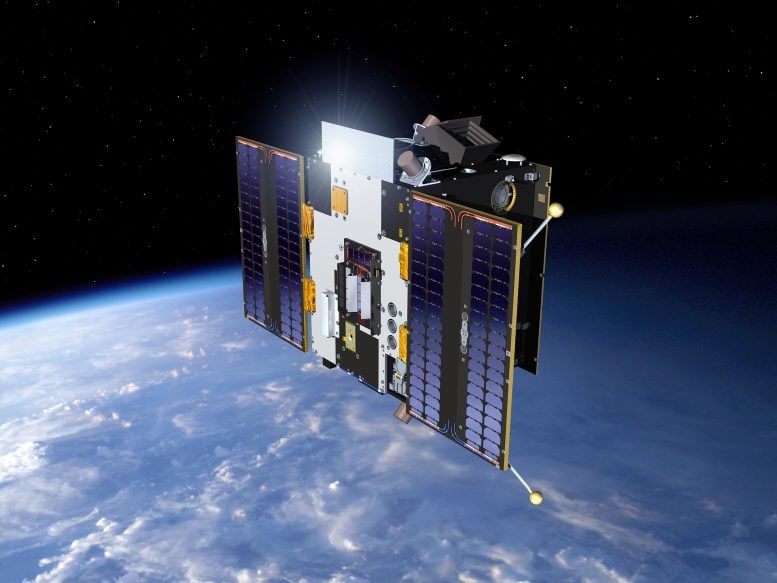
    Proba-2 Spacecraft
    Proba stands for PRoject for OnBoard Autonomy. The Proba satellites are among the smallest ever to be flown by ESA, but they are making a big impact in space technology. Proba-2 is the second of the series, building on nearly eight years of successful Proba-1 experience. Credit: ESA

    On October 25 only part of the Sun’s light was blocked by the Moon, creating what is known as a partial eclipse. It was visible from most of Europe, North Africa, the Middle East, and parts of Asia, with the Moon blocking 82% of the sunlight near the North Pole. In Europe, up to 40% of the sunlight was obscured during the event.

    This partial eclipse was observed by ESA’s Proba-2 mission from its unique vantage point in space. Its SWAP instrument studies the Sun in the extreme ultraviolet (EUV) light where it focuses on the solar corona – the Sun’s hot turbulent atmosphere – at temperatures of about a million degrees. The corona is seen in the background of this video.

    For us on Earth, the Moon passes only once in front of the Sun during a solar eclipse. Since Proba-2 orbits the Earth in about 100 minutes, it was able to observe this eclipse not once but twice. Additionally, the Moon was first observed while traversing the field of view in the upper right corner, but not blocking any solar light. The first observation of the eclipse around 10:30 UTC (12:30 CEST) was cut short as Proba-2 experienced an occultation. Such an occultation occurs when Proba-2 flies through the Earth’s atmosphere and the SWAP instrument is not active. The second partial eclipse was captured around 12:25 UTC (14:25 CEST). The movie embedded above shows both eclipses.
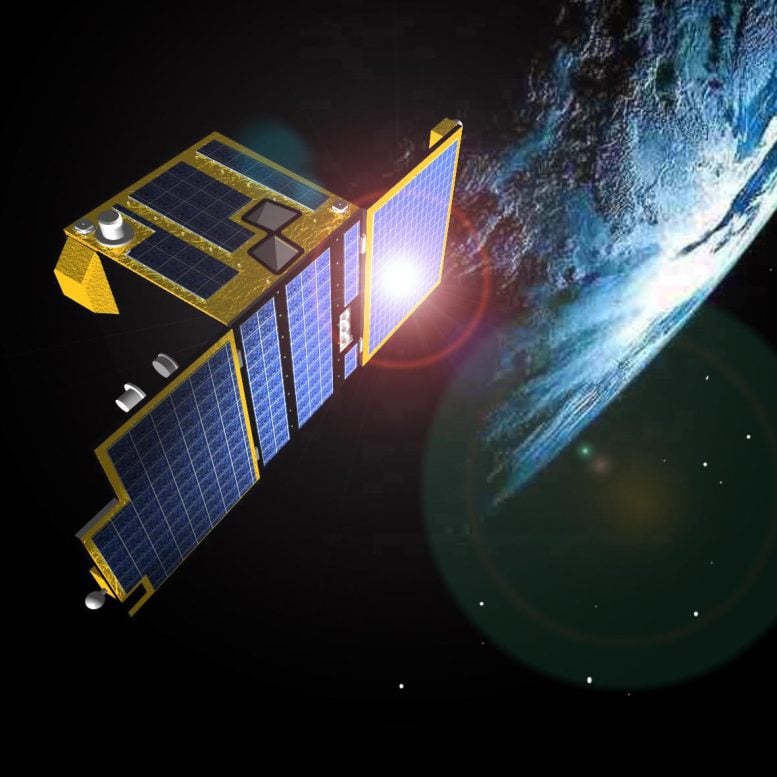
    Proba 2 Spacecraft in Orbit
    Proba-2 is a 0.6 × 0.6 × 0.8 meter (2.0 × 2.0 × 2.6 foot), box-shaped structure with two deployable solar panels and a nominal weight of 130 kilograms. The primary mechanical structure consists of three aluminum honeycomb panels arranged in an H configuration and a bottom panel that acts as the interface to the launch vehicle. Almost all the satellite system units are mounted on these inner panels. Credit: ESA/Pierre Carril

    ESA’s Sun-watching spacecraft monitor the Sun’s behavior to better understand the influence of space weather on our home planet. The ESA-led Solar Orbiter mission, in partnership with NASA, is orbiting the Sun from closer than ever before and will provide the first high-resolution images of the Sun’s poles. Meanwhile, ESA Vigil will be the first mission to keep a constant eye on brewing space weather events, to better protect vital infrastructure on Earth and in orbit. 

    Never miss a breakthrough: Join the SciTechDaily newsletter.
    Follow us on Google and Google News.

    Eclipse European Space Agency Solar Eclipse
    Share. Facebook Twitter Pinterest LinkedIn Email Reddit

    Related Articles

    Proba-2 Satellite Sees the Moon Eclipse the Sun Twice [Video]

    Eclipse in Motion: Dramatic Space Footage of the Total Solar Eclipse

    Five NASA Tips for Photographing the “Ring of Fire” Solar Eclipse

    Don’t Miss: A “Ring of Fire” in the Sky

    Eclipsing Expectations: Aussie Adventure Sets the Stage for 2024 U.S. Eclipse Spectacle

    Australian Total Solar Eclipse Captured in Stunning Image

    Don’t Miss Eclipses: NASA Releases New Map of Upcoming Solar Eclipses

    NASA’s ACE Mission: Total Solar Eclipses Shine a Light on the Solar Wind

    A Unique View of a Solar Eclipse

    3 Comments

    1. Zack on October 27, 2022 7:53 am

      The 1st eclipse is fragmented in the 2nd video, unfortunately.

      Reply
      • Zack on October 27, 2022 10:31 am

        The 1st eclipse approached the sun from 10:00 and immediately disappeared, the so-called occultation, till later showed up leaving the sum from 3:00. The 2nd entered the sun from 9:00 leaving at 12:00.

        Reply
    2. Zack on October 27, 2022 10:39 am

      Time stamps above = angles to/from the sun, not time.

      Reply
    Leave A Reply Cancel Reply

    • Facebook
    • Twitter
    • Pinterest
    • YouTube

    Don't Miss a Discovery

    Subscribe for the Latest in Science & Tech!

    Trending News

    New “Nanozyme Hypothesis” Could Rewrite the Story of Life’s Origins

    Anatomy Isn’t Finished: The Human Body Still Holds Secrets

    “Pretty Close to Home”: The Hidden Earthquake Threat Beneath Seattle

    The Surprising Reason You Might Want To Sleep Without a Pillow

    Scientists Say This Natural Hormone Reverses Obesity by Targeting the Brain

    35-Million-Year-Old Mystery: Strange Arachnid Discovered Preserved in Amber

    Is AI Really Just a Tool? It Could Be Altering How You See Reality

    JWST Reveals a “Forbidden” Planet With a Baffling Composition

    Follow SciTechDaily
    • Facebook
    • Twitter
    • YouTube
    • Pinterest
    • Newsletter
    • RSS
    SciTech News
    • Biology News
    • Chemistry News
    • Earth News
    • Health News
    • Physics News
    • Science News
    • Space News
    • Technology News
    Recent Posts
    • These New Molecules Could Change How We Treat Lupus and Arthritis
    • Saunas May Do More Than Raise Body Temperature – They Activate Your Immune System
    • Exercise in a Pill? Metformin Shows Surprising Effects in Cancer Patients
    • Saturn’s Magnetic Shield Isn’t What Scientists Expected
    • Hidden Oceans of Magma Could Be Protecting Alien Life
    Copyright © 1998 - 2026 SciTechDaily. All Rights Reserved.
    • Science News
    • About
    • Contact
    • Editorial Board
    • Privacy Policy
    • Terms of Use

    Type above and press Enter to search. Press Esc to cancel.