
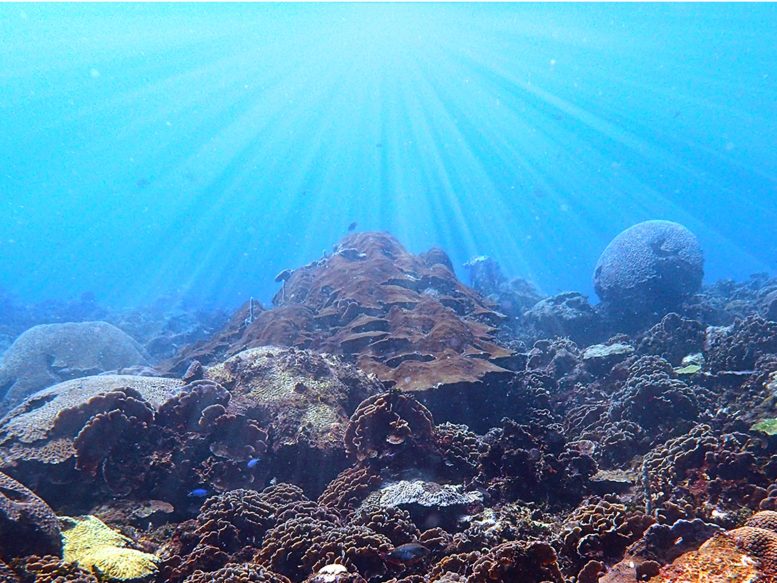
Penn State’s new research underscores the vital role of water clarity in coral reef conservation. The study reveals that underwater light intensity significantly impacts coral biodiversity by affecting photosynthetic algae energy expenditure. The findings suggest local efforts to maintain water clarity can significantly contribute to preserving these biodiverse ecosystems.
New research at Penn State suggests that when preserving the world’s coral reefs, both above and below the surface activity is equally important.
A recent study published in the journal Scientific Reports found that maintaining water clarity in coral reefs is crucial for preserving coral biodiversity and avoiding reef degradation. The study analyzed the productivity and biodiversity of the world’s symbiotic coral communities
“Coral reefs are one of the most biodiverse ecosystems on Earth,” said Tomás López-Londoño, a postdoctoral scholar at Penn State and lead author on the study. “To better understand that diversity, we looked at the role sunlight plays in the symbiotic relationship between coral and the algae that provide the oxygen for its survival. We found that underwater light intensity plays a critical role in the energy expended by the coral’s symbiotic algae to maintain its photosynthetic activity.”
The findings, although novel, are hardly a revelation, he explained. Science has long shown that sunlight is the major source of energy for virtually all biochemical reactions that sustain life on Earth, but sunlight’s impact had not yet been fully understood in coral, he said.
A New Model to Understand Coral Diversity
“What’s new here is we developed a model that provides a mechanistic explanation for the biodiversity patterns in coral,” said López-Londoño. “Central to that explanation is water clarity, meaning that preserving the underwater light climate should be a priority for coral reef conservation. It’s as vital as pollution mitigation, limiting ocean acidification, and reducing thermal stress.”
The researchers studied coral grown in an aquarium, simulating depth and gradations of sunlight, to develop a mathematical model that describes the association between the depth‐dependent variation in photosynthetic energy to corals and gradients of species diversity.
They then tested the model on existing published data, comparing reefs with contrasting water clarity and biodiversity patterns in hotspots of marine biodiversity across the globe. The team’s productivity‐biodiversity model explained between 64% and 95% of the depth‐related variation in coral species richness, indicating that much of the variation in species richness with depth is driven by changes in exposure to sunlight.
“The model is very elegant in that it takes into consideration only two things,” said Roberto Iglesias-Prieto, Penn State professor of biology and co-author on the study. “It looks at productivity, the potential that an alga has to extract energy from the sun, and the cost of living, the cost of the repair of the photosynthetic machinery. It’s a very simple notion and we found it explains the existing empirical data.”
Running their model against global data sets, the researchers found that variation in sunlight-supported algal energy supply plays an important role in the spatial variation of species diversity within coral communities. The results show that highly productive submarine environments, with plentiful access to sunlight, are a vital safeguard against the risk of species extinction from demographic and environmental changes.
The findings offer a new tactic for reef conservation: preserving the clarity of the water. The researchers found that “the maintenance of water optical quality in coral reefs is fundamental to protect coral biodiversity and prevent reef degradation.”
Mitigating Optical Pollution Locally
“We tend to react reflexively against large-scale threats like ocean acidification and thermal stress from climate change,” said Iglesias-Prieto. “We say ‘this is a serious issue, but what can I really do locally?’ In the case of mitigating optical pollution, the answer is ‘everything.’”
He explained that communities can protect the clarity of the local seawater by reducing the sedimentation and pollution associated with human development — and anyone can participate in that work.
“Unlike so much of the environmental threats that corals face, this is something that can and should be managed locally,” said Iglesias-Prieto.
Reference: “Photosynthetic usable energy explains vertical patterns of biodiversity in zooxanthellate corals” by Tomás López-Londoño, Kelly Gómez-Campo, Xavier Hernández-Pech, Susana Enríquez and Roberto Iglesias-Prieto, 2 December 2022, Scientific Reports.
DOI: 10.1038/s41598-022-25094-5
The work was supported by Penn State startup funds.
Never miss a breakthrough: Join the SciTechDaily newsletter.
Follow us on Google and Google News.