
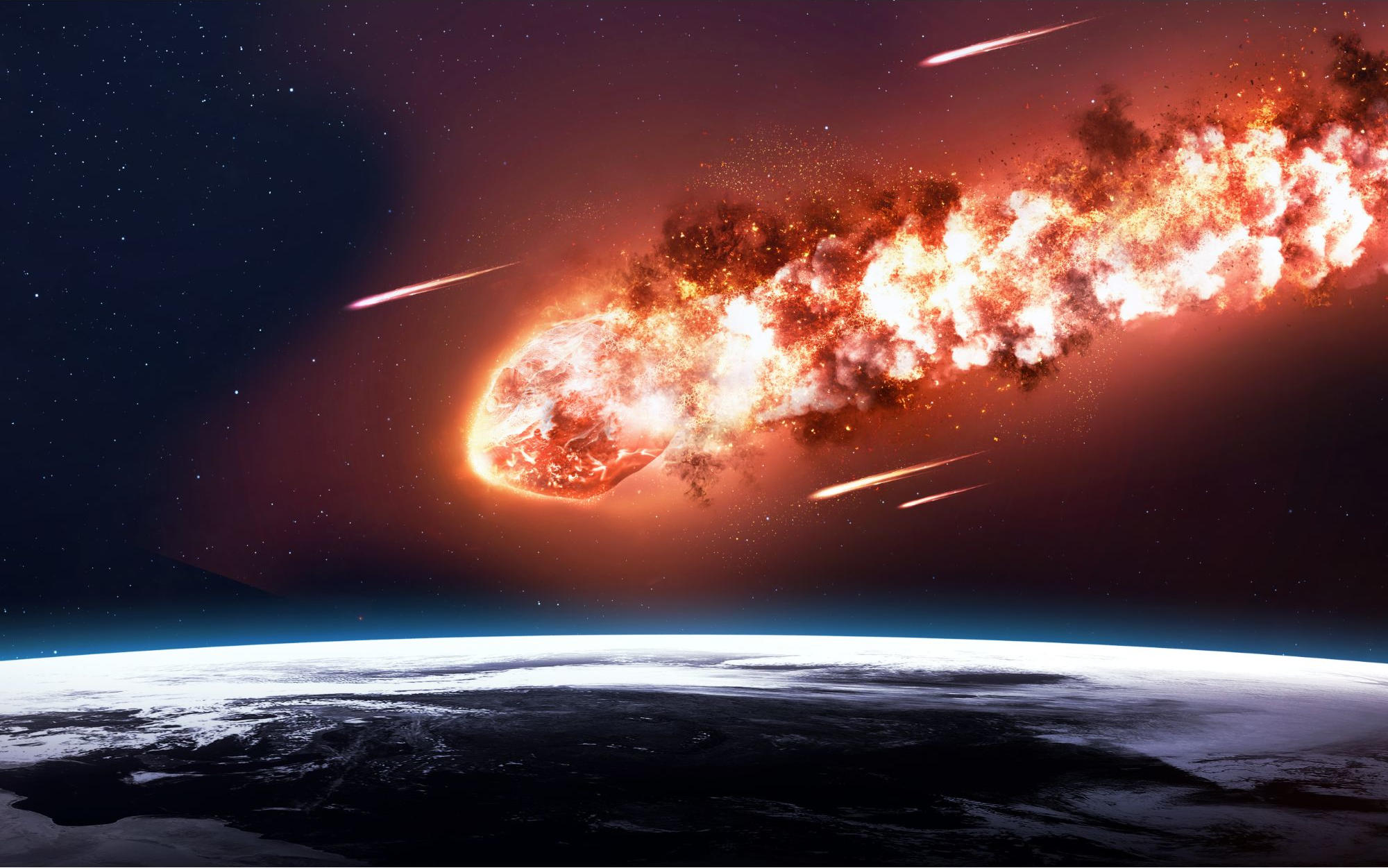
A meteorite impact in Scotland happened 990 million years ago, not 1.2 billion as previously thought, possibly influencing the emergence of early life on land, new Curtin University research shows.
Curtin University researchers have discovered that a massive meteorite struck northwestern Scotland around 990 million years ago, 200 million years later than previously believed. This finding not only reshapes Scotland’s geological timeline but also impacts our broader understanding of the evolution of life on Earth.
The impact, originally thought to have occurred 1.2 billion years ago, formed the Stac Fada Member, a distinct rock layer that preserves critical evidence of ancient Earth conditions. These rocks offer insight into how meteorite collisions may have influenced the planet’s climate and biological development.
According to lead author Professor Chris Kirkland of Curtin University’s Frontier Institute for Geoscience Solutions, part of the School of Earth and Planetary Sciences, the team determined the new date using zircon crystals, durable minerals that act as geological “time capsules” to precisely record the timing of the impact.

“These microscopic crystals recorded the exact moment of impact, with some even transforming into an incredibly rare mineral called reidite, which only forms under extreme pressures,” Professor Kirkland said.
“This provided undeniable proof that a meteorite strike caused the Stac Fada deposit.
“When a meteorite hits, it partially resets the atomic clocks inside the zircon crystals, and these ‘broken timepieces’ are often unable to be dated but we developed a model to reconstruct when the disturbance occurred, confirming the impact at 990 million years ago.”
Innovative Dating Model Confirms New Timeline
Professor Kirkland said this impact event occurred at a similar time to the emergence of some of the earliest freshwater eukaryotes, which are the ancient ancestors of plants, animals, and fungi.
“The revised dating suggests these life forms in Scotland appeared at a similar time to a meteorite impact,” Professor Kirkland said.
“This raises fascinating questions about whether large impacts may have influenced environmental conditions in ways that affected early ecosystems.
“While the impact crater itself has yet to be found, this study has collected further clues that could finally reveal its location.
“Understanding when meteorite impacts occurred helps us explore their potential influence on Earth’s environment and the expansion of life beyond the oceans.”
Reference: “A one-billion-year-old Scottish meteorite impact” by C.L. Kirkland, T.M. Erickson, T.E. Johnson, T. Prave, R.A. Strachan, M.L. Daggitt, M.I.H. Hartnady, S.M. Reddy, R.J.M. Taylor, B.V. Ribeiro, K. Rankenburg, U. Kirscher and S. Fischer, 28 April 2025, Geology.
DOI: 10.1130/G53121.1
The research was done in collaboration with NASA Johnson Space Center, University of St. Andrews, University of Portsmouth, and Carl Zeiss Microscopy Ltd.
Never miss a breakthrough: Join the SciTechDaily newsletter.
Follow us on Google and Google News.