
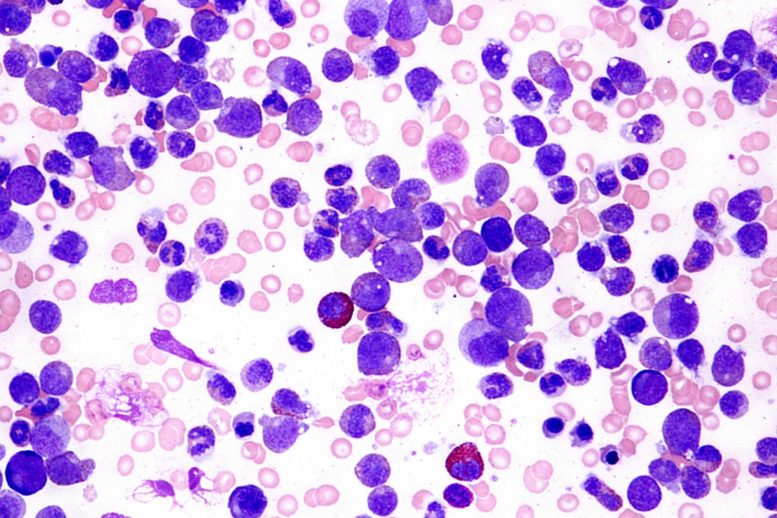
New research changes a natural substance such that it may be used as a potential treatment for acute myeloid leukemia.
Natural substances often have therapeutic promise, but their utility in the treatment of illnesses is limited by their toxicity or undesirable side effects.
Recent research led by Gonçalo Bernardes, group leader at the Instituto de Medicina Molecular João Lobo Antunes (iMM; Portugal) and Professor at the University of Cambridge (Cambridge, UK), and Gonzalo Jiménez-Osés, group leader at the Center for Cooperative Research in Biosciences (Derio, Spain), and published in the scientific journal Nature Chemistry reports the development of new chemistry on natural compounds derived from Brazilian lapacho tree bark to obtain a therapeutic agent that could be efficient to treat acute myeloid leukemia.
The most prevalent kind of acute leukemia in adults, acute myeloid leukemia, is an aggressive cancer that develops when there is an abnormal surge in the amount of a certain type of immature blood cell. These cells are known as myeloid cells. After five years, there is only a 20 percent patient survival rate, and disease relapses are common.
“It’s important to find new therapeutic strategies for acute myeloid leukemia. There are a lot of natural compounds with medicinal value that can’t be used as therapies at the moment due to toxicity and negative effects on healthy cells. In our work, which was done in collaboration with Gonzalo Jiménez-Osés, we used these natural compounds and modified them in a way that controls their negative effects and allows us to take advantage of their therapeutic value”, explains Gonçalo Bernardes, group leader at iMM and co-leader of the study.
β-lapachone: A Natural Compound with Therapeutic Potential
Back in 2018, this team used machine learning to identify the targeting site of a compound from the lapacho tree bark that belongs to the family of ortho-quinones, called β-lapachone. These compounds are known for their potential to control the abnormal increase in the number of cells that characterizes cancer and are good candidates for the treatment of leukemia.
“The compound that we explored in this study, called β-lapachone, is a promising drug to treat leukemia, but its reactive properties could have undesirable effects. In this work, we combined two strategies to minimize the negative effects of the compound. On one side, we added a chemical group to this compound that protects from its reactive properties. It acts like a mask that covers the toxicity of the drug. This mask is released in a more acidic environment, that corresponds to the interior of cells. This leads to our second strategy. We attached the modified compound to a protein, an antibody, that delivers it directly to the interior of cancer cells.”, adds Gonçalo Bernardes.
“Cancer cells have certain marks that tell them apart from healthy cells. In acute myeloid leukemia we know that one of these specific markers, called CD33, is present in the cancer cells. We attached our natural product to an antibody that binds specifically to this CD33. This allows the drug to go through the body without damaging any healthy cells and when the antibody encounters the cancer cell, it binds to the CD33 marker and delivers the drug. At this moment it will turn into its active and toxic form, killing the cancer cell,” clarifies Ana Guerreiro, co-second author of the study.
Broader Implications for Drug Development
Besides the therapeutic interest of this approach for the treatment of acute myeloid leukemia, the chemistry that was developed in this study can be used for other valuable natural compounds, enabling the use of compounds with therapeutic potential that were previously inappropriate for medicinal use.
Reference: “Controlled masking and targeted release of redox-cycling ortho-quinones via a C–C bond-cleaving 1,6-elimination” by Lavinia Dunsmore, Claudio D. Navo, Julie Becher, Enrique Gil de Montes, Ana Guerreiro, Emily Hoyt, Libby Brown, Viviane Zelenay, Sigitas Mikutis, Jonathan Cooper, Isaia Barbieri, Stefanie Lawrinowitz, Elise Siouve, Esther Martin, Pedro R. Ruivo, Tiago Rodrigues, Filipa P. da Cruz, Oliver Werz, George Vassiliou, Peter Ravn, Gonzalo Jiménez-Osés and Gonçalo J. L. Bernardes, 27 June 2022, Nature Chemistry.
DOI: 10.1038/s41557-022-00964-7
This work was developed at the University of Cambridge (UK) with researchers from iMM (Portugal) in collaboration with the Center for Cooperative Research in Biosciences (Spain), AstraZeneca (UK), Friedrich Schiller University Jena (Germany), and the Basque Foundation for Science (Spain).
The study was funded by the European Union’s Horizon 2020 research and innovation program, Agencia Estatal Investigacion of Spain, Severo Ochoa Excellence Accreditation, Cancer Research UK, and the Deutsche Forschungsgemeinschaft.
Never miss a breakthrough: Join the SciTechDaily newsletter.
Follow us on Google and Google News.