
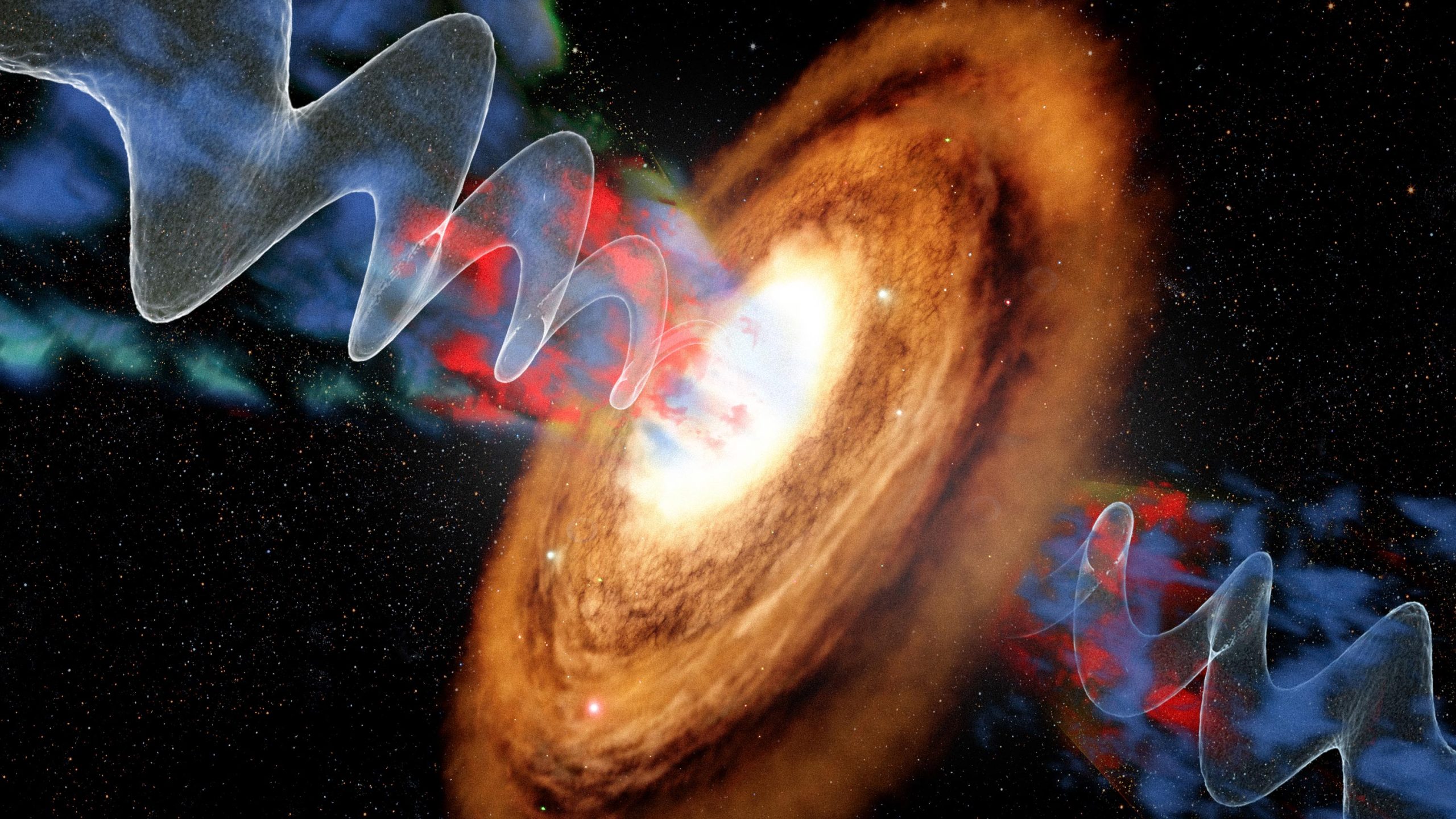
A nearby galaxy is launching an enormous stream of super-heated gas, driven by a precessing jet from its central black hole.
University of California, Irvine astronomers report that they have identified the largest known stream of super heated gas ever seen flowing out of a galaxy. The outflow is coming from a nearby system called VV 340a, and the researchers detail the result in Science.
The team spotted the gas in observations from NASA’s James Webb Space Telescope. Their analysis shows two long, narrow clouds of extremely hot material blasting out from opposite sides of VV 340a, powered by an active supermassive black hole in the galaxy’s core. Each cloud stretches at least three kiloparsecs (one parsec equates to roughly 19 trillion miles).
That distance is striking when set against the galaxy itself. VV 340a’s disk is about three kiloparsecs thick.
“In other galaxies, this type of highly energized gas is almost always confined to several tens of parsecs from a galaxy’s black hole, and our discovery exceeds what is typically seen by a factor of 30 or more,” said lead author Justin Kader, a UC Irvine postdoctoral researcher in physics and astronomy.
To trace what might be driving the outflow, the researchers also turned to radio observations. Images from the Karl G. Jansky Very Large Array radio astronomy observatory near San Agustin, New Mexico, revealed two large plasma jets shooting out from either side of the galaxy. Astronomers understand that jets like these can supercharge surrounding gas and fling it outward, forming when gas with extreme heat and strong magnetic fields plunges toward an active supermassive black hole.
An Unprecedented Coronal Gas Structure
On even larger scales, the jets appear twisted into a spiral shape. This pattern points to “jet precession,” meaning the jet’s direction shifts over time, much like the repeating wobble of a spinning top.
“This is the first observation of a precessing kiloparsec-scale radio jet in a disk galaxy,” said Kader. “To our knowledge, this is the first time we have seen a kiloparsec, or galactic-scale, precessing radio jet driving a massive coronal gas outflow.”
The team proposes that as these jets move outward, they interact with gas inside the galaxy, pushing it away from the center and boosting it to an extremely energized state. That process produces coronal line gas, a name borrowed from the sun’s outer atmosphere for a hot, highly ionized plasma. Kader noted that this kind of super heated coronal gas is normally linked to the compact inner region around an active supermassive black hole and seldom reaches far into the surrounding galaxy. It is also typically not seen beyond the galaxy itself.
Kader said the energy carried by this coronal gas outflow is so immense that it is comparable to 10 quintillion hydrogen bombs detonating every second.
“We found the most extended and coherent coronal gas structure to date,” said senior co-author Vivian U, a former UC Irvine research astronomer who is now an associate scientist at Caltech’s Infrared Processing and Analysis Center. “We expected JWST to open up the wavelength window where these tools for probing active supermassive black holes would be available to us, but we had not expected to see such highly collimated and extended emission in the first object we looked at. It was a nice surprise.”
The picture of the jets and the coronal line emission they create became clear after Kader and his team combined observations of VV 340a obtained with several different telescopes.
Observations from the University of California-administered Keck II Telescope in Hawaii revealed more gas extending even farther from the galaxy, all the way out to 15 kiloparsecs from the active black hole. The authors believe this cooler gas is a “fossil record” of the jet’s interaction history with the galaxy, debris from previous episodes of the jet ejecting material from the heart of the galaxy.
Why Infrared Vision Was Crucial
Observations of the coronal gas came from the Webb telescope, which, as the largest space telescope ever built, orbits the sun one million miles away from the Earth. Its instruments see the universe in the infrared part of the electromagnetic spectrum, which means the telescope can detect things that would otherwise be invisible to visible light telescopes.
The Webb telescope’s infrared capabilities were key in helping Kader and his team spot the coronal line emission, he said. VV 340a has a lot of dust, which prevents a visible light telescope like Keck from seeing much of what’s happening in the galaxy’s interior.
However, the dust doesn’t block infrared light, so when the Webb telescope retrieved images of VV 340a, the existence of the coronal line gas erupting out of it became clear. The effects of such a gas jet on a galaxy can be massive. According to the study, the jet is stripping VV 340a of enough gas every year to make 19 of our own suns.
“What it really is doing is significantly limiting the process of star formation in the galaxy by heating and removing star-forming gas,” said Kader.
Looking Beyond VV 340a
A jet like this doesn’t seem to exist in our own Milky Way galaxy. Kader explained that there appears to be evidence that suggests the Milky Way’s own supermassive black hole had an active feeding event two million years ago – something Kader said our Homo erectus ancestors may have been able to see in the night sky here on Earth.
Now that the team has found the precessing jet and the associated outflowing gas, Kader and U agree that the next thing to do is to investigate other galaxies to see if they can spot the same phenomenon in order to understand how galaxies like our own Milky Way may turn out in the future.
“We are excited to continue exploring such never-before-seen phenomena at different physical scales of galaxies using observations from these state-of-the-art tools, and we can’t wait to see what else we will find,” U said.
Reference: “A precessing jet from an active galactic nucleus drives gas outflow from a disk galaxy” by Justin A. Kader, Vivian U, Loreto Barcos-Muñoz, Marina Bianchin, Sean T. Linden, Yiqing Song, Gabriela Canalizo, Archana Aravindan, George C. Privon, Tanio Díaz-Santos, Christopher Hayward, Matthew A. Malkan, Lee Armus, Rosalie C. McGurk, Jeffrey A. Rich, Anne M. Medling, Sabrina Stierwalt, Claire E. Max, Aaron S. Evans, Christopher J. Agostino, Vassilis Charmandaris, Tianmu Gao, Justin H. Howell, Hanae Inami, Thomas S.-Y. Lai, Kirsten L. Larson, Christopher D. Martin, Mateusz Matuszewski, Joseph M. Mazzarella, James D. Neill, Nikolaus Z. Prusinski, Raymond Remigio, David B. Sanders and Jason Surace, 8 January 2026, Science.
DOI: 10.1126/science.adp8989
Funding for this project was provided by NASA and the National Science Foundation.
Never miss a breakthrough: Join the SciTechDaily newsletter.
Follow us on Google and Google News.