
Close Menu
    Facebook X (Twitter) Instagram
    SciTechDaily
    • Biology
    • Chemistry
    • Earth
    • Health
    • Physics
    • Science
    • Space
    • Technology
    Facebook X (Twitter) Pinterest YouTube RSS
    SciTechDaily
    Home»Space»A Neutron Star Suddenly Brightened by 100x and Scientists Are Stunned
    Space

    A Neutron Star Suddenly Brightened by 100x and Scientists Are Stunned

    By Ehime UniversityDecember 16, 2025No Comments4 Mins Read
    Facebook Twitter Pinterest Telegram LinkedIn WhatsApp Email Reddit
    Share
    Facebook Twitter LinkedIn Pinterest Telegram Email Reddit
    Pulsar Highly Magnetized Rotating Neutron Star
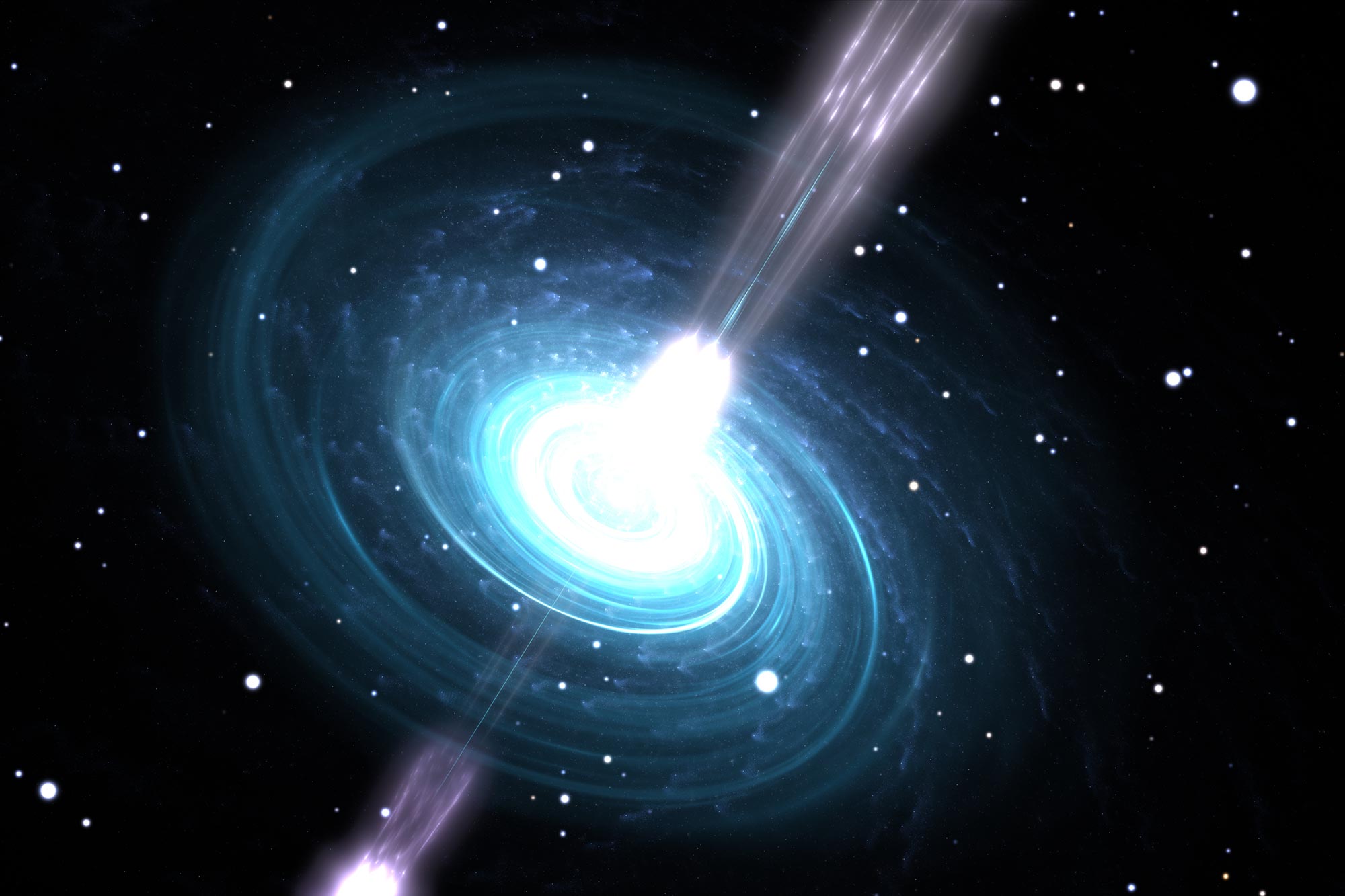
    After years of fading, the neutron star P13 suddenly flared back to life, becoming more than 100 times brighter in X-rays. The dramatic comeback hints at major changes in how matter crashes onto the star’s surface. Credit: Shutterstock

    A distant neutron star unexpectedly reawakened, unleashing a powerful X-ray surge that may reveal how the universe’s most extreme stars feed.

    A research team has studied the long-term changes in X-ray emissions from the neutron star NGC 7793 P13, which is believed to be powered by supercritical accretion. This process involves a massive amount of gas falling onto the neutron star, generating intense X-rays. The researchers discovered a connection between the star’s X-ray brightness and its rotation speed, offering valuable insights that may help explain the underlying mechanism of supercritical accretion.

    When gas is pulled in by the intense gravity of a compact object such as a neutron star or a black hole, a process known as accretion, it releases energy in the form of electromagnetic radiation. Advances in high-sensitivity telescopes have revealed sources that shine with exceptionally powerful X-ray output.
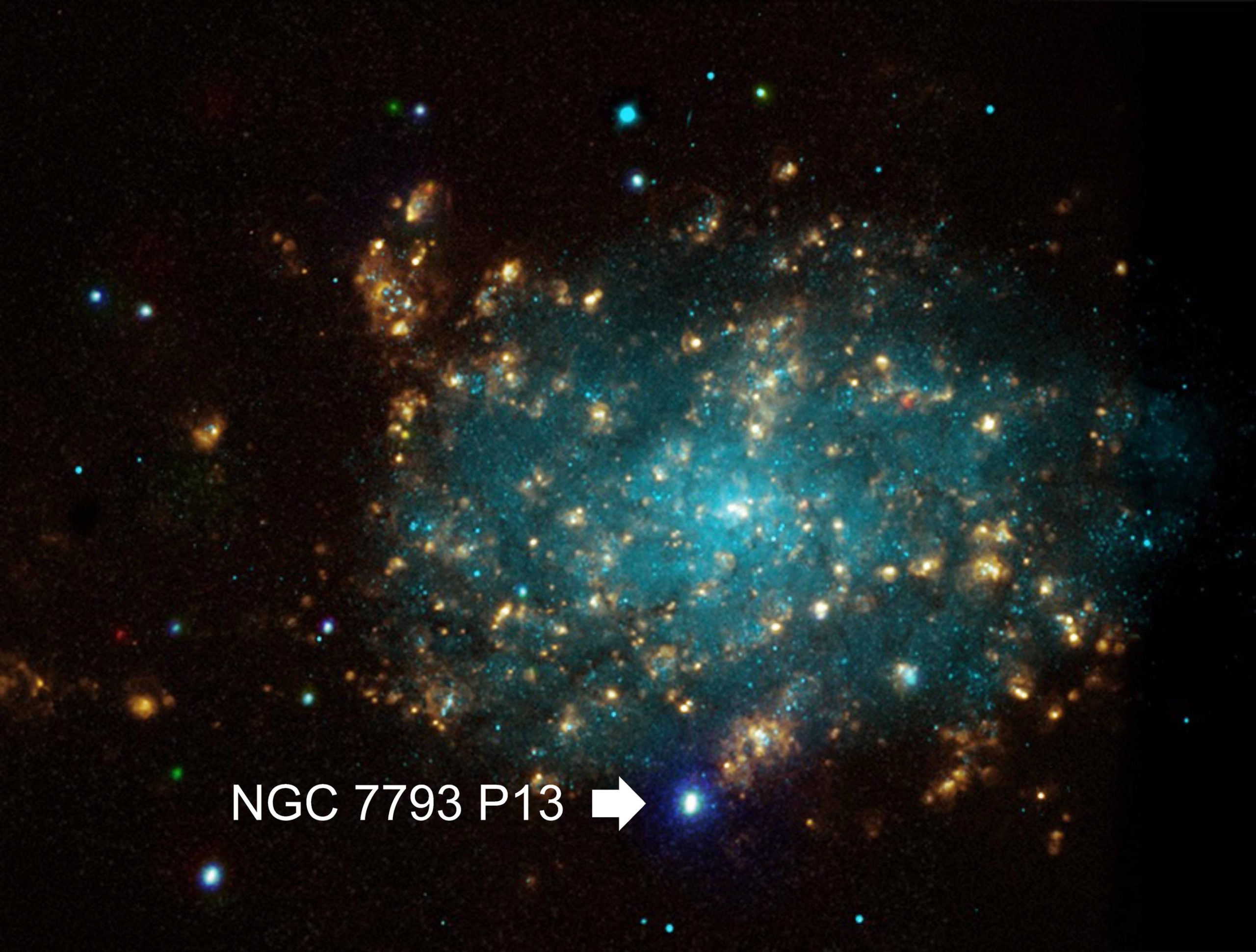
    Galaxy NGC 7793 and NGC 7793 P13
    The image that combines data from X-ray, optical, and Hα line observations. NGC 7793 P13 is located away from the galactic center of NGC 7793. Credit: X-ray (NASA/CXC/Univ. of Strasbourg/M. Pakull et al.); Optical (ESO/VLT/Univ. of Strasbourg/M. Pakull et al.); Hα (NOAO/AURA/NSF/CTIO 1.5 m)

    One leading idea is that these extreme emissions occur when unusually large amounts of gas stream onto a compact object through a phenomenon known as supercritical accretion. Despite this progress, the physical processes that enable supercritical accretion are still not well understood.

    To explore this mystery, the research team examined NGC 7793 P13 (hereafter, P13), a neutron star undergoing supercritical accretion in the galaxy NGC 7793 (about 10 million light-years from the Earth). As matter spirals toward a neutron star, its strong magnetic field guides the inflowing gas toward the magnetic poles, where it forms tall, narrow structures known as accretion columns. These regions are believed to be the source of the system’s intense X-ray emission.
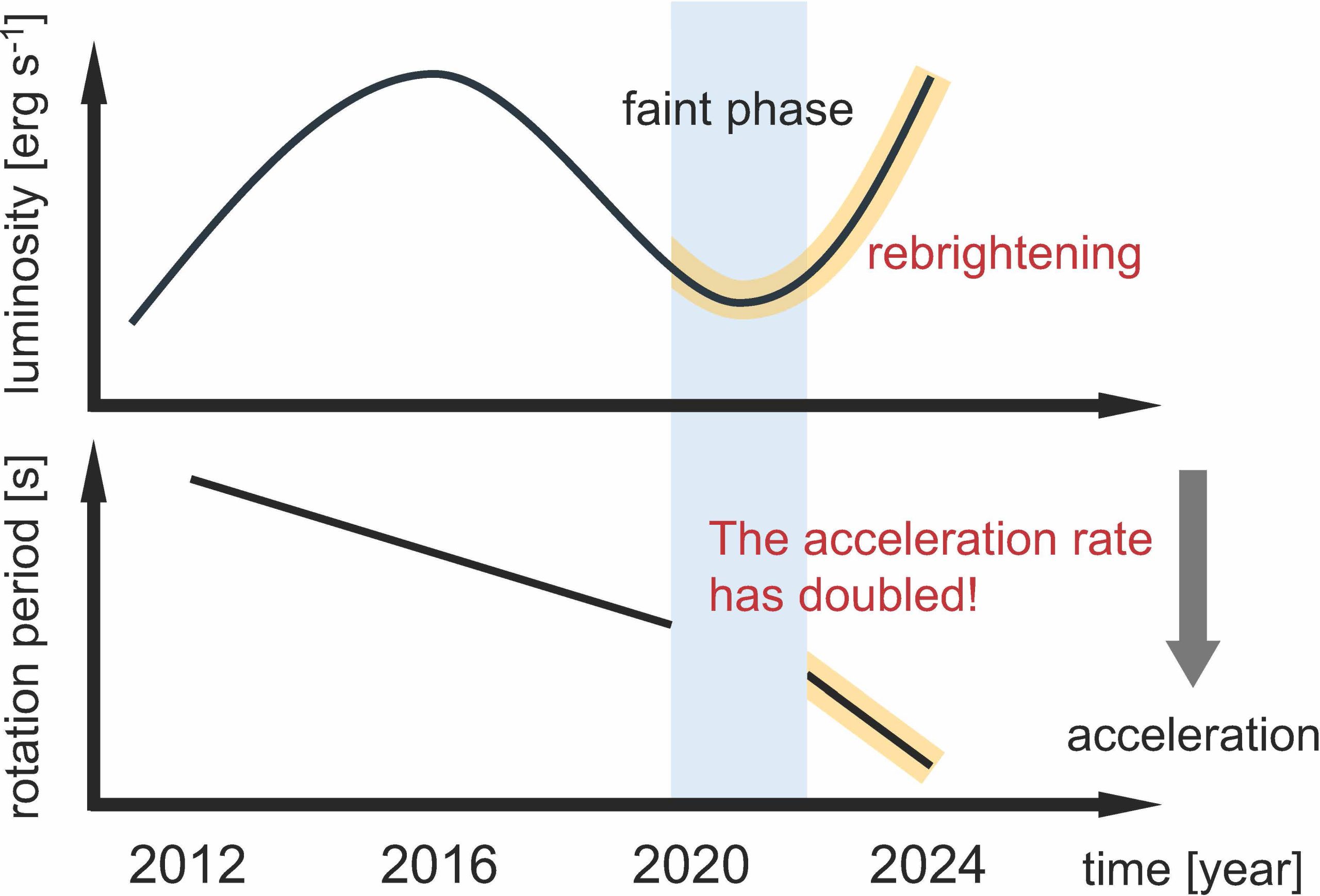
    Evolution of the X Ray Luminosity and Rotation Period
    The luminosity and rotation speed changed significantly. There is an inverse relationship between rotational speed and period; a shorter period indicates faster rotation. The acceleration rate of rotational speed is represented by the slope. Credit: Marina Yoshimoto (Ehime University)

    As the neutron star spins, its X-ray emission can appear as regular, repeating pulses that follow the star’s rotation. Earlier research showed that P13 has a rotation period of about 0.4 s and that its spin rate increases at a nearly steady pace.

    Over a timescale of roughly 10 years, the system’s brightness also varied dramatically, changing by more than a hundredfold. Both the spin behavior and the X-ray brightness are useful indicators of how much material is falling onto the neutron star, yet for P13 no clear connection between these two measurements had been identified.

    Long-Term Variability and Clues to Supercritical Accretion

    The research team investigated the long-term evolution of the X-ray luminosity and rotation period of P13 from 2011 to 2024, using the archival data of XMM-Newton, Chandra, NuSTAR, and NICER. It was found that P13 was in a faint phase in 2021 and started to be bright again in 2022. By 2024, it reached a high luminosity, more than two orders of magnitude higher than in 2021. Moreover, in the rebrightening phase in 2022, the acceleration rate of the rotation velocity was increased by a factor of 2, and it was maintained until 2024.
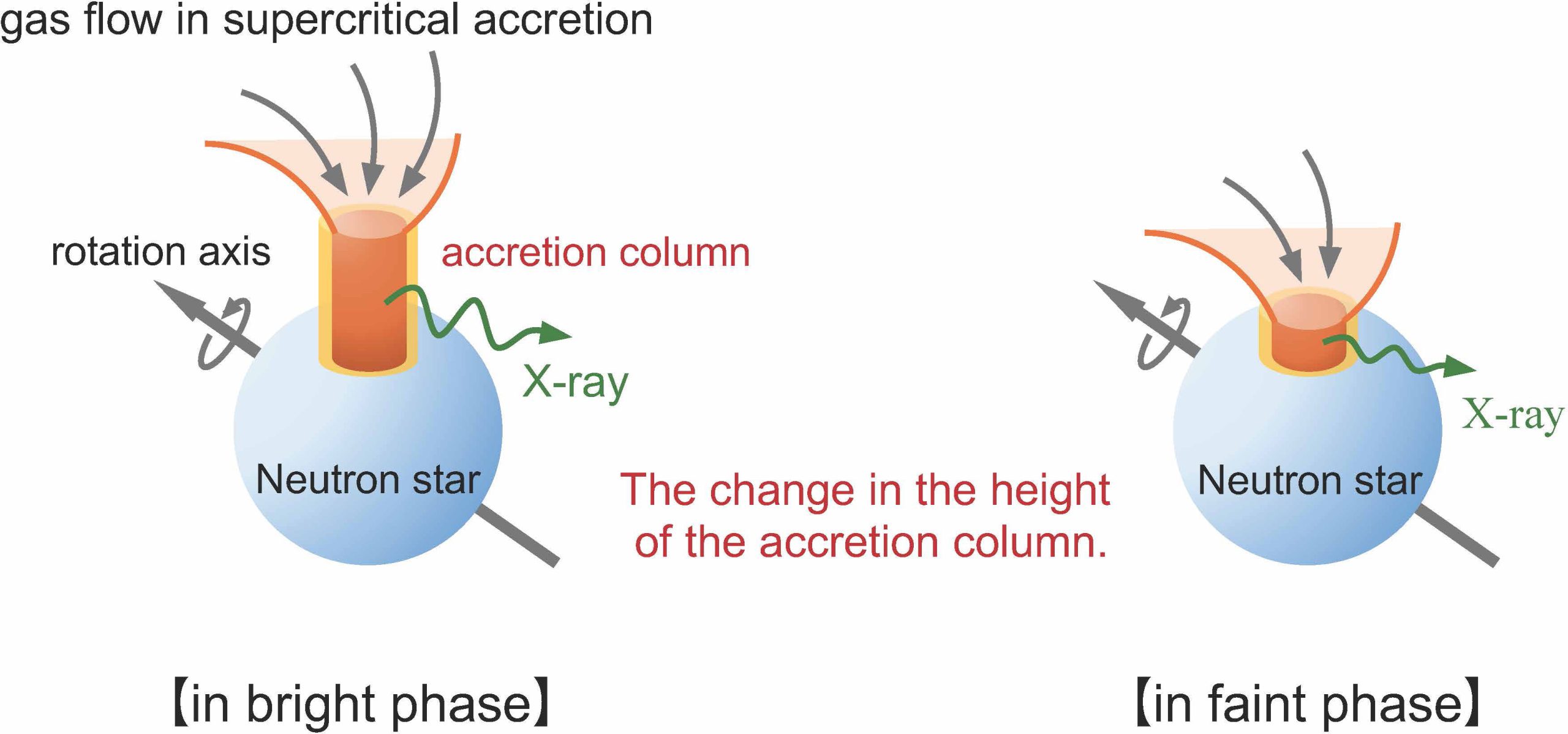
    Changes in the Height of the Accretion Column Corresponding to Variations in Luminosity
    During the bright phase, the accretion column is tall, while during the faint phase, it becomes shorter. Credit: Marina Yoshimoto (Ehime University)

    This result suggests a relationship between X-ray luminosity and rotation velocity, and that the accretion system changed during the faint phase. The research team then focused on the pulsation and performed detailed analyses. It was suggested that the height of the accretion column was changed with the 10-year flux modulation. Those results are expected to be clues to reveal the mechanism of supercritical accretion.

    Reference: “Monitoring of the Spectral and Timing Properties of the Ultraluminous X-Ray Pulsar NGC 7793 P13” by Marina Yoshimoto, Tomokage Yoneyama, Shogo B. Kobayashi, Hirokazu Odaka, Taiki Kawamuro and Hironori Matsumoto, 29 October 2025, The Astrophysical Journal Letters.
    DOI: 10.3847/2041-8213/ae018f

    Funding: Japan Science and Technology Agency, Japan Society for the Promotion of Science

    Never miss a breakthrough: Join the SciTechDaily newsletter.
    Follow us on Google and Google News.

    Astronomy Astrophysics Ehime University Neutron Star X-ray
    Share. Facebook Twitter Pinterest LinkedIn Email Reddit

    Related Articles

    Decoding the Universe’s Most Violent Explosions: New Data on X-Ray Bursts

    Time To Rethink Theories: Physicists Predict Neutron Stars May Be Bigger Than Previously Imagined

    Supercomputing Tapped to Study Exotic Matter in Stars

    Deciphering the Lives of Double Neutron Stars Using the Ripples in the Fabric of Space and Time

    Evidence of “Pulsar Wind Nebula” May Solve 34-Year-Old Astronomical Mystery

    New Clues to Remains of Star That Exploded Just Outside Our Galaxy

    Reclusive Neutron Star May Have Been Found in Famous Supernova SN 1987A

    True Identity of Mysterious High-Energy Gamma-Ray Source Revealed

    New Measurement of the Hubble Constant – Rate of Expansion of the Universe – From Combined Observations of Neutron Stars

    Leave A Reply Cancel Reply

    • Facebook
    • Twitter
    • Pinterest
    • YouTube

    Don't Miss a Discovery

    Subscribe for the Latest in Science & Tech!

    Trending News

    New Pill Lowers Stubborn Blood Pressure and Protects the Kidneys

    Humans May Have Hidden Regenerative Powers, New Study Suggests

    Scientists Just Solved the Mystery of Why Crabs Walk Sideways

    Doctors Are Surprised by What This Vaccine Is Doing to the Heart

    This Popular Supplement May Boost Your Brain, Not Just Your Muscles

    Scientists Say This Simple Supplement May Actually Reverse Heart Disease

    Warming Oceans Could Trigger a Dangerous Methane Surge

    This Simple Movement Could Be Secretly Cleaning Your Brain

    Follow SciTechDaily
    • Facebook
    • Twitter
    • YouTube
    • Pinterest
    • Newsletter
    • RSS
    SciTech News
    • Biology News
    • Chemistry News
    • Earth News
    • Health News
    • Physics News
    • Science News
    • Space News
    • Technology News
    Recent Posts
    • Hidden Heart Risk Found in 1 in 5 People, Study Warns
    • Scientists Say This Daily Walking Habit May Be the Secret to Keeping Weight Off After Dieting
    • New Therapy Rewires the Brain To Restore Joy in Depression Patients
    • Researchers Discover Efficient New Way To Split Hydrogen From Water for Energy
    • This Korean Skincare Ingredient Could Help Fight Deadly Superbugs
    Copyright © 1998 - 2026 SciTechDaily. All Rights Reserved.
    • Science News
    • About
    • Contact
    • Editorial Board
    • Privacy Policy
    • Terms of Use

    Type above and press Enter to search. Press Esc to cancel.