
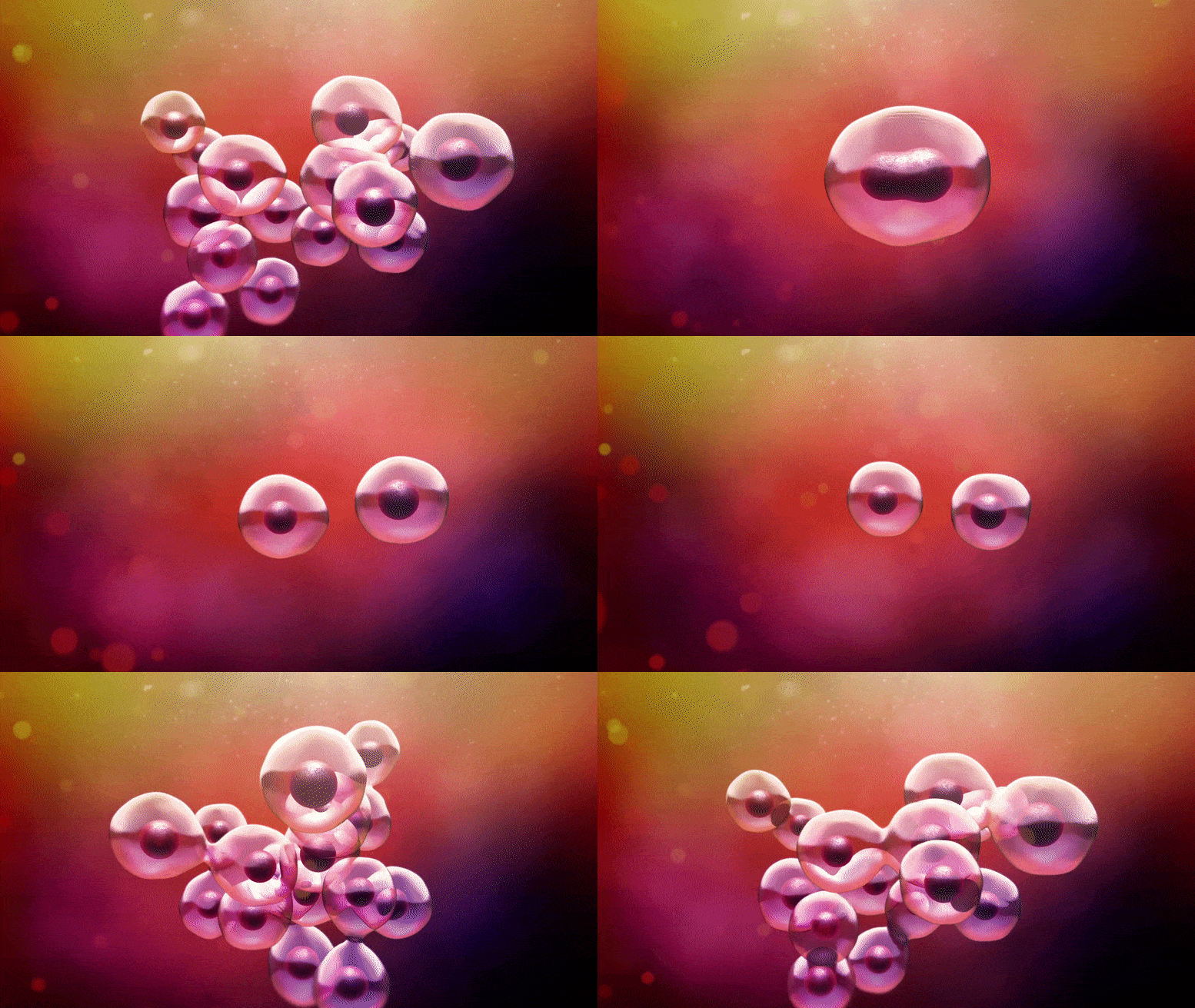
The University of Copenhagen researchers utilized a mouse model to discover an alternate path that some cells follow to build organs and used that information to exploit a new kind of stem cells as a possible supply of organs in a dish
Imagine being able to restore damaged organ tissue. Because stem cells have the incredible ability to create the cells of organs such as the liver, pancreas, and intestine, that is what stem cell research is aiming to do.
For many years, researchers have worked to duplicate the process by which embryonic stem cells develop into organs and other parts of the body. However, despite several attempts, it has proven to be incredibly challenging to get lab-grown cells to mature correctly. However, recent research from the University of Copenhagen reveals that they could have missed a crucial step and perhaps another kind of stem cell.
Alternative Route Using Extra-Embryonic Stem Cells
“Very simply put, a number of recent studies have attempted to make a gut from stem cells in a dish. We have found a new way to do this, a way that follows different aspects of what happens in the embryo. Here, we found a new route that the embryo uses, and we describe the intermediate stage that different types of stem cells could use to make the gut and other organs,” says Ph.D. student at Martin Proks, one of the primary authors of the study from Novo Nordisk Foundation Center for Stem Cell Medicine at the University of Copenhagen (reNEW).
The study focused on pluripotent stem cells and endoderm extra-embryonic stem cells. Extra-embryonic endoderm cells are a new stem cell line identified by the same research team a few years ago. They help the gastrointestinal organs by acting as key support cells that supply membranes, nourishment for the membranes, and other functions.
Group Leader and Professor Joshua Brickman at reNEW explains:
Creating Intestinal Organs from Support Cells
“We have identified an alternative route that so-called extra-embryonic cells can use to make intestinal organs in the embryo. We then took our extra-embryonic endoderm stem cells and developed them into intestinal organ-like structures in the dish.”
“But until the very recent past, people assumed these cells helped the embryo to develop, and then they’re gone. That they do not have anything to do with your body. So in this paper, we discovered that if we steer these support cells through this new alternative route, they would actually form organoid structures,” says Joshua Brickman on the findings, which were published in the journal Nature Cell Biology.
Might Improve Laboratory-Grown Cells
The researchers identified all the potential cells that were candidates to form organs associated with the digestive tract, such as the liver, pancreas, lung, and intestine, based on labeling them with a genetic marker. This big data is hard to analyze and required innovative new approaches to analysis that were developed in collaboration with physical scientists at the Niels Bohr Institute.
“We then identified the genes being used in these cells. To facilitate this work, we developed a new computational tool to compare clusters of cells and used this both to compare cells within our own dataset and examine others,” explains Associate Professor Ala Trusina at the Niels Bohr Institute.
In order to ask whether the alternative route could develop organ cell types in the lab, the researchers set about using a different type of stem cells. These stem cells, which were described earlier in the article, originate from a different part of the embryo than pluripotent stem cells, and they resemble the starting point for the second or alternative route of organ formation.
“We then used these stem cells to generate intestinal organ-like structures in a dish. The findings suggest that both routes could work. Using the alternative route might help laboratory-grown cells form functional cells and treat and study disease,” says Michaela Rothova, one of the other principal authors of the study.
It could prove an important discovery, as scientists for long have been trying to crack the code on how to develop stem cells into the correct cells needed for a specific treatment, test drugs, or model a disease.
Combining Routes to Solve Maturation Challenges
“We haven’t quite gotten there in terms of function, and we have problems maturing these cells. So perhaps we can solve some of these problems by trying this alternative route or by combining the alternative route with the traditional route,” concludes Joshua Brickman at reNEW.
Reference: “Identification of the central intermediate in the extra-embryonic to embryonic endoderm transition through single-cell transcriptomics” by Michaela Mrugala Rothová, Alexander Valentin Nielsen, Martin Proks, Yan Fung Wong, Alba Redo Riveiro, Madeleine Linneberg-Agerholm, Eyal David, Ido Amit, Ala Trusina, and Joshua Mark Brickman, 9 June 2022, Nature Cell Biology.
DOI: 10.1038/s41556-022-00923-x
Never miss a breakthrough: Join the SciTechDaily newsletter.
Follow us on Google and Google News.