
Close Menu
    Facebook X (Twitter) Instagram
    SciTechDaily
    • Biology
    • Chemistry
    • Earth
    • Health
    • Physics
    • Science
    • Space
    • Technology
    Facebook X (Twitter) Pinterest YouTube RSS
    SciTechDaily
    Home»Biology»A Single Gene “Invented” Hemoglobin Several Times
    Biology

    A Single Gene “Invented” Hemoglobin Several Times

    By CNRSJanuary 17, 2021No Comments3 Mins Read
    Facebook Twitter Pinterest Telegram LinkedIn WhatsApp Email Reddit
    Share
    Facebook Twitter LinkedIn Pinterest Telegram Email Reddit
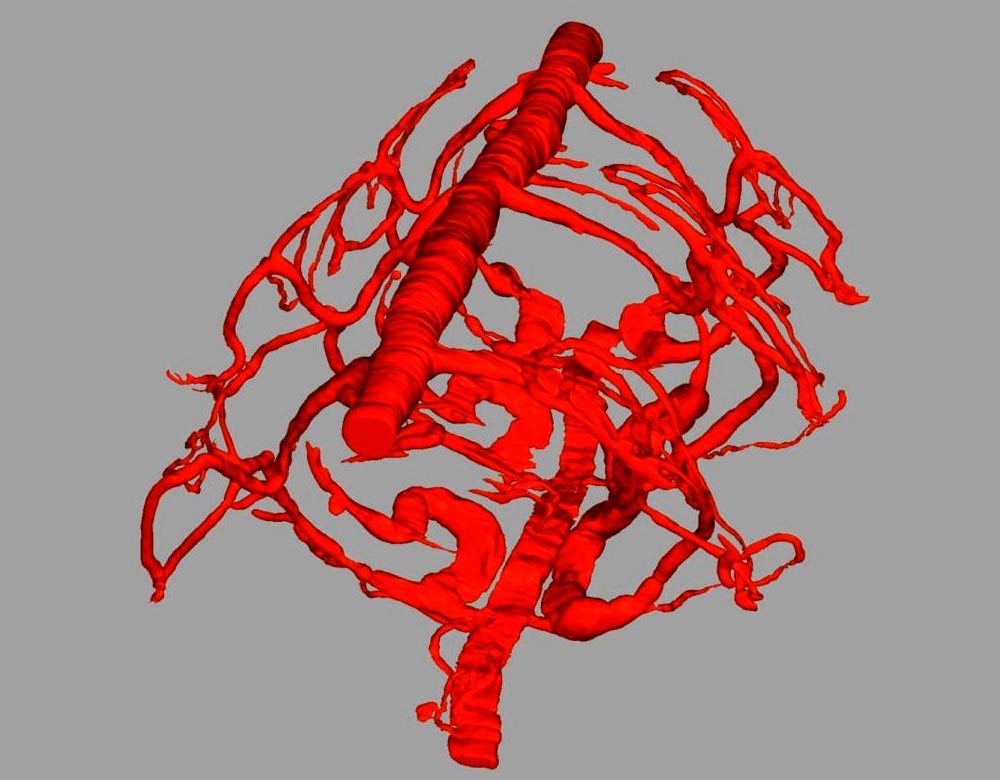
    Platynereis dumerilii Vascular System
    The Platynereis dumerilii vascular system in three segments. Credit: © Song et al. / BMC Evolutionary Biology

    Using the slow-evolving marine worm Platynereis dumerilii, scientists revealed that all hemoglobins trace back to a common ancestral gene, cytoglobin.

    Thanks to the marine worm Platynereis dumerilii, an animal whose genes have evolved very slowly, scientists from CNRS, Université de Paris and Sorbonne Université, in association with others at the University of Saint Petersburg and the University of Rio de Janeiro, have shown that while hemoglobin appeared independently in several species, it actually descends from a single gene transmitted to all by their last common ancestor. These findings were published on December 29, 2020, in BMC Evolutionary Biology.

    Having red blood is not peculiar to humans or mammals. This color comes from hemoglobin, a complex protein specialized in transporting the oxygen found in the circulatory system of vertebrates, but also in annelids (a worm family whose most famous members are earthworms), mollusks (especially pond snails) and crustaceans (such as daphnia or ‘water fleas’). It was thought that for hemoglobin to have appeared in such diverse species, it must have been ‘invented’ several times during evolution. But recent research has shown that all of these hemoglobins born ‘independently’ actually derive from a single ancestral gene.

    Researchers from the Institut Jacques Monod (CNRS/Université de Paris), the Laboratoire Matière et Systèmes Complexes (CNRS/Université de Paris), the Station Biologique de Roscoff (CNRS/Sorbonne Université), the Universities of Saint Petersburg (Russia) and Rio de Janeiro (Brazil), conducted this research on Platynereis dumerilii, a small marine worm with red blood.

    It is considered to be an animal that evolved slowly, because its genetic characteristics are close to those of the marine ancestor of most animals, Urbilateria.[1] Studying these worms by comparing them with other species with red blood has helped in tracing back to the origins of hemoglobins.

    The research focused on the broad family to which hemoglobins belong: globins, proteins present in almost all living beings that ‘store’ gases like oxygen and nitric oxide. But globins usually act inside the cells because they do not circulate in the blood like hemoglobin.

    How Cytoglobin Became Hemoglobin

    This work shows that in all species with red blood, it is the same gene that makes a globin called ‘cytoglobin’ that independently evolved to become a hemoglobin-encoding gene. This new circulating molecule made oxygen transport more efficient in their ancestors, who became larger and more active.

    Scientists now want to change scale and continue this work by studying when and how the different specialized cells of bilaterian vascular systems emerged.

    Notes

    1. Urbilateria is the last common ancestor of bilaterians, i.e. animals with bilateral (left-right) symmetry and complex organs, apart from species with simpler organization such as sponges and jellyfish.

    Reference: “Globins in the marine annelid Platynereis dumerilii shed new light on hemoglobin evolution in bilaterians” by Solène Song, Viktor Starunov, Xavier Bailly, Christine Ruta, Pierre Kerner, Annemiek J. M. Cornelissen and Guillaume Balavoine, 29 December 2020, BMC Evolutionary Biology.
    DOI: 10.1186/s12862-020-01714-4

    Never miss a breakthrough: Join the SciTechDaily newsletter.
    Follow us on Google and Google News.

    Blood CNRS Evolution Genetics Popular
    Share. Facebook Twitter Pinterest LinkedIn Email Reddit

    Related Articles

    Genetic Analysis Shows Life’s Earliest Evolution Was More Complicated Than Previously Suspected

    Different Groups of Bats Have Their Own Unique Strains of Coronavirus – They Have Been Evolving Together for Millions of Years

    Breakthrough in Understanding Evolution – Mitochondrial Division Conserved Across Species

    Scientists Extract Complete Human Genome From 5,700-Year-Old “Chewing Gum” – Here’s What They Found

    New Fossils of Ancient Snake With Hind Legs Reveals Tantalizing Details of Evolution

    Calcified Bacteria Sheds Light on the Health Consequences of the Evolving Diet

    Prolific Changes in the Human Genome in the Past 5,000 Years

    Study Provides Picture of Human Expansion From Africa

    Improved Estimates of DNA’s Mutation Rate Paint Clearer Picture of Human Prehistory

    Leave A Reply Cancel Reply

    • Facebook
    • Twitter
    • Pinterest
    • YouTube

    Don't Miss a Discovery

    Subscribe for the Latest in Science & Tech!

    Trending News

    Your Blood Pressure Reading Could Be Wrong Because of One Simple Mistake

    Astronomers Stunned by Ancient Galaxy With No Spin

    Physicists May Be on the Verge of Discovering “New Physics” at CERN

    Scientists Solve 320-Million-Year Mystery of Reptile Skin Armor

    Scientists Say This Daily Walking Habit May Be the Secret to Keeping Weight Off After Dieting

    New Therapy Rewires the Brain To Restore Joy in Depression Patients

    Giant Squid Detected off Western Australia in Stunning Deep-Sea Discovery

    Popular Sugar-Free Sweetener Linked to Liver Disease, Study Warns

    Follow SciTechDaily
    • Facebook
    • Twitter
    • YouTube
    • Pinterest
    • Newsletter
    • RSS
    SciTech News
    • Biology News
    • Chemistry News
    • Earth News
    • Health News
    • Physics News
    • Science News
    • Space News
    • Technology News
    Recent Posts
    • Hidden Warm Water Beneath Antarctica Could Rapidly Raise Global Sea Levels
    • Scientists Revive Ancient Chemistry Trick To Engineer Next-Generation Glass
    • Scientists Use AI To Supercharge Ultrafast Laser Simulations by More Than 250x
    • Scientists Just Found a Surprising Way To Destroy “Forever Chemicals”
    • Popular Supplement Ingredient Linked to Shorter Lifespan in Men
    Copyright © 1998 - 2026 SciTechDaily. All Rights Reserved.
    • Science News
    • About
    • Contact
    • Editorial Board
    • Privacy Policy
    • Terms of Use

    Type above and press Enter to search. Press Esc to cancel.