

Europa’s ice may be quietly delivering life-sustaining nutrients to a hidden ocean beneath the surface.
Geophysicists at Washington State University have uncovered a possible explanation for how nutrients may travel into the subsurface ocean of Europa, a moon of Jupiter that ranks among the strongest candidates for extraterrestrial life in the solar system.
For decades, researchers have questioned how essential nutrients could move from Europa’s surface down into its ocean, which lies buried beneath a thick layer of ice and is thought to host microscopic life. Using computer simulations inspired by a geological process on Earth called crustal delamination, the team showed that heavy, nutrient-rich ice can separate from surrounding ice and sink downward until it reaches the ocean.
“This is a novel idea in planetary science, inspired by a well-understood idea in Earth science,” said Austin Green, lead author and postdoctoral researcher at Virginia Tech. “Most excitingly, this new idea addresses one of the longstanding habitability problems on Europa and is a good sign for the prospects of extraterrestrial life in its ocean.”
Why Europa’s Ocean Raises Big Questions
The study was published in The Planetary Science Journal and authored by Green, who carried out much of the research during his doctoral dissertation at WSU, along with Catherine Cooper, an associate professor of geophysics in the School of Environment and associate dean in the College of Arts and Sciences.
Europa contains more liquid water than all of Earth’s oceans combined. However, that vast ocean sits beneath a global ice shell so thick that sunlight cannot penetrate it. Because of this barrier, any organisms living in Europa’s ocean would need to rely on chemical sources of energy and nutrients instead of sunlight, a challenge that has long puzzled scientists studying the moon’s potential habitability.
Europa also endures constant exposure to powerful radiation from Jupiter. This radiation reacts with salts and other surface materials, creating compounds that could serve as nutrients for ocean-dwelling microbes. While multiple ideas have been proposed, researchers have struggled to explain how this nutrient-rich surface ice could move through the ice shell to reach the ocean below. Even though Europa’s surface is highly active due to Jupiter’s gravitational influence, most of the ice motion occurs horizontally rather than vertically, limiting direct transport to the ocean.
An Earth-Based Process Offers a Clue
To address this problem, Green and Cooper turned to a process commonly observed on Earth. Crustal delamination occurs when a portion of Earth’s crust becomes compressed and chemically altered until it grows dense enough to detach and sink into the mantle.
The researchers suspected a similar mechanism could operate on Europa. Certain regions of the moon’s ice shell are rich in salts that increase ice density. Previous studies have also shown that ice containing impurities is structurally weaker and less stable than pure ice. For delamination to take place, this weakened ice must be able to break free and descend deeper into the ice shell.
A Possible Pathway for Feeding Europa’s Ocean
The team proposed that dense, salt-laden ice surrounded by purer ice could slowly sink into the interior of Europa’s ice shell, effectively recycling surface material and transporting nutrients into the ocean. Their computer models revealed that this sinking could occur across nearly all salt concentrations, as long as the surface ice experiences even a small amount of weakening.
The simulations also showed that the process could unfold relatively quickly on geological timescales and repeat over long periods. This makes it a potentially reliable way to replenish Europa’s ocean with nutrients, improving the likelihood that life could survive in its dark, hidden waters.
Supporting the Goals of Europa Clipper
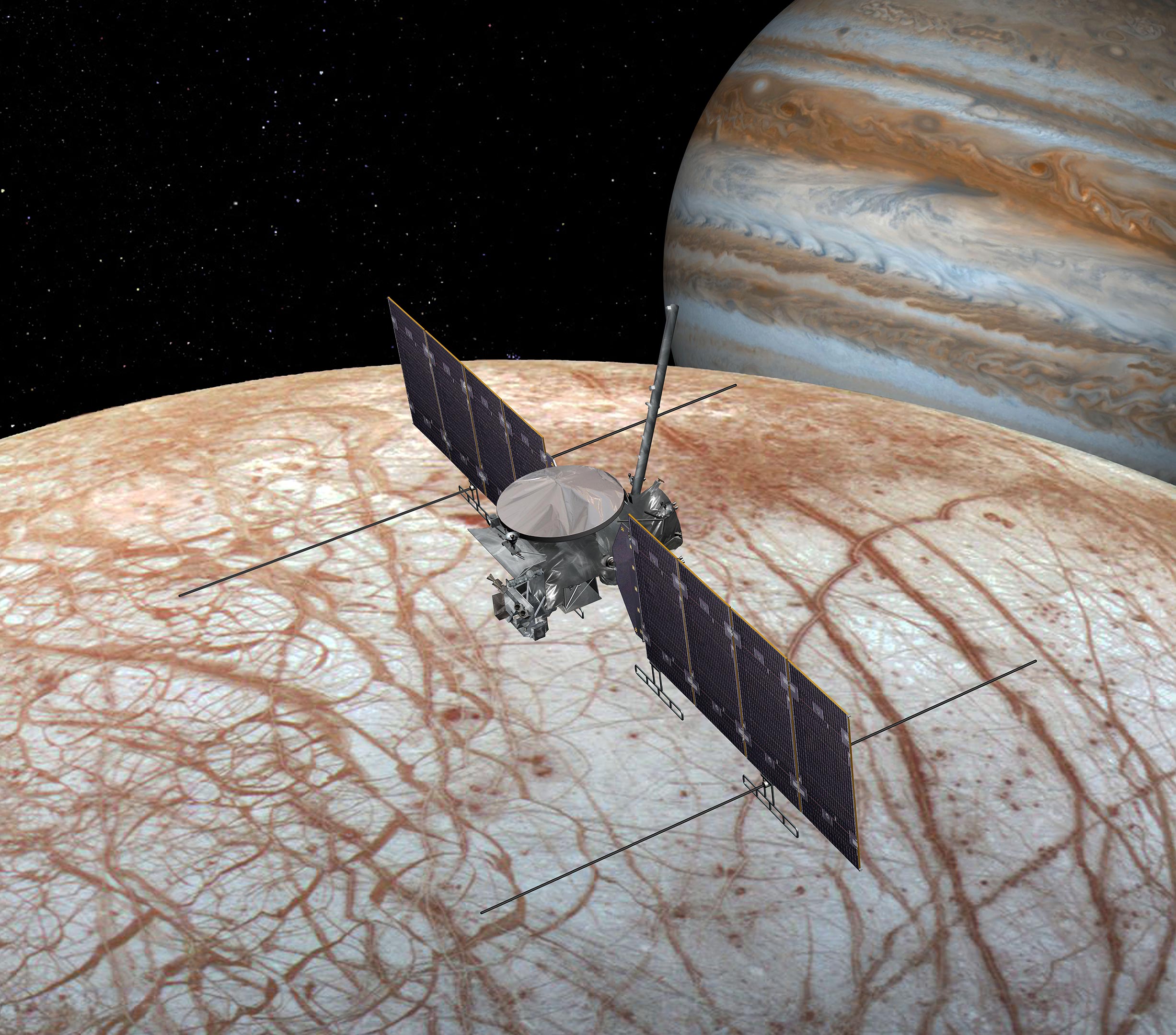
These results align closely with the objectives of the Europa Clipper mission, a NASA flagship spacecraft launched in 2024. The mission aims to study Europa’s ice shell, subsurface ocean, and overall potential to support life using a wide range of scientific instruments.
Reference: “Dripping to Destruction: Exploring Salt-driven Viscous Surface Convergence in Europa’s Icy Shell” by A. P. Green and C. M. Cooper, 20 January 2026, The Planetary Science Journal.
DOI: 10.3847/PSJ/ae2b6f
The research was supported in part by the National Aeronautics and Space Administration (NASA) Grant NNX15AH91G and made use of computing resources from the Center for Institutional Research Computing at Washington State University.
Never miss a breakthrough: Join the SciTechDaily newsletter.
Follow us on Google and Google News.
2 Comments
Somewhere Above The Methane Sea: a poem by Phillip Beer
https://docs.google.com/presentation/d/e/2PACX-1vQXQ37D72fPLL4P132ZjT9QGVZ0Qpeqpj4gFYQw3mKVV3WxGtUlsxQiT6aUkZ-QJ6X5DN0ec1aCRaHv/pub?start=false&loop=false&delayms=3000
Nice poem.