
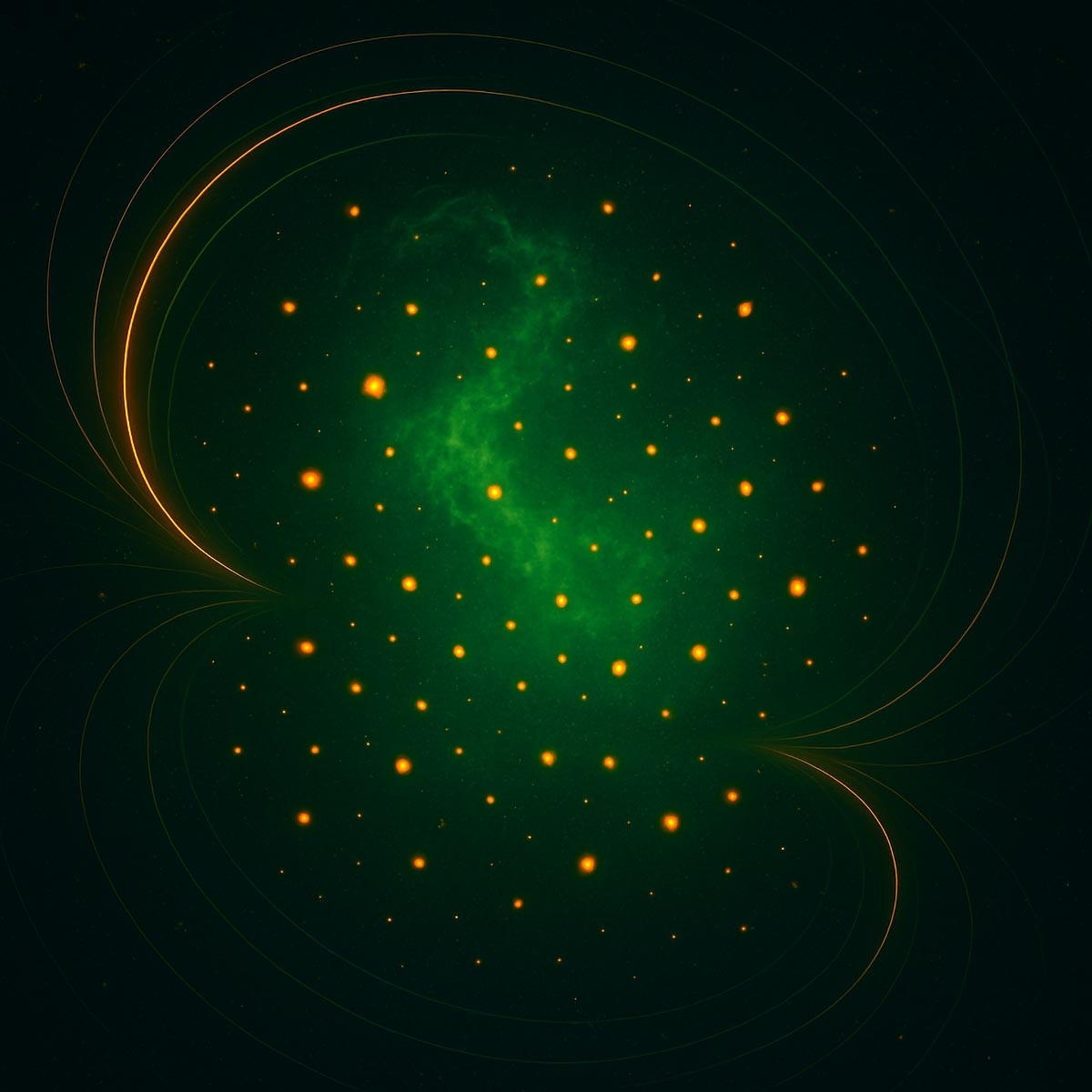
An Auburn University study finds that magnetic fields can guide electrons in plasma much like traffic signals, giving researchers new ways to control how dust particles form.
Picture a glowing cloud that looks like a neon sign, except it holds countless microscopic dust particles suspended in space rather than raindrops. This unusual state of matter is known as a dusty plasma, and it exists both in laboratory experiments and throughout deep space.
A new study published in Physical Review E reports that even relatively weak magnetic fields can strongly influence how dusty plasmas behave. Physicists at Auburn University found that these fields can either slow or accelerate the growth of nanoparticles within the plasma. Their experiments show that when magnetic forces guide electrons into curved, spiraling motion, the structure of the plasma shifts, altering how particles gain charge and increase in size.

Electrons set the pace of growth
“Dusty plasmas are like tiny particles in a vacuum box,” said Bhavesh Ramkorun, lead author of the study. “We found that by introducing magnetic fields, we could make these particles grow faster or slower, and the dust particles ended up with very different sizes and lifetimes.”
To conduct the experiments, the researchers created carbon nanoparticles by igniting a mixture of argon and acetylene gas. Under normal conditions, the particles grew steadily for roughly two minutes before drifting away. When magnetic fields were applied, that growth period became much shorter, sometimes lasting less than a minute, and the resulting particles remained smaller.
“It’s remarkable how sensitive the system is,” explained Saikat Thakur, co-author. “Electrons are the lightest players in the plasma, but when they become magnetized, they dictate the rules. That simple change can completely alter how nanomaterials form.”
From laboratory plasmas to space
The results could help scientists design new plasma-based techniques for creating nanoparticles with tailored properties for electronics, coatings, and quantum devices. At the same time, they offer fresh insight into natural plasmas in space, from planetary rings to the solar atmosphere, where dust and magnetic fields are constantly interacting.
“Plasma makes up most of the visible universe, and dust is everywhere,” added Ramkorun. “By studying how the smallest forces shape these systems, we’re uncovering patterns that connect the lab to the cosmos.”
Reference: “Electron magnetization effects on carbonaceous dusty nanoparticles grown in capacitively coupled nonthermal plasma” by Bhavesh Ramkorun, Saikat C. Thakur, Ryan B. Comes and Edward Thomas, Jr., 21 October 2025, Physical Review E.
DOI: 10.1103/3d3h-rkmb
Never miss a breakthrough: Join the SciTechDaily newsletter.
Follow us on Google and Google News.
1 Comment
Please ask researchers to think deeply:
Any so-called empirical evidence mixed with human intervention measures may distort human understanding and cognition of the essence of natural laws.