
Recent Findings Point to a Key Role of the Gut in Maintaining Brain Health
Results from a recent study indicate that the use of a probiotic may help prevent the decline in memory and thinking that can accompany aging. This discovery could lay the groundwork for innovative, non-invasive methods that utilize the gut microbiome to lessen cognitive deterioration in the elderly.
The scientists discovered that the cognitive scores of study participants who were experiencing mild cognitive impairment improved after receiving the probiotic Lactobacillus rhamnosus GG (LGG) for a three-month period. This improvement in cognitive function was also linked to alterations in their gut microbiome.
“The implication of this finding is quite exciting, as it means that modifying the gut microbiome through probiotics could potentially be a strategy to improve cognitive performance, particularly in individuals with mild cognitive impairment,” said Mashael Aljumaah, a microbiology doctoral candidate at the University of North Carolina at Chapel Hill and North Carolina State University. “This adds a new layer to our understanding of the microbiome brain-gut connection and opens up new avenues for combating cognitive decline associated with aging.”
Aljumaah, who is also affiliated with King Saud University in Saudi Arabia, recently presented the findings at NUTRITION 2023, the annual flagship meeting of the American Society for Nutrition held July 22-25 in Boston.
“Many studies focus on severe forms of cognitive diseases such as Alzheimer’s and dementia, but these conditions are more advanced, making them significantly harder to reverse or treat,” said Aljumaah. “In contrast, we focused on mild cognitive impairment, which can include problems with memory, language, or judgment. Interventions at this stage of cognitive impairment could slow down or prevent the progression to more severe forms of dementia.”
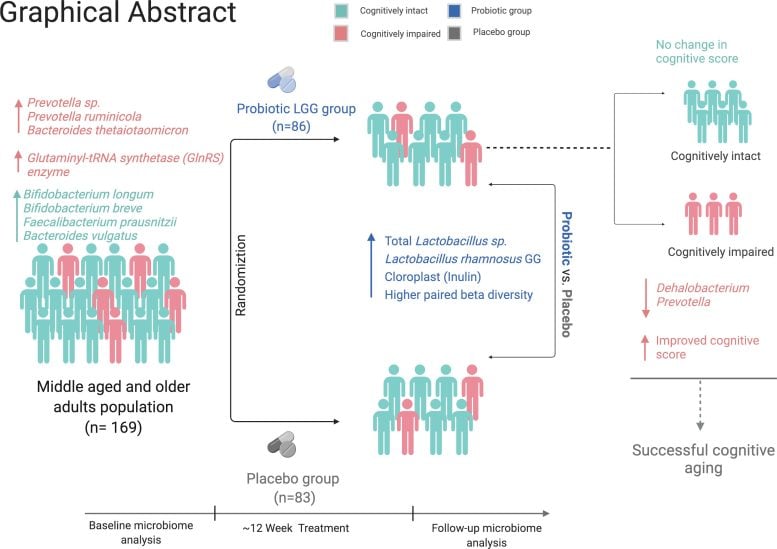
The study involved 169 participants between 52 and 75 years old who were divided into two groups depending on whether they had no neurological issues or mild cognitive impairment. Within each group, participants either received the LGG probiotic or a placebo in a double-blind, randomized clinical trial lasting three months. The researchers selected the LGG probiotic because prior research had shown its potential beneficial effects in animal models.
To investigate the study participants’ gut microbiomes, the researchers used 16S rRNA gene sequencing to identify and compare bacteria present in stool samples. They then used whole genome sequencing to gain insights into the functional roles of the bacteria identified.
The analysis revealed that microbes in the genus Prevotella were present in a higher relative abundance in participants with mild cognitive impairment than in those with no cognitive impairment. This suggests that gut microbiome composition could serve as an early indicator for mild cognitive impairment, offering opportunities for earlier interventions to slow cognitive decline.
Manipulating Gut Microbes to Improve Cognitive Function
For study participants who had mild cognitive impairment and received the LGG probiotics, the Prevotella relative abundance decreased. This change coincided with improved cognitive scores, suggesting that cognitive health in older adults could be improved by manipulating the gut microbiota.
“By identifying specific shifts in the gut microbiome associated with mild cognitive impairment, we’re exploring a new frontier in preventive strategies in cognitive health,” said Aljumaah. “If these findings are replicated in future studies, it suggests the feasibility of using gut microbiome-targeted strategies as a novel approach to support cognitive health.”
The researchers are now working to understand the specific mechanisms of how microbes like Prevotella influence the gut in a way that improves brain health. Specifically, they are exploring how certain molecules produced by these bacteria modulate the functionality of neuroprotective hormones that can cross the blood-brain barrier.
Reference: “The Gut Microbiome, Mild Cognitive Impairment, and Probiotics: a Randomized Clinical Trial in Middle-Aged and Older Adults” by Mashael R. Aljumaah, Andrea M. Azcarate-Peril, Jeffery Roach, John Gunstad and Urja Bhatia, 24 July 2023, NUTRITION 2023 (abstract; presentation details).
Never miss a breakthrough: Join the SciTechDaily newsletter.
Follow us on Google and Google News.