

Scientists have developed a protein-based gel that breaks down alcohol in the gastrointestinal tract without harming the body. In the future, people who take the gel could reduce the harmful and intoxicating effects of alcohol.
- A gel made from whey protein fibrils that uses individual iron atoms to convert alcohol in the intestine into harmless acetic acid before it enters the bloodstream has been developed by researchers at ETH Zurich.
- They showed that the gel reduces blood alcohol levels by up to 50 percent and protects the body from damage in experiments with mice.
- Although further tests are necessary before the gel can be used in humans, the scientists are confident that these will be a success and have already applied to patent the gel.
Most alcohol enters the bloodstream via the mucous membrane layer of the stomach and the intestines. These days, the consequences of this are undisputed: even small amounts of alcohol impair people’s ability to concentrate and to react, increasing the risk of accidents. Drinking large quantities on a regular basis is detrimental to one’s health: common consequences include liver disease, inflammation of the gastrointestinal tract, and cancer. According to the World Health Organization, around 3 million people die every year from excessive alcohol consumption.
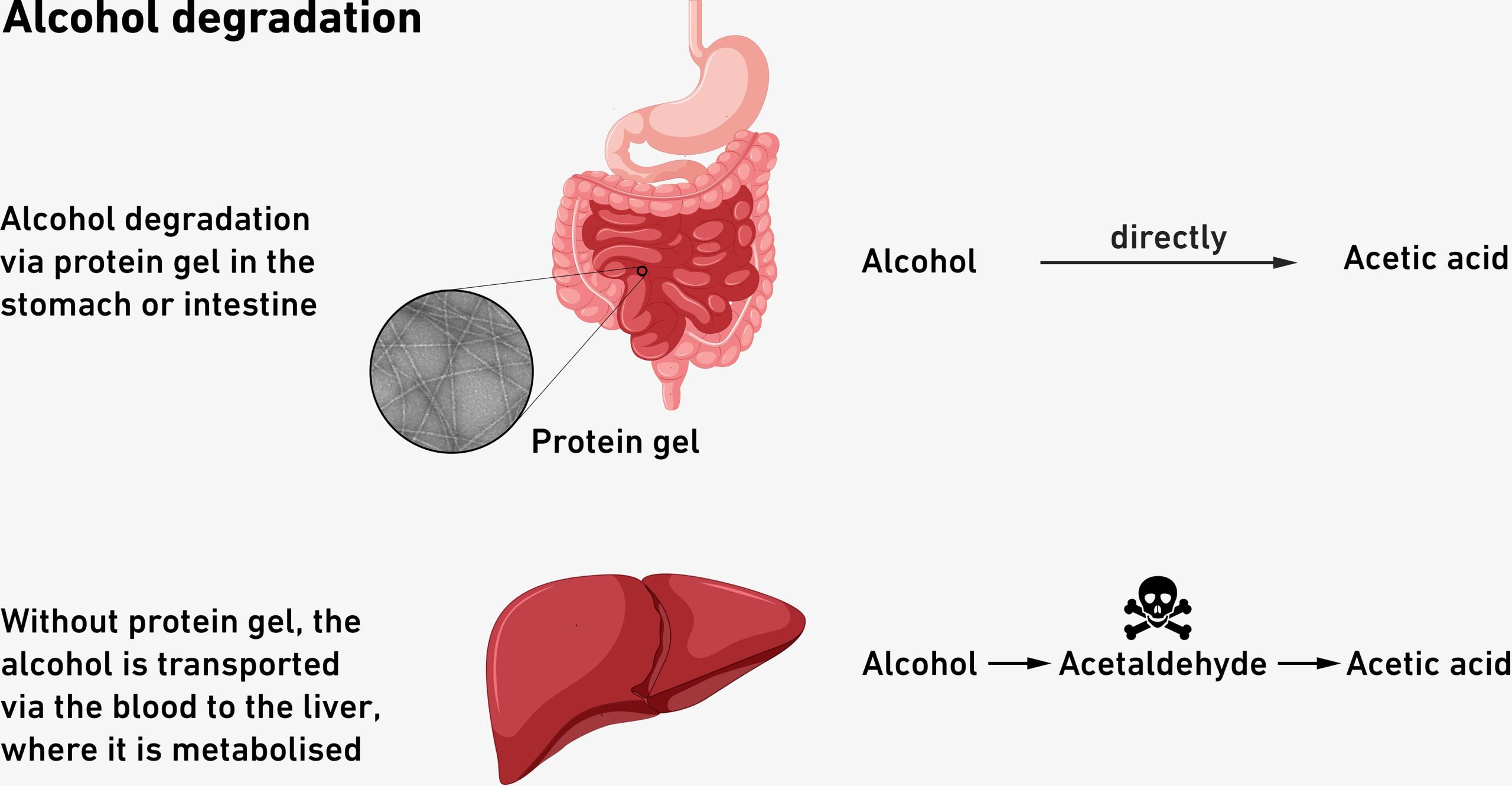
Researchers at ETH Zurich have now developed a protein gel that breaks down alcohol in the gastrointestinal tract. In a study recently published in the journal Nature Nanotechnology, they show that in mice, the gel converts alcohol quickly, efficiently, and directly into harmless acetic acid before it enters the bloodstream, where it would normally develop its intoxicating and harmful effects.
Reducing Health Damage Caused by Alcohol
“The gel shifts the breakdown of alcohol from the liver to the digestive tract. In contrast to when alcohol is metabolized in the liver, no harmful acetaldehyde is produced as an intermediate product,” explains Professor Raffaele Mezzenga from the Laboratory of Food & Soft Materials at ETH Zurich. Acetaldehyde is toxic and is responsible for many health problems caused by excessive alcohol consumption.
In the future, the gel could be taken orally before or during alcohol consumption to prevent blood alcohol levels from rising and acetaldehyde from damaging the body. In contrast to many products available on the market, the gel combats not only the symptoms of harmful alcohol consumption but also its causes. Yet, the gel is only effective as long as there is still alcohol in the gastrointestinal tract. This means it can do very little to help with alcohol poisoning, once the alcohol has crossed into the bloodstream. Nor does it help to reduce alcohol consumption in general. “It’s healthier not to drink alcohol at all. However, the gel could be of particular interest to people who don’t want to give up alcohol completely, but don’t want to put a strain on their bodies and aren’t actively seeking the effects of alcohol,” Mezzenga says.
Main Ingredients: Whey, Iron and Gold
The researchers used ordinary whey proteins to produce the gel. They boiled them for several hours to form long, thin fibrils. Adding salt and water as a solvent then causes the fibrils to cross-link and form a gel. The advantage of a gel over other delivery systems is that it is digested very slowly. But to break down the alcohol, the gel needs several catalysts.
The researchers used individual iron atoms as the main catalyst, which they distributed evenly over the surface of the long protein fibrils. “We immersed the fibrils in an iron bath, so to speak, so that they can react effectively with the alcohol and convert it into acetic acid,” says ETH researcher Jiaqi Su, the first author of the study. Tiny amounts of hydrogen peroxide are needed to trigger this reaction in the intestine. These are generated by an upstream reaction between glucose and gold nanoparticles. Gold was chosen as a catalyst for hydrogen peroxide because the precious metal is not digested and therefore stays effective for longer in the digestive tract. The researchers packed all these substances – iron, glucose and gold – into the gel. This resulted in a multi-stage cascade of enzymatic reactions that ultimately converts alcohol into acetic acid.
Gel Works in Mice
The researchers tested the effectiveness of the new gel on mice that were given alcohol just once as well as on mice that were given alcohol regularly for ten days. Thirty minutes after the single dose of alcohol, the prophylactic application of the gel reduced the alcohol level in the mice by 40 percent. Five hours after alcohol intake, their blood alcohol level had dropped by as much as 56 percent compared to the control group. Harmful acetaldehyde accumulated less in these mice, and they exhibited greatly reduced stress reactions in their livers, which was reflected in better blood values.
In the mice that were given alcohol for ten days, the researchers were able to demonstrate not only a lower alcohol level but also a lasting therapeutic effect of the gel: the mice that were given the gel daily in addition to alcohol showed significantly less weight loss, less liver damage and hence better fat metabolism in the liver as well as better blood values. Other organs in the mice, such as the spleen or the intestine, as well as their tissues also showed much less damage caused by alcohol.
Patent Pending
In an earlier study of administering iron through whey protein fibrils, the researchers discovered that iron reacts with alcohol to form acetic acid. As this process was too slow and too ineffective at the time, they changed the form in which they attached the iron to the protein fibrils. “Instead of using larger nanoparticles, we opted for individual iron atoms, which can be distributed more evenly on the surface of the fibrils and therefore react more effectively and quickly with the alcohol,” Mezzenga says.
The researchers have already applied for a patent for the gel. While several clinical tests are still required before it can be authorized for human use, the researchers are confident that this step will also be successful, as they already showed that the whey protein fibrils that make up the gel are edible.
Reference: “Single-site iron-anchored amyloid hydrogels as catalytic platforms for alcohol detoxification” by Jiaqi Su, Pengjie Wang, Wei Zhou, Mohammad Peydayesh, Jiangtao Zhou, Tonghui Jin, Felix Donat, Cuiyuan Jin, Lu Xia, Kaiwen Wang, Fazheng Ren, Paul Van der Meeren, F. Pelayo García de Arquer and Raffaele Mezzenga, 13 May 2024, Nature Nanotechnology.
DOI: 10.1038/s41565-024-01657-7
Never miss a breakthrough: Join the SciTechDaily newsletter.
Follow us on Google and Google News.
2 Comments
So in the meantime, drinkers take drugs to maximize the effects.
You would have to drink more to get the same effect. Whats the point? I