

A hidden pigment helps ocean algae harness sunlight without getting burned—and it may hold clues for better solar tech.
Too much sunlight can spoil a beach day, and it can also damage photosynthesis, the process plants and algae use to turn light into energy. Excessive exposure can overwhelm this system, harming organisms that depend on sunlight to survive. Under the ocean surface, however, some algae have developed an effective defense.
Researchers from Osaka Metropolitan University and their collaborators found that a pigment called siphonein helps marine green algae continue photosynthesis smoothly, even under intense light.
How Photosynthesis Can Go Wrong in Strong Light
Photosynthetic organisms rely on sensitive structures known as light-harvesting complexes (LHCs) to absorb sunlight. When chlorophyll captures light, it briefly enters an excited singlet state and passes that energy to reaction centers that drive chemical processes. Under normal conditions, this transfer is efficient and safe. When light levels become too high, though, chlorophyll can shift into a harmful “triplet” state. This state can produce reactive oxygen species that cause oxidative damage to cells.
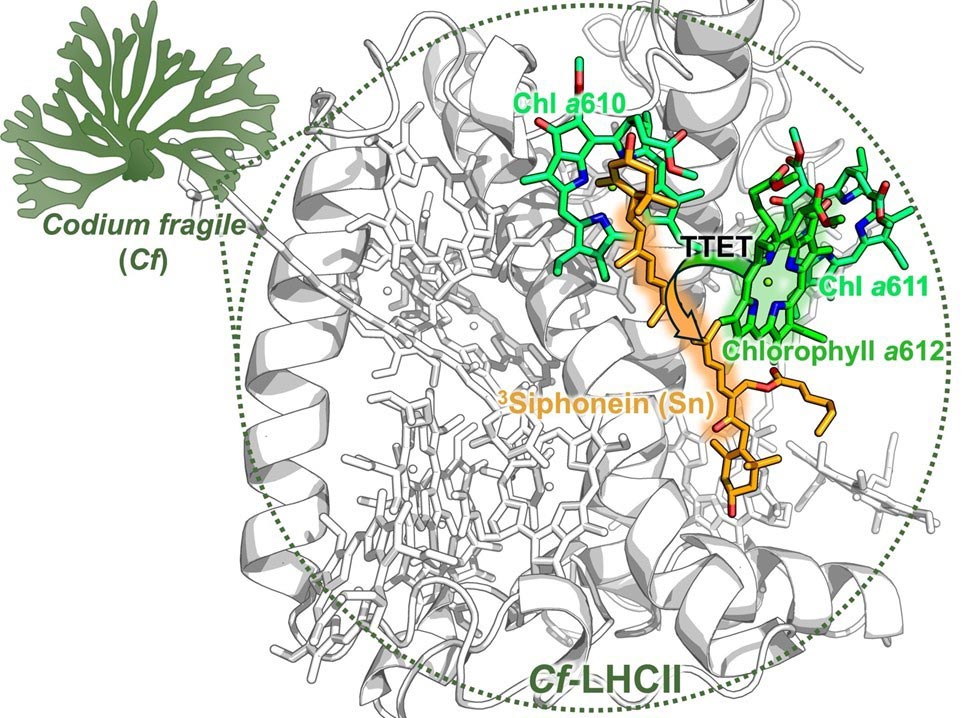
“Organisms use carotenoids to quickly dissipate excess energy, or quench these triplet states, through a process called triplet-triplet energy transfer (TTET),” said Ritsuko Fujii, lead author and associate professor at the Graduate School of Science and Research Center for Artificial Photosynthesis at Osaka Metropolitan University.
Despite its importance, the basic rules behind this protective process have remained unclear.
Why Scientists Turned to Marine Algae
To better understand how this protection works, the research team studied Codium fragile, a species of marine green algae. Like land plants, it has a light-harvesting antenna called LHCII, but it also contains unusual carotenoids, including siphonein and siphonaxanthin. These pigments allow the algae to make use of green light, which is more common underwater.
“The key to the quenching mechanism lies in how quickly and efficiently the triplet states can be deactivated,” said Alessandro Agostini, a researcher at the University of Padua in Italy and co-lead author of the study.
Measuring Algae’s Natural Sun Protection
The researchers used electron paramagnetic resonance (EPR) spectroscopy, a technique that can directly detect triplet excited states, to compare spinach plants with Codium fragile. In spinach, faint signals from chlorophyll triplet states were still present. In Codium fragile, those signals disappeared entirely. This showed that carotenoids in the algae were fully neutralizing the harmful states.
“Our research has revealed that the antenna structure of photosynthetic green algae has an excellent photoprotective function,” Agostini said.
Siphonein’s Role in Shielding Algae
By combining EPR results with quantum chemical simulations, the team identified siphonein as the main pigment responsible for this protection. The pigment sits at a crucial binding site within the LHCII complex. The analysis also explained how siphonein’s electronic structure and precise location make it especially effective at dispersing excess energy before it can cause damage.
These results show that marine algae have evolved specialized pigments not only to absorb the blue-green light available underwater but also to survive intense sunlight.
Implications for Future Solar Technology
Beyond shedding light on photosynthesis, the findings could help inspire bio-inspired solar technologies that include built-in protection against energy overload. Such designs could lead to renewable energy systems that are both more durable and more efficient.
“We hope to further clarify the structural characteristics of carotenoids that increase quenching efficiency, ultimately enabling the molecular design of pigments that optimize photosynthetic antennae,” Fujii said.
The study was published in Cell Reports Physical Science.
Reference: “Siphonein enables an effective photoprotective triplet-quenching mechanism in green algal light-harvesting complexes” by Alessandro Agostini, Soichiro Seki, Andrea Calcinoni, Lopa Paul, Agostino Migliore, Ritsuko Fujii and Donatella Carbonera, 1 October 2025, Cell Reports Physical Science.
DOI: 10.1016/j.xcrp.2025.102873
Never miss a breakthrough: Join the SciTechDaily newsletter.
Follow us on Google and Google News.
1 Comment
arakininite is a property of titanium. if you break down the force of fusion of the unstable or compounding of said photosynthesis it is probably that you could rewrite the therom of the solar panels to be stable with congruent power from sunlight. storing this is easier with said titanium alloys because it compounds and contracts the said fusion for electricity so when there is not plentiful sunlight the power level contained could keep said pattern serving the batteries long after nightfall.