
Close Menu
    Facebook X (Twitter) Instagram
    SciTechDaily
    • Biology
    • Chemistry
    • Earth
    • Health
    • Physics
    • Science
    • Space
    • Technology
    Facebook X (Twitter) Pinterest YouTube RSS
    SciTechDaily
    Home»Space»ALMA Uncovers How Ancient Quasars Silence Star Formation
    Space

    ALMA Uncovers How Ancient Quasars Silence Star Formation

    By Hokkaido UniversityFebruary 27, 2024No Comments4 Mins Read
    Facebook Twitter Pinterest Telegram LinkedIn WhatsApp Email Reddit
    Share
    Facebook Twitter LinkedIn Pinterest Telegram Email Reddit
    Astrophysics Quasar Gas Outflow Concept
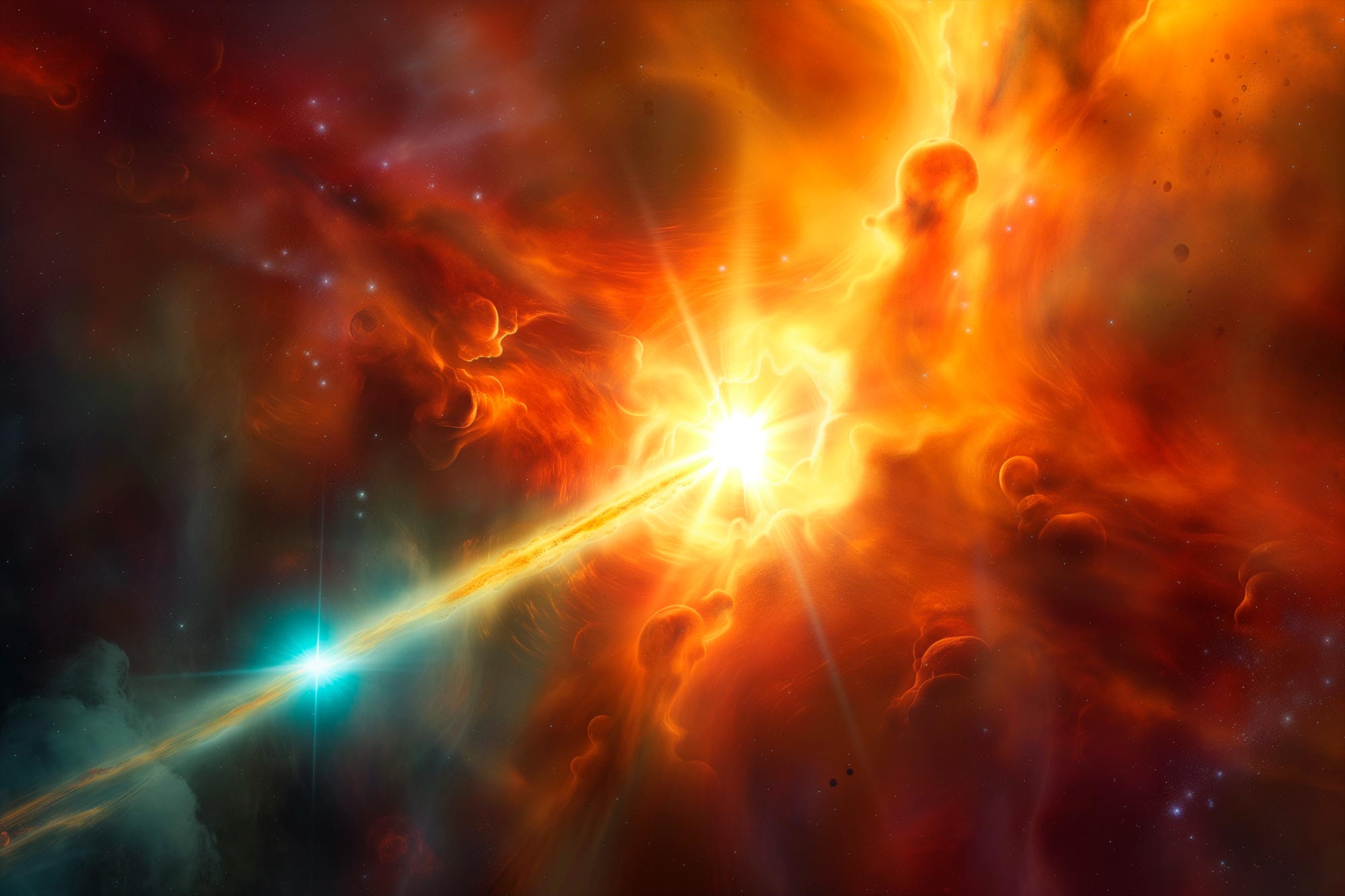
    Researchers have discovered evidence of suppressed star formation in a quasar-host galaxy, caused by the outflow of molecular gas. This finding marks a significant step in understanding galaxy evolution in the early Universe. Credit: SciTechDaily.com

    Theoretical predictions have been confirmed with the discovery of an outflow of molecular gas from a quasar when the Universe was less than a billion years old.

    A quasar is a compact region powered by a supermassive black hole located in the center of a massive galaxy. They are extremely luminous, with a point-like appearance similar to stars, and are extremely distant from Earth. Owing to their distance and brightness, they provide a peek into the conditions of the early Universe, when it was less than 1 billion years old.

    Breakthrough in Quasar Research

    A team of researchers led by Assistant Professor Dragan Salak at Hokkaido University, Assistant Professor Takuya Hashimoto at the University of Tsukuba, and Professor Akio Inoue at Waseda University, has discovered the first evidence of suppression of star formation driven by an outflow of molecular gas in a quasar-host galaxy in the early Universe. Their findings, based on observations they made using the Atacama Large Millimeter/submillimeter Array (ALMA), in Chile, were published in The Astrophysical Journal.
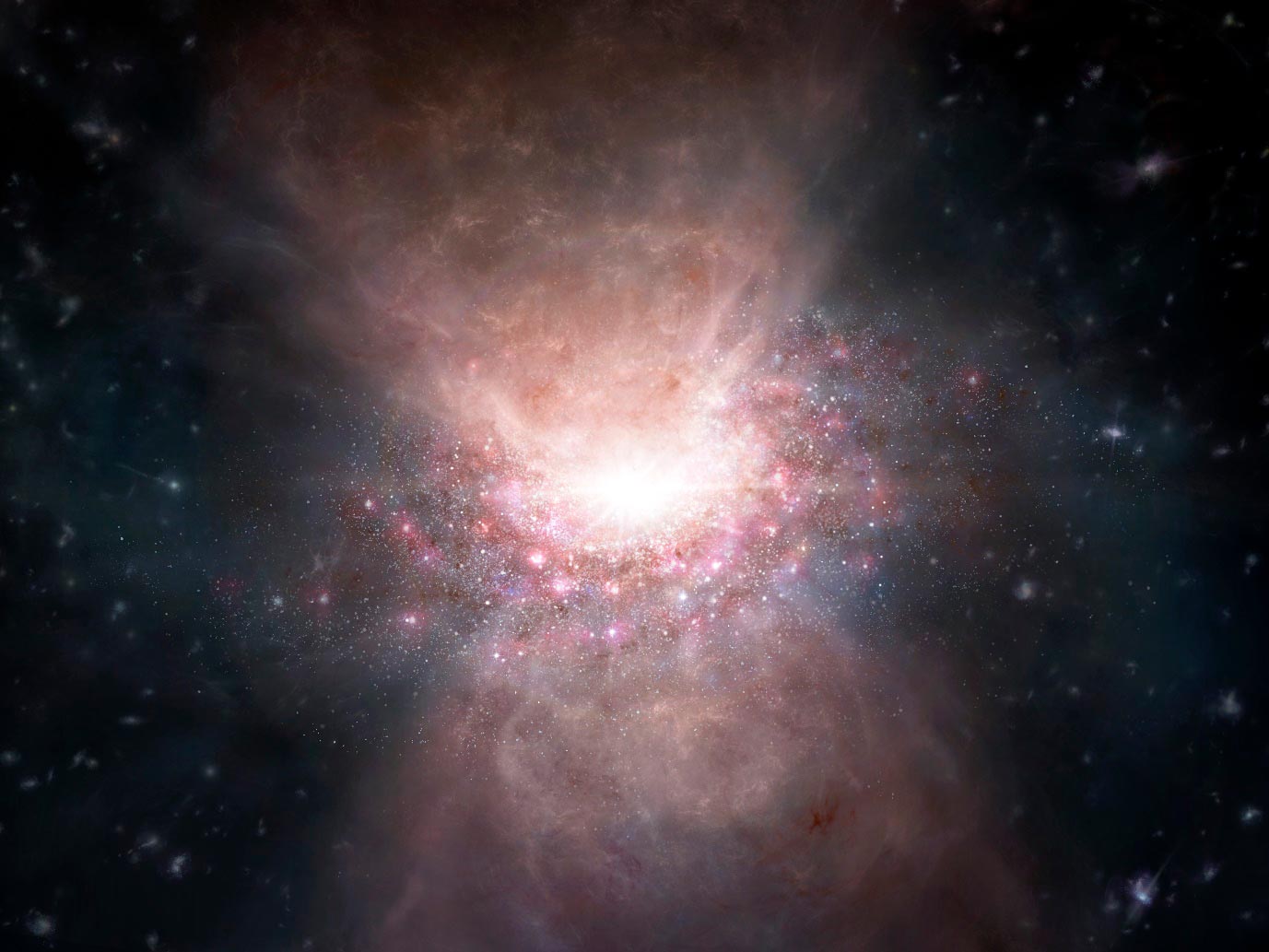
    Outflow Molecular Gas Quasar
    Artist’s impression of an outflow of molecular gas from the quasar J2054-0005. Credit: ALMA (ESO/NAOJ/NRAO)

    The Role of Molecular Gas in Galaxies

    Molecular gas is vital to the formation of stars. As the primary fuel of star formation, the ubiquity and high concentrations of molecular gas within a galaxy would lead to a vast number of stars being formed. By ejecting this gas into intergalactic space faster than it could be consumed by star formation, molecular outflows effectively suppress the formation of stars in galaxies that host quasars.

    “Theoretical work suggests that molecular gas outflows play an important role in the formation and evolution of galaxies from an early age, because they can regulate star formation,” Salak explains. “Quasars are especially energetic sources, so we expected that they may be able to generate powerful outflows.”
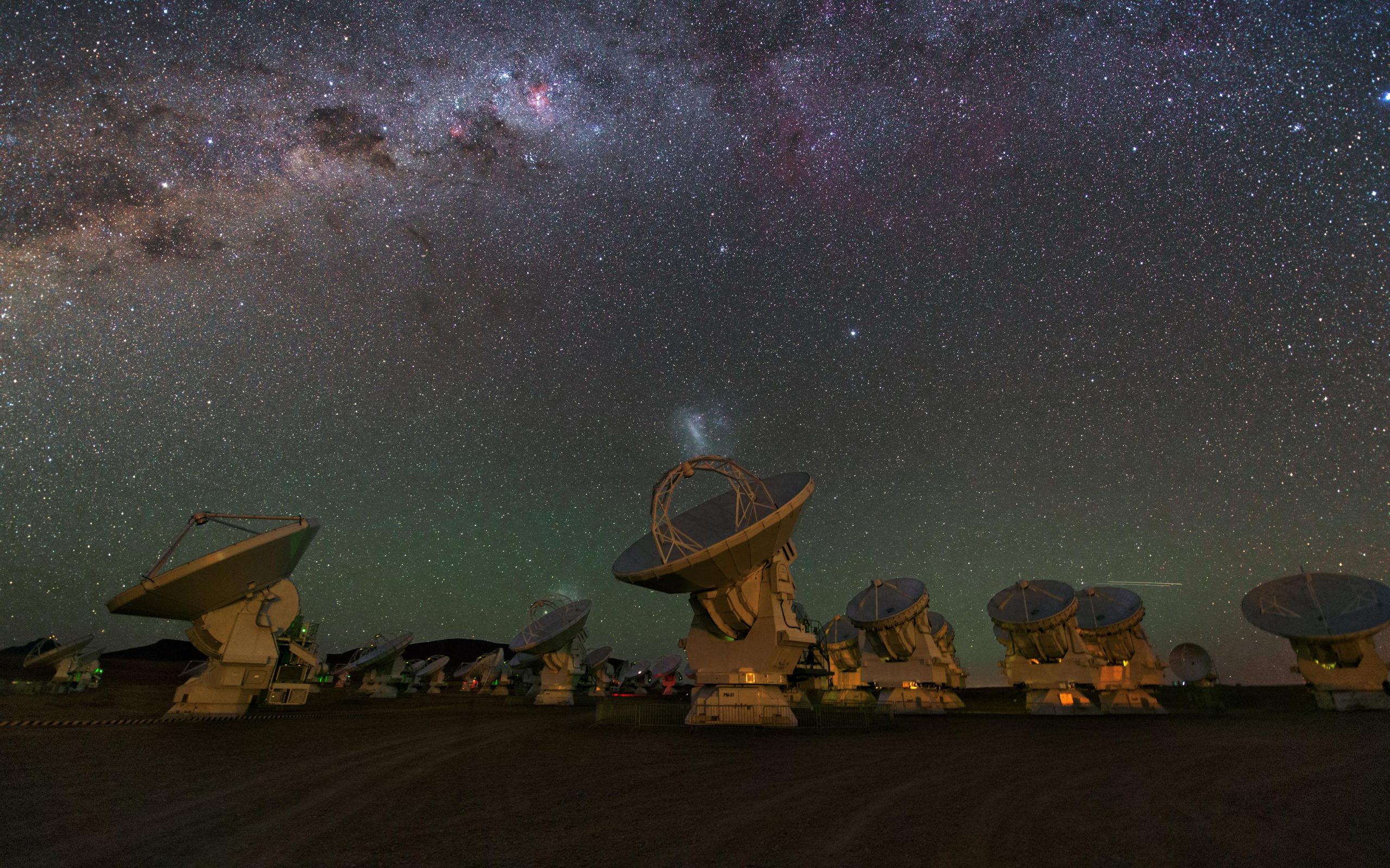
    A Group of ALMA 12-m Antennas Observing the Night Sky
    A group of ALMA 12-m antennas observing the night sky. Observations in this study were made using the 12-m antennas. Credit: ESO/Y. Beletsky

    Discovering Molecular Gas Outflows

    The quasar the researchers observed, J2054-0005, has a very high redshift—it and the Earth are apparently moving away from each other very fast. “J2054-0005 is one of the brightest quasars in the distant Universe, so we decided to target this object as an excellent candidate to study powerful outflows,” Hashimoto says. The researchers used ALMA to observe the outflow of molecular gas from the quasar. As the only telescope in the world that has the sensitivity and frequency coverage to detect molecular gas outflows in the early Universe, ALMA was key to this study.

    Speaking about the method used in the study, Salak comments: “The outflowing molecular (OH) gas was discovered in absorption. This means we did not observe microwave radiation coming directly from the OH molecules; instead, we observed the radiation coming from the bright quasar—and absorption means that OH molecules happened to absorb a part of the radiation from the quasar. So, it was like revealing the presence of a gas by seeing the ‘shadow’ it cast in front of the light source.”
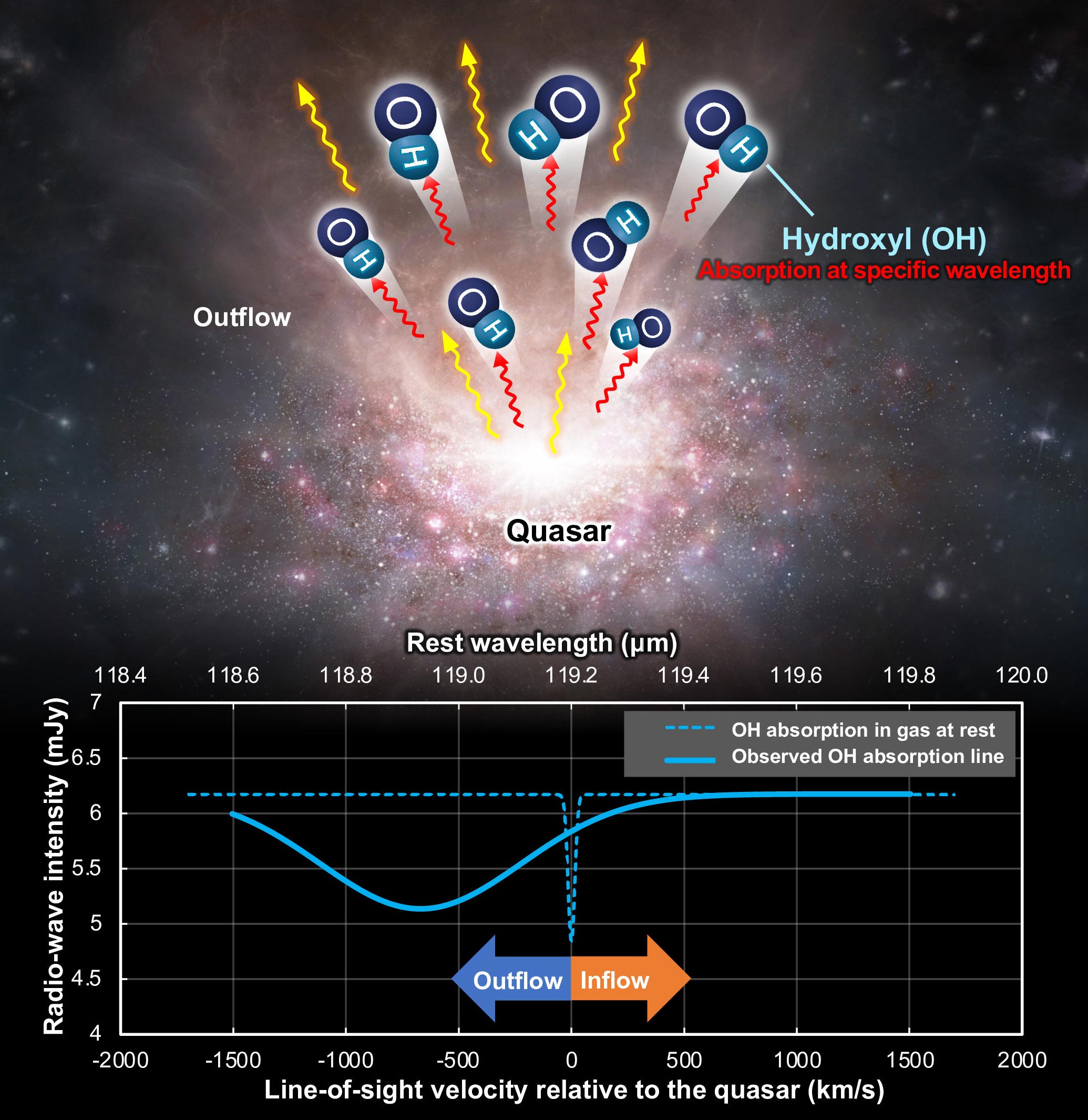
    Redshift of OH Absorption Spectrum in Molecular Gas Outflow
    The molecular gas outflow from the quasar includes hydroxyl (OH) (top). Due to the motion of the molecular gas toward the observer, the OH peak in the absorption spectrum (bottom, dashed blue line) appears at a shorter wavelength (solid blue line), a phenomenon known as the Doppler effect. Credit: ALMA (ESO/NAOJ/NRAO) modified from Dragan Salak, et al. The Astrophysical Journal. February 1, 2024

    Implications for Galaxy Evolution

    The findings from this study are the first strong evidence that powerful molecular gas outflows from quasar-host galaxies exist and impact galaxy evolution at the early cosmic age. “Molecular gas is a very important constituent of galaxies because it is the fuel for star formation,” Salak concludes. “Our findings show that quasars are capable of suppressing star formation in their host galaxies by ejecting molecular gas into intergalactic space.”

    Reference: “Molecular Outflow in the Reionization-epoch Quasar J2054-0005 Revealed by OH 119 μm Observations” by Dragan Salak, Takuya Hashimoto, Akio K. Inoue, Tom J. L. C. Bakx, Darko Donevski, Yoichi Tamura, Yuma Sugahara, Nario Kuno, Yusuke Miyamoto, Seiji Fujimoto and Suphakorn Suphapolthaworn, 1 February 2024, The Astrophysical Journal.
    DOI: 10.3847/1538-4357/ad0df5

    Never miss a breakthrough: Join the SciTechDaily newsletter.
    Follow us on Google and Google News.

    ALMA Astronomy Astrophysics Hokkaido University Popular Quasars
    Share. Facebook Twitter Pinterest LinkedIn Email Reddit

    Related Articles

    Cosmic Cloak & Dagger: Quasars Shrouded by Starburst Galaxies

    Observations of Molecular Gas in a Tidal Dwarf Galaxy Sheds Light on How Stars Form

    Distant Colliding Galaxy Dying Out As It Loses the Ability to Form Stars – Ejecting 10,000 Suns-Worth of Gas a Year

    Purported Phosphine – An Indicator of Life – On Venus More Likely to Be Ordinary Sulfur Dioxide

    Astronomers Discover Earliest Supermassive Black Hole and Quasar in the Universe – 1000x More Luminous Than the Milky Way

    Most Distant Quasar Discovered Sheds Light on How Supermassive Black Holes Grow

    Research Shows NASA’s James Webb Space Telescope Will Reveal Hidden Galaxies

    NASA Discovers “Very Weird” Molecule in Titan’s Atmosphere

    Astronomers Find Extreme Galaxy With Intense Ultraviolet Luminosity Comparable to a Quasar

    Leave A Reply Cancel Reply

    • Facebook
    • Twitter
    • Pinterest
    • YouTube

    Don't Miss a Discovery

    Subscribe for the Latest in Science & Tech!

    Trending News

    Scientists Uncover Potential Brain Risks of Popular Fish Oil Supplements

    Scientists Discover a Surprising Way To Make Bread Healthier and More Nutritious

    After 60 Years, Scientists Uncover Unexpected Brain Effects of Popular Diabetes Drug Metformin

    New Research Uncovers Hidden Side Effects of Popular Weight-Loss Drugs

    Scientists Rethink Extreme Warming After Surprising Ocean Discovery

    Landmark Study Links Never Marrying to Significantly Higher Cancer Risk

    Researchers Discover Unknown Beetle Species Just Steps From Their Lab

    Largest-Ever Study Finds Medicinal Cannabis Ineffective for Anxiety, Depression, PTSD

    Follow SciTechDaily
    • Facebook
    • Twitter
    • YouTube
    • Pinterest
    • Newsletter
    • RSS
    SciTech News
    • Biology News
    • Chemistry News
    • Earth News
    • Health News
    • Physics News
    • Science News
    • Space News
    • Technology News
    Recent Posts
    • Scientists Discover Hidden Pathway Inside Catalysts That Defies Decades of Assumptions
    • Scientists Finally Crack Decades-Old Mystery of “Breathing” Lasers
    • “Like Liquid Metal”: Scientists Create Strange Shape-Shifting Material
    • Early Warning Signals of Esophageal Cancer May Be Hiding in Plain Sight
    • Researchers Have Discovered a THC-Free Cannabis Compound That May Replace Opioids
    Copyright © 1998 - 2026 SciTechDaily. All Rights Reserved.
    • Science News
    • About
    • Contact
    • Editorial Board
    • Privacy Policy
    • Terms of Use

    Type above and press Enter to search. Press Esc to cancel.