
A clinical trial suggests that ropinirole, a Parkinson’s drug, may slow ALS progression by nearly seven months. Patients’ lab-grown motor neurons mirrored clinical responses, offering potential for personalized treatment.
Amyotrophic lateral sclerosis (ALS), also known as Lou Gehrig’s disease is a lethal neurological disorder that progressively results in individuals losing muscle control. Currently, there is no cure, and the primary focus of treatments is to alleviate symptoms and offer supportive care. Early clinical trial findings recently published in the journal Cell Stem Cell, demonstrated that the drug ropinirole, typically used for Parkinson’s disease, is safe for ALS patients and delayed the progression of the disease by an average of 27.9 weeks.
Some patients showed a greater response to the ropinirole treatment than others. Interestingly, the scientists were able to forecast this clinical responsiveness in a lab setting, by utilizing motor neurons derived from the stem cells of the patients.
“ALS is totally incurable, and it’s a very difficult disease to treat,” says senior author and physiologist Hideyuki Okano of the Keio University School of Medicine in Tokyo. “We previously identified ropinirole as a potential anti-ALS drug in vitro by iPSC drug discovery, and with this trial, we have shown that it is safe to use in ALS patients and that it potentially has some therapeutic effect, but to confirm its effectiveness we need more studies, and we are now planning a phase 3 trial for the near future.”
To test ropinirole’s safety and effectiveness in patients with sporadic (i.e., non-familial) ALS, the team recruited 20 patients receiving care at Keio University Hospital in Japan. None of the patients carried genes predisposing to the disease, and, on average, they had been living with ALS for 20 months.
The trial was double-blinded for the first 24 weeks, meaning that the patients and doctors did not know which patients were receiving ropinirole and which were receiving a placebo. Then, for the following 24 weeks, all patients who wished to continue were knowingly administered ropinirole. Many patients dropped out along the way—partially due to the COVID-19 pandemic—so only 7/13 ropinirole-treated and 1/7 placebo-followed-by-ropinirole-treated patients were monitored for the full year. However, no patients dropped out due to safety reasons.
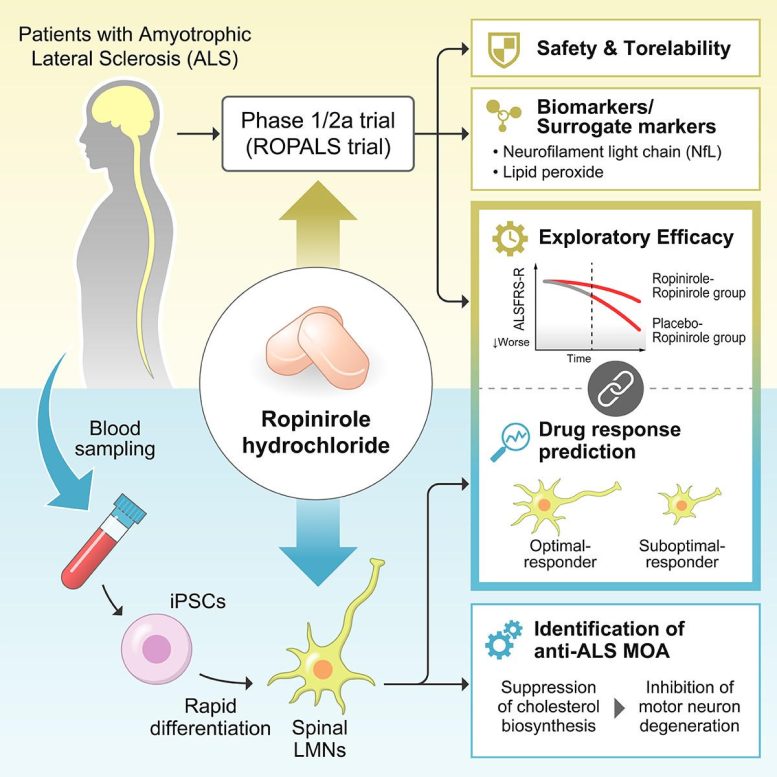
To determine whether the drug was effective at slowing the progression of ALS, the team monitored a variety of different measures throughout the trial and for 4 weeks after treatment concluded. These included changes in the patients’ self-reported physical activity and ability to eat and drink independently, activity data from wearable devices, and physician-measured changes in mobility, muscle strength, and lung function.
“We found that ropinirole is safe and tolerable for ALS patients and shows therapeutic promise at helping them sustain daily activity and muscle strength,” says first author Satoru Morimoto, a neurologist at the Keio University School of Medicine in Tokyo.
Patients who received ropinirole during both phases of the trial were more physically active than patients in the placebo group. They also showed slower rates of decline in mobility, muscle strength, and lung function, and they were more likely to survive.
The benefits of ropinirole relative to the placebo became increasingly pronounced as the trial progressed. However, placebo group patients who began taking ropinirole halfway through the trial did not experience these improvements, which suggests that ropinirole treatment may only be useful if treatment is started earlier and administered over a longer duration.
Key Mechanisms Behind Ropinirole’s Effects
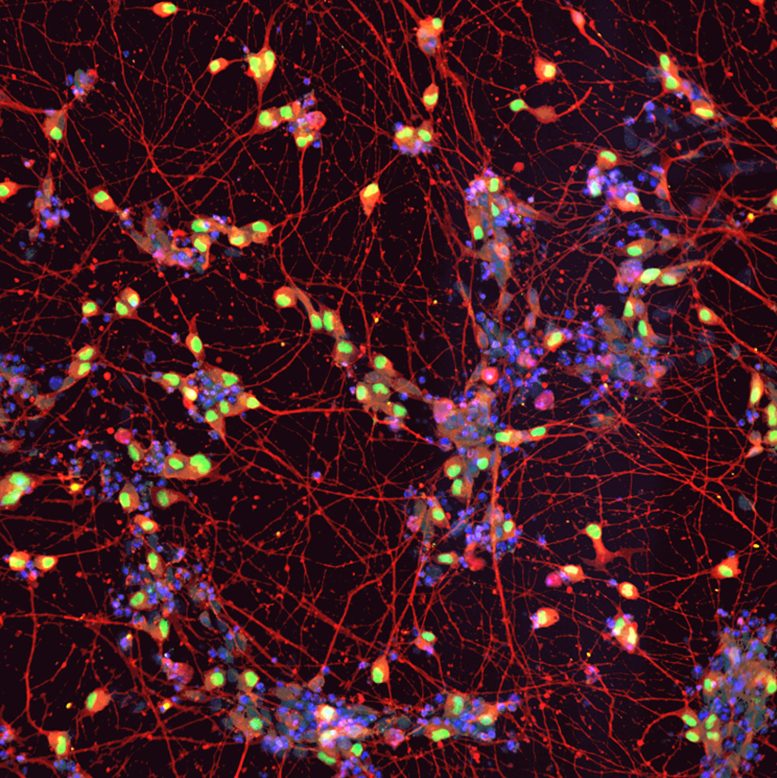
Next, the researchers investigated the mechanisms behind ropinirole’s effects and looked for molecular markers of the disease. To do this, they generated induced pluripotent stem cells from the patients’ blood and grew these cells into motor neurons in the lab. Compared to healthy motor neurons, they found that motor neurons from ALS patients showed distinct differences in structure, gene expression, and metabolite concentrations, but ropinirole treatment reduced these differences.
Specifically, motor neurons grown from ALS patients had shorter neurites compared to healthy motor neurons, but these axons grew to a more normal length when the cells were treated with ropinirole. The team also identified 29 genes related to cholesterol synthesis that tended to be upregulated in motor neurons from ALS patients, but ropinirole treatment suppressed their gene expressions over time. They also identified lipid peroxide as a good surrogate marker for estimating the effect of ropinirole both in vitro and clinically.
“We found a very striking correlation between a patient’s clinical response and the response of their motor neurons in vitro,” says Morimoto. “Patients whose motor neurons responded robustly to ropinirole in vitro had a much slower clinical disease progression with ropinirole treatment, while suboptimal responders showed much more rapid disease progression despite taking ropinirole.”
The researchers say that this suggests that this method—of growing and testing motor neurons from patient-derived induced pluripotent stem cells—could be used clinically to predict how effective the drug would be for a given patient. It’s unclear why some patients are more responsive to ropinirole than others, but the researchers think that it’s probably due to genetic differences that they hope to pinpoint in future studies.
Reference: “Phase 1/2a clinical trial in ALS with ropinirole, a drug candidate identified by iPSC drug discovery” by Satoru Morimoto, Shinichi Takahashi, Daisuke Ito, Yugaku Daté, Kensuke Okada, Chris Kato, Shiho Nakamura, Fumiko Ozawa, Chai Muh Chyi, Ayumi Nishiyama, Naoki Suzuki, Koki Fujimori, Tosho Kondo, Masaki Takao, Miwa Hirai, Yasuaki Kabe, Makoto Suematsu, Masahiro Jinzaki, Masashi Aoki, Yuto Fujiki and Hideyuki Okano, 1 June 2023, Cell Stem Cell.
DOI: 10.1016/j.stem.2023.04.017
This research was supported by funding from the Japan Agency for Medical Research and Development (AMED), the Japan Society for the Promotion of Science (JSPS), the Uehara Memorial Foundation, the Yukihiko Miyata Memorial Trust for ALS Research, the Okasan-Kato Foundation Research Grant, the Yoshio Koide Grant, the Japan ALS Association, the Japanese Ministry of Health Labor and Welfare (MHLW), the National Centre of Neurology and Psychiatry, the Japanese Ministry of Education, Culture, Sports, Science and Technology (MEXT), and K Pharma. The study drug was supplied by GlaxoSmithKline.
Never miss a breakthrough: Join the SciTechDaily newsletter.
Follow us on Google and Google News.