
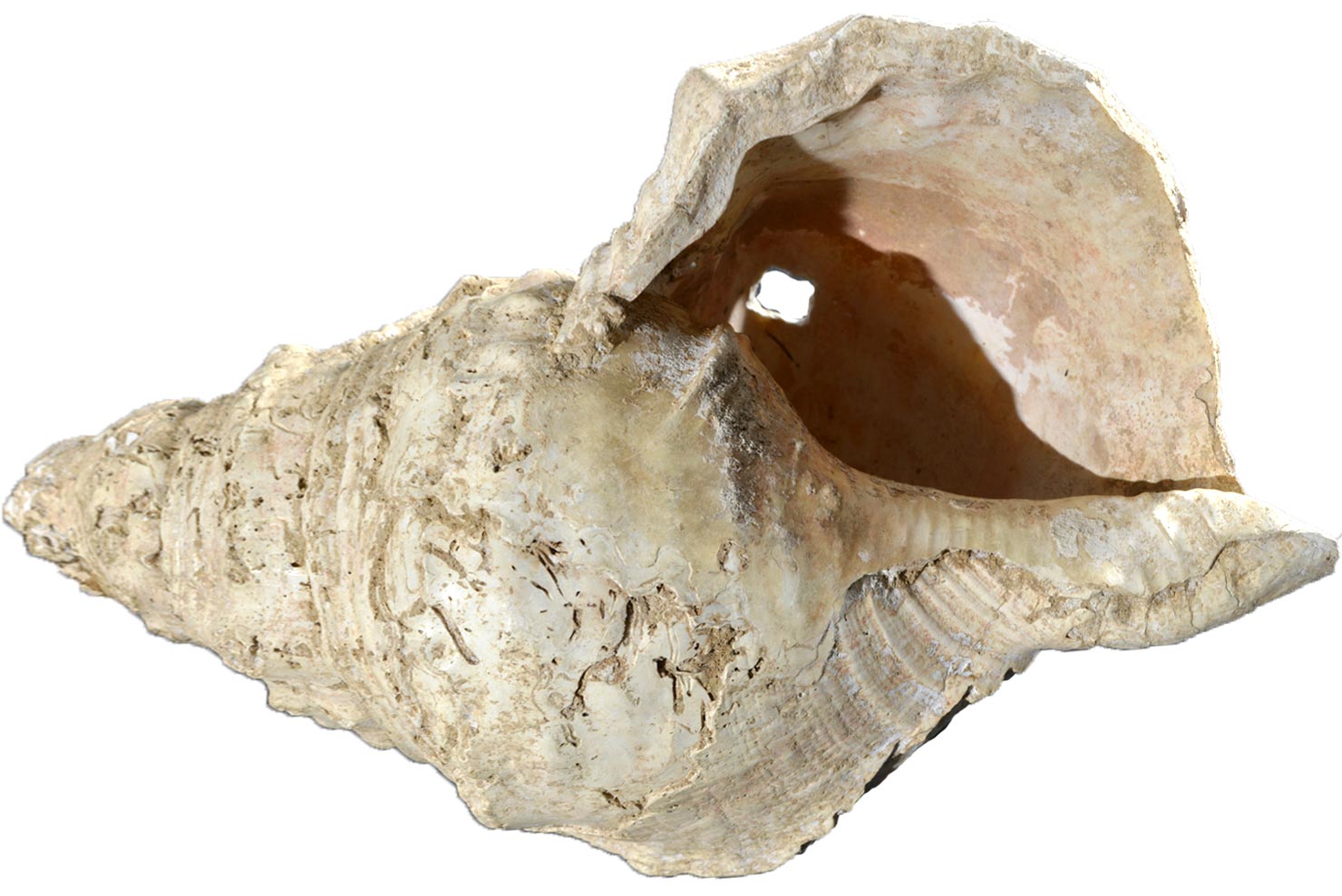
A decorated conch shell from the Marsoulas Cave has been confirmed as the oldest known wind instrument of its kind, dating back around 18,000 years.
Almost 80 years after its discovery, a large shell from the ornate Marsoulas Cave in the Pyrenees has been studied by a multidisciplinary team from the CNRS, the Muséum de Toulouse, the Université Toulouse – Jean Jaurès and the Musée du quai Branly – Jacques-Chirac[1]: it is believed to be the oldest wind instrument of its type. Scientists reveal how it sounds in a study published in the journal Science Advances on February 10th, 2021.
The Marsoulas Cave, between Haute-Garonne and Ariège, was the first decorated cave to be found in the Pyrenees. Discovered in 1897, the cave bears witness to the beginning of the Magdalenian[2] culture in this region, at the end of the Last Glacial Maximum. During an inventory of the material from the archaeological excavations, most of which is kept in the Muséum de Toulouse, scientists examined a large Charonia lampas (sea snail) shell, which had been largely overlooked when discovered in 1931.
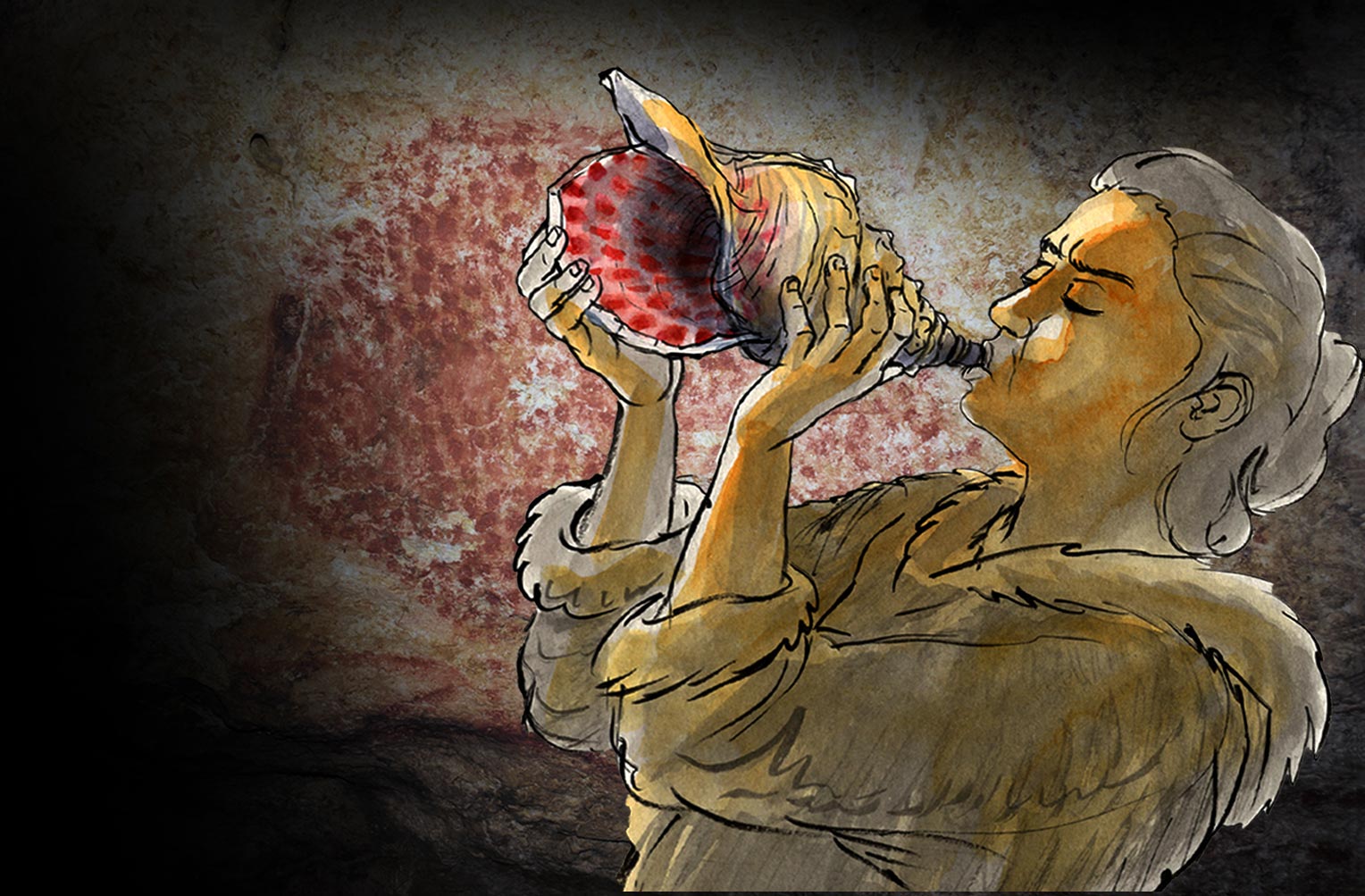
Clues in the Shell’s Structure and Decoration
The tip of the shell is broken, forming a 3.5 cm (1.4 in) diameter opening. As this is the hardest part of the shell, the break is clearly not accidental. At the opposite end, the shell opening shows traces of retouching (cutting) and a tomography scan has revealed that one of the first coils is perforated. Finally, the shell has been decorated with a red pigment (hematite), characteristic of the Marsoulas Cave, which indicates its status as a symbolic object.
To confirm the hypothesis that this conch was used to produce sounds, scientists enlisted the help of a horn player, who managed to produce three sounds close to the notes C, C-sharp, and D. As the opening was irregular and covered with an organic coating[3], the researchers assume that a mouthpiece was also attached, as is the case for more recent conches in collection of the Musée du quai Branly – Jacques Chirac. 3D impressions of the conch will enable this lead to be explored and verify whether it can be used to produce other notes.
Listen to the sound of the Marsoulas conch, as it may have been played 18,000 years ago. Credit: © Carole Fritz et al. 2021 / playing: Jean-Michel Court / recording: Julien Tardieu
A Musical Legacy From 18,000 Years Ago
The first carbon-14 dating of the cave, carried out on a piece of charcoal and a fragment of bear bone from the same archaeological level as the shell, provided a date of around 18,000 years. This makes the Marsoulas conch the oldest wind instrument of its type: to date, only flutes have been discovered in earlier European Upper Palaeolithic contexts; the conches found outside Europe are much more recent.
In addition to immersing us in the sounds produced by our Magdalenian ancestors, this shell reinforces the idea of exchanges between the Pyrenees and the Atlantic coast, more than 200 kilometers (125 miles)away.
Notes
- The laboratories involved are the Travaux et recherches archéologiques sur les cultures, les espaces et les sociétés (CNRS/Université Toulouse – Jean Jaurès/Ministère de la Culture), the Maison des sciences de l’homme et de la société de Toulouse (CNRS/Université Fédérale de Toulouse) and the Laboratoire d’archéologie moléculaire et structurale (CNRS/Sorbonne Université).
- Covering a period between around 21,000 and 14,000 years BP, it is characterized by worked animal bones and antlers and extensive exchange networks. The Altamira and Lascaux caves are the most famous examples.
- As the quantity is limited, analyses have not been able to identify its nature.
Reference: “First record of the sound produced by the oldest Upper Paleolithic seashell horn” by C. Fritz, G. Tosello, G. Fleury, E. Kasarhérou, Ph. Walter, F. Duranthon, P. Gaillard and J. Tardieu, 10 February 2021, Science Advances.
DOI: 10.1126/sciadv.abe9510
Never miss a breakthrough: Join the SciTechDaily newsletter.
Follow us on Google and Google News.