
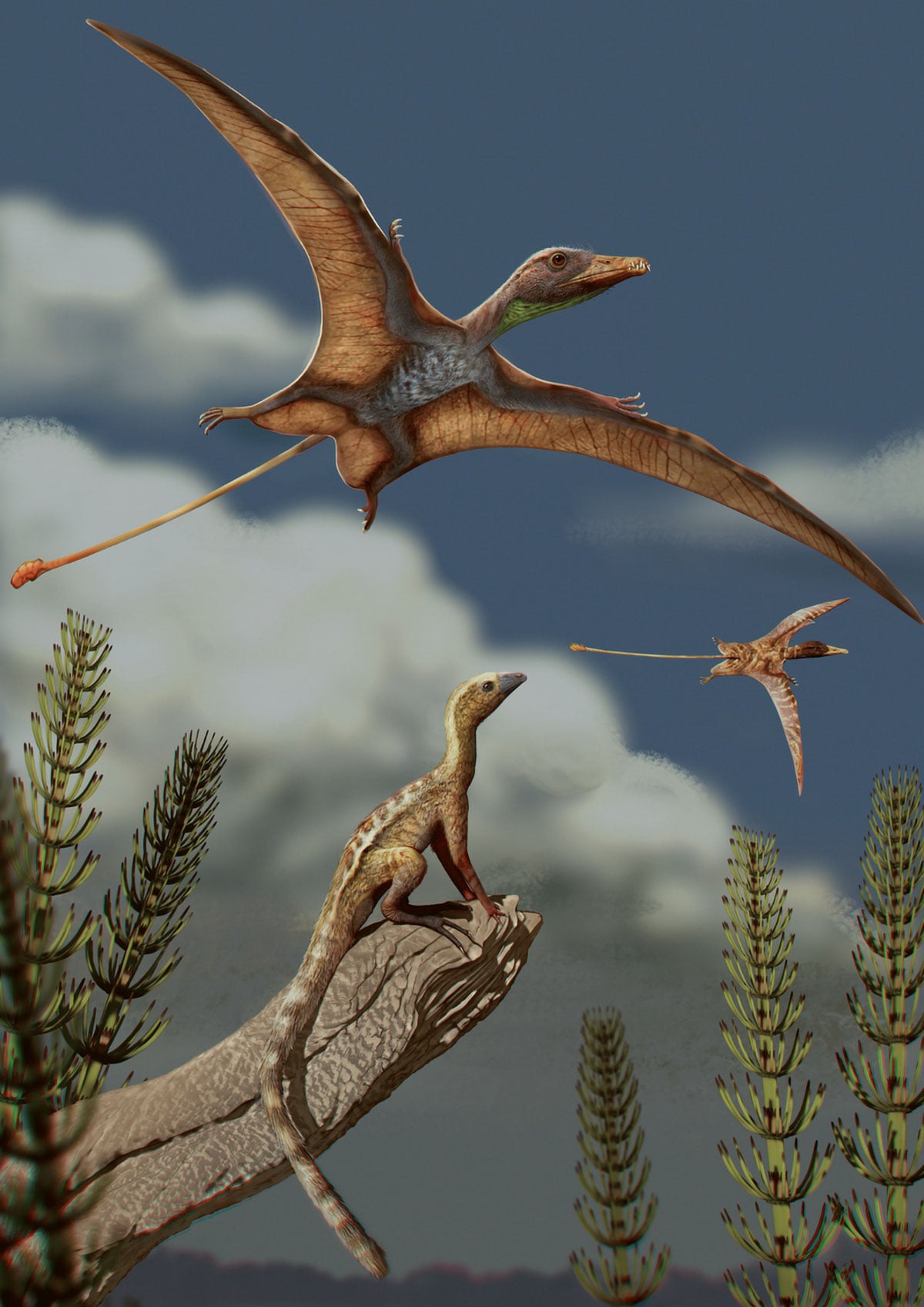
A new study using advanced fossil imaging reveals that ancient pterosaurs may have mastered flight almost instantly when they first appeared, without the large brains that supported flight in birds.
A team of researchers examining ancient fossils, led by an evolutionary biologist at Johns Hopkins Medicine, reports that a lineage of large reptiles living as far back as 220 million years ago may have gained the ability to fly right at the start of their existence. This idea contrasts with what is known about the early relatives of modern birds, which appear to have adopted flight gradually and with the support of larger brains.
Details of the work, which relied on advanced imaging methods to examine the brain cavities of pterosaur fossils and received partial support from the National Science Foundation, were published in Current Biology.
According to Matteo Fabbri, Ph.D., assistant professor of functional anatomy and evolution at the Johns Hopkins University School of Medicine, the results strengthen the view that the enlarged brains present in today’s birds, and assumed to exist in their prehistoric predecessors, were not responsible for enabling pterosaurs to fly.
“Our study shows that pterosaurs evolved flight early on in their existence and that they did so with a smaller brain similar to true non-flying dinosaurs,” Fabbri says.
Fabbri adds that pterosaurs were powerful fliers of the dinosaur era. Some species reached weights of up to 500 pounds and spanned as much as 30 feet from wingtip to wingtip. They are recognized as the earliest of the three major groups of flying vertebrates (in addition to birds and bats) that developed powered flight independently.
Tracing the Origins of Pterosaur Flight
To investigate whether pterosaurs came to fly in a different way than birds and bats, the scientists reconstructed the reptile’s evolutionary history and tracked how pterosaur brain shape and size changed over time. They paid special attention to the optic lobe, the part of the brain responsible for vision, whose expansion is thought to be linked to the development of flying abilities.
Using CT scans and imaging software that allowed the scientists to extract information about the nervous systems of fossils, the researchers honed in on the pterosaur’s closest relative initially described by a team of researchers in 2016, the flightless, tree-dwelling lagerpetid that originated during the Triassic period 242 to 212 million years ago. In 2020, another group of scientists characterized the lagerpetid’s close relation to the pterosaur.
“The lagerpetid’s brain already showed features linked to improved vision, including an enlarged optic lobe, an adaptation that may have later helped their pterosaur relatives take to the skies,” says corresponding author Mario Bronzati, a researcher at University of Tübingen, Germany.
A Rapid Evolutionary Leap
A larger optic lobe was also present in pterosaurs, Fabbri says. However, he says there were otherwise very few similarities in the shape and size of pterosaur brains and that of the flying reptile’s closest relative, the lagerpetid.
“The few similarities suggest that flying pterosaurs, which appeared very soon after the lagerpetid, likely acquired flight in a burst at their origin,” Fabbri says. “Essentially, pterosaur brains quickly transformed acquiring all they needed to take flight from the beginning.”
By contrast, modern birds are believed to have acquired flight in a step-by-step, more gradual process, inheriting certain features, such as an enlarged cerebrum, cerebellum, and optic lobes from their prehistoric relatives, and later adapting them to enable flight, says Fabbri. This theory is supported by 2024 findings from the lab of Amy Balanoff, Ph.D., assistant professor of functional anatomy and evolution at Johns Hopkins Medicine, that point to the expansion of the brain’s cerebellum as a key to bird flight. The cerebellum, located at the back of the brain, regulates and controls muscle movement among other activities.
“Any information that can fill in the gaps of what we don’t know about dinosaur and bird brains is important in understanding flight and neurosensory evolution within pterosaur and bird lineages,” Balanoff says.
Comparisons With Birds and Crocodilian Ancestors
In further studies, the scientists analyzed brain cavities of fossils from crococdylians (crocodile ancestors) and early, extinct birds, and compared these with pterosaur brain cavities.
They determined that the pterosaur’s brain had moderately enlarged hemispheres, similar in size to other dinosaurs—including two-legged bird-like troodontids living during the Late Jurassic to the Late Cretaceous periods 163 to 66 million years ago, and the oldest-known bird, Archaeopteryx lithographica from 150.8 million to 125.45 million years ago—compared with the brain cavities of modern birds.
In the future, Fabbri says that better understanding how the structure of the pterosaur brain, in addition to the size and shape, enabled flight will be the most important step to better infer the basic biological laws of flight.
Reference: “Neuroanatomical convergence between pterosaurs and non-avian paravians in the evolution of flight” by Mario Bronzati, Akinobu Watanabe, Roger B.J. Benson, Rodrigo T. Müller, Lawrence M. Witmer, Martín D. Ezcurra, Felipe C. Montefeltro, M. Belén von Baczko, Bhart-Anjan S. Bhullar, Julia B. Desojo, Fabien Knoll, Max C. Langer, Stephan Lautenschlager, Michelle R. Stocker, Alan H. Turner, Ingmar Werneburg, Sterling J. Nesbitt and Matteo Fabbri, 26 November 2025, Current Biology.
DOI: 10.1016/j.cub.2025.10.086
Funding support for this research was provided by the Alexander von Humboldt Foundation, Brazilian Federal Government, The Paleontological Society, Agencia Nacional de Promoción Científica y Técnica, Conselho Nacional de Desenvolvimento Científico e Tecnológico, the European Union NextGeneration EU/PRTR, the National Science Foundation ( NSF DEB 1754596, NSF IOB-0517257, IOS-1050154, IOS-1456503), and the Swedish Research Council
Never miss a breakthrough: Join the SciTechDaily newsletter.
Follow us on Google and Google News.