
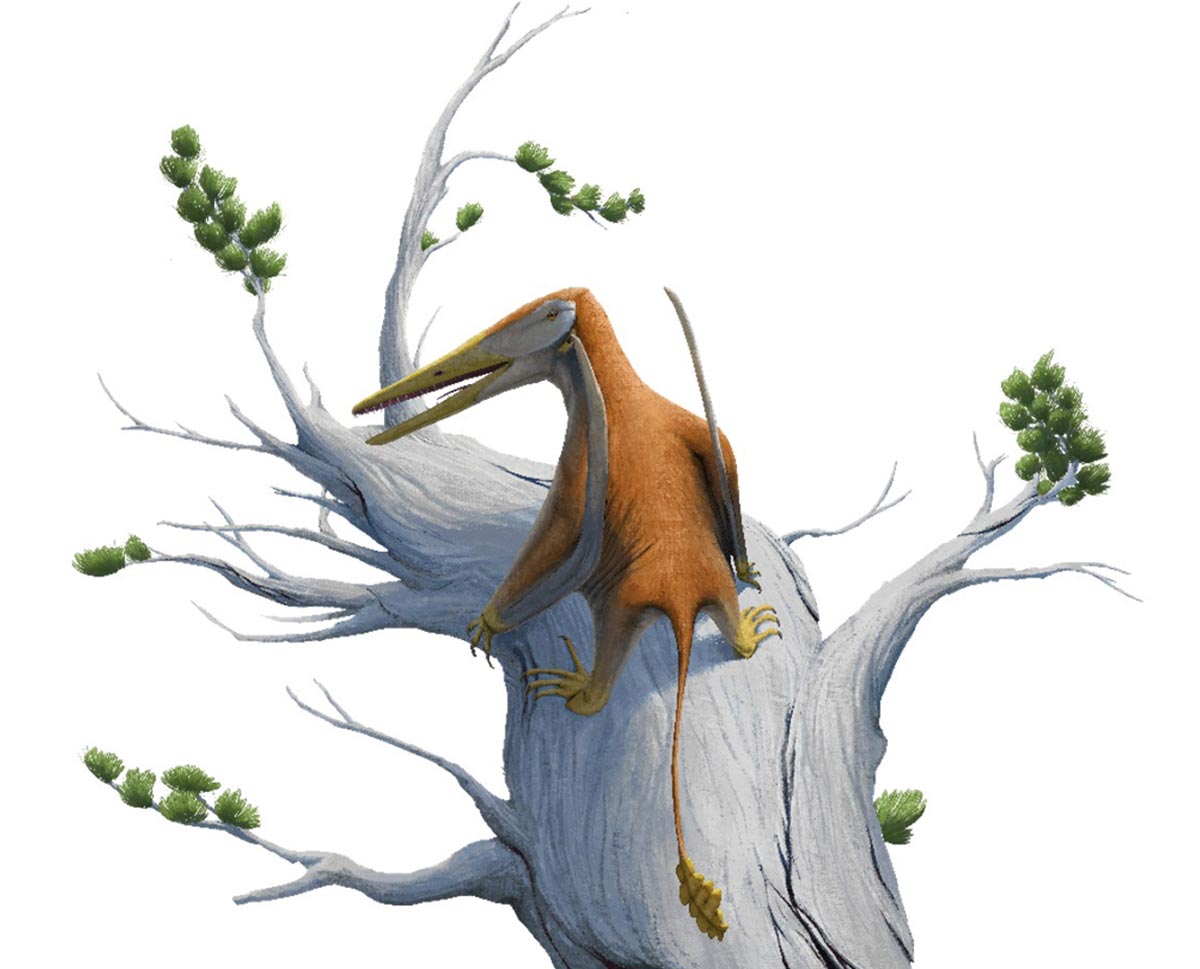
Pterosaurs evolved active flight over 230 million years ago. The discovery of Melkamter pateko in Argentina suggests pterodactyloids originated earlier and in inland habitats, feeding on insects. This finding expands our understanding of pterosaur evolution, especially in the Southern Hemisphere.
About 230 million years ago, roughly 80 million years before the first birds appeared, their distant relatives—the pterosaurs—took to the skies as the first vertebrates capable of active flight. These early fliers achieved powered, flapping flight using a wing membrane supported primarily by an exceptionally elongated fourth finger of the hand.
Over time, pterosaurs refined their flight capabilities through evolution. Early species typically had short wings and long tails. However, a more advanced group known as pterodactyloids developed slender, elongated wings and shorter tails, enhancing their aerial efficiency. This group included all Cretaceous pterosaurs and produced some of the largest flying creatures in history, such as Quetzalcoatlus, which boasted wingspans exceeding 12 meters.

Location of Melkamter pateko (right) in the Argentine province of Chubut. Credit: Oliver RauhutThe transition from early pterosaurs to the more advanced pterodactyloids occurred during the Jurassic period, with the first members of this group appearing in the fossil record around 160 million years ago in the Late Jurassic. However, our understanding of pterosaur evolution during this time is largely based on fossils from the Northern Hemisphere, as remains from the southern continents are extremely scarce.
Discovery of Melkamter pateko
Alexandra Fernandes and Prof. Oliver Rauhut of the Bavarian State Collection for Paleontology and Geology (SNSB – Bayerische Staatssammlung für Paläontologie and Geologie) have now introduced a new species of pterosaur from the late Early Jurassic (some 178 million years ago) of Chubut province, Argentina. The new species, named Melkamter pateko, shows several characteristics of advanced pterodactyloids – but is around 15 million years older than its next-oldest known relative. Apparently, the origin of this group of pterosaurs reaches much further back in time than currently recognized.
The location of Melkamter‘s find is also remarkable. The new species comes from an inland setting – apparently this pterosaur lived far from the nearest seacoast. Most known Jurassic pterosaurs come from marine environments and obviously lived close to the sea and probably mainly fed on fish and other marine organisms. In contrast, Melkamter probably mainly fed on insects. This occurrence in inland environments and preference for non-aquatic prey supports recent suggestions that pterodactyloids might have originated in such environments.
“It is possible that an early specialization in highly mobile prey such as flying insects contributed to the evolutionary success of pterodactyloids. This find highlights not only how little we still know about the pterosaurs of the Southern Hemisphere, but also the potential that the southern continents have to improve our understanding of pterosaur evolution,” explains Alexandra Fernandes, a researcher at the Bavarian State Collection for Paleontology and Geology and first author of the study.
Reference: “The oldest monofenestratan pterosaur from the Queso Rallado locality (Cañadón Asfalto Formation, Toarcian) of Chubut Province, Patagonia, Argentina” by Alexandra E. Fernandes, Diego Pol and Oliver W. M. Rauhut, 30 November 2024, Royal Society Open Science.
DOI: 10.1098/rsos.241238
Never miss a breakthrough: Join the SciTechDaily newsletter.
Follow us on Google and Google News.