
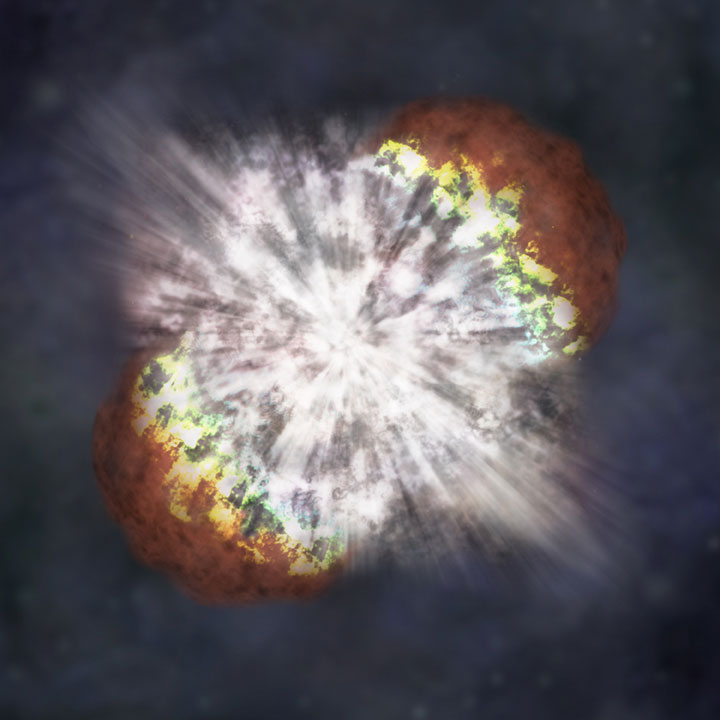
Did ancient supernovae induce proto-humans to walk on two legs, eventually resulting in homo sapiens with hands free to build cathedrals, design rockets, and snap iPhone selfies?
A paper published today in the Journal of Geology makes the case: Supernovae bombarded Earth with cosmic energy starting as many as 8 million years ago, with a peak some 2.6 million years ago, initiating an avalanche of electrons in the lower atmosphere and setting off a chain of events that feasibly ended with bipedal hominins such as homo habilis, dubbed “handy man.”
The authors believe atmospheric ionization probably triggered an enormous upsurge in cloud-to-ground lightning strikes that ignited forest fires around the globe. These infernos could be one reason ancestors of homo sapiens developed bipedalism — to adapt in savannas that replaced torched forests in northeast Africa.
“It is thought there was already some tendency for hominins to walk on two legs, even before this event,” said lead author Adrian Melott, professor emeritus of physics & astronomy at the University of Kansas. “But they were mainly adapted for climbing around in trees. After this conversion to savanna, they would much more often have to walk from one tree to another across the grassland, and so they become better at walking upright. They could see over the tops of grass and watch for predators. It’s thought this conversion to savanna contributed to bipedalism as it became more and more dominant in human ancestors.”
Based on a “telltale” layer of iron-60 deposits lining the world’s sea beds, astronomers have high confidence supernovae exploded in Earth’s immediate cosmic neighborhood — between 100 and only 50 parsecs (163 light years) away — during the transition from the Pliocene Epoch to the Ice Age.
“We calculated the ionization of the atmosphere from cosmic rays which would come from a supernova about as far away as the iron-60 deposits indicate,” Melott said. “It appears that this was the closest one in a much longer series. We contend it would increase the ionization of the lower atmosphere by 50-fold. Usually, you don’t get lower-atmosphere ionization because cosmic rays don’t penetrate that far, but the more energetic ones from supernovae come right down to the surface — so there would be a lot of electrons being knocked out of the atmosphere.”
According to Melott and co-author Brian Thomas of Washburn University, ionization in the lower atmosphere meant an abundance of electrons would form more pathways for lightning strikes.
“The bottom mile or so of atmosphere gets affected in ways it normally never does,” Melott said. “When high-energy cosmic rays hit atoms and molecules in the atmosphere, they knock electrons out of them — so these electrons are running around loose instead of bounding to atoms. Ordinarily, in the lightning process, there’s a buildup of voltage between clouds or the clouds and the ground — but current can’t flow because not enough electrons are around to carry it. So, it has to build up high voltage before electrons start moving. Once they’re moving, electrons knock more electrons out of more atoms, and it builds to a lightning bolt. But with this ionization, that process can get started a lot more easily, so there would be a lot more lightning bolts.”
The KU researcher said the probability that this lightning spike touched off a worldwide upsurge in wildfires is supported by the discovery of carbon deposits found in soils that correspond with the timing of the cosmic-ray bombardment.
“The observation is that there’s a lot more charcoal and soot in the world starting a few million years ago,” Melott said. “It’s all over the place, and nobody has any explanation for why it would have happened all over the world in different climate zones. This could be an explanation. That increase in fires is thought to have stimulated the transition from woodland to savanna in a lot of places — where you had forests, now you had mostly open grassland with shrubby things here and there. That’s thought to be related to human evolution in northeast Africa. Specifically, in the Great Rift Valley where you get all these hominin fossils.”
Melott said no such event is likely to occur again anytime soon. The nearest star capable of exploding into a supernova in the next million years is Betelgeuse, some 200 parsecs (652 light years) from Earth.
“Betelgeuse is too far away to have effects anywhere near this strong,” Melott said. “So, don’t worry about this. Worry about solar proton events. That’s the danger for us with our technology — a solar flare that knocks out electrical power. Just imagine months without electricity.”
Reference: “From cosmic explosions to terrestrial fires?” by Adrian L. Melott and Brian C. Thomas, 4 March 2019, Journal of Geology.
DOI: 10.48550/arXiv.1903.01501
Never miss a breakthrough: Join the SciTechDaily newsletter.
Follow us on Google and Google News.
20 Comments
Why don’t you just say it was magic? The huge assumptions made to support this theory are too much for me. Also, I’m pretty sure that Supernovae occurred prior to 8 million years ago.
Just because it is too much for your mind to comprehend and/or you have the inability to understand research and the science behind sound theories does not mean the rest of us have to say it is magic or rely on religious belief to understand the world around us
I’d say that of 99% of people. What are the odds you are in that 1% group?
Wow. Another outlandish theory as porous as a mosquito net. Why would it affect only humans? What about other 4 legged creatures?
That’s kinda the entire point. The idea is, this didn’t happen to humans. The electron bombardment happened to all 4-legged animals, and certain animals were susceptible to certain changes. One of those changes was a preference to walk upright. The animals that were susceptible to that change would ultimately be the ancestors of humans.
Climate change is what caused the new behavioral pattern. The supernova contributed to global cooling. There was no direct effect of electrons in the atmosphere on hominids.
Wow, another home run for science. This kind of ultra speculative research really helps us trust science and its conclusions. And it is likely taxpayer funded as well.
it appears to have been written by a couple of grad students. considering the US doesn’t offer free college, it’s probably not “taxpayer funded”, whatever that means.
i don’t suppose you read any one of the 20 pages of the actual paper, did you?
It’s really laughable that the garbage presented here is called “science”. Pure speculation based on false assumptions and all ultimately fueled by a faulty worldview.
I see that “science” has a sense of humor and are ready to entertain us at the drop of a supernova – or something like that. Come on, guys, I am trying to make science credible again, but this kind of crap does not help.
Sounds like the anti-evolutionist Christians are commenting in full force today! I found the article fascinating and suggestive of paths for further research.
Maybe, as a science website, you should be writing scientific names correctly…(in italics; first name capitalized).
What a bunch of crock. This is not science but a fairy tale.
I’m with you, Ed. Where did these people get their PhDs – Walmart or $ General?
Oh please. That is really stretching it.
I wonder if that guy realizes that we can see that all the rebuttals are being posted by the same IP address with different usernames?
Looks like the copy and paste team over at NBC News has picked up this hogwash, and so has Popular Science. WTF is going on here?!
Why did early humans leave the safety of the trees and resort to becoming bipedal? Until I read this article, I never considered supernovae as being responsible for this most important step in human evolution. Fascinating.
Well, it was climate change…of which the supernova contributed to glaciation and drying of world climate. Forest fires in general are correlated with cooling climate.
Hmmmmm.
OUR PRIMATE COUSINS HAVE BEEN VIEWING SUPERNOVAE EVENTS FOR UNTOLD THOUSANDS OF YEARS AND THEY ARE STILL NOT WALKING ERECT. Gould IT BE THAT WALKING ERECT ALLOWED OUR ANCESTORS TO SEE DANGEROUS SITUATIONS SOONER THUS ALLOWING THEM A BETTER OPPORTUNITY TO PASS THEIR GENES ON TO A FUTURE GENERATION?