
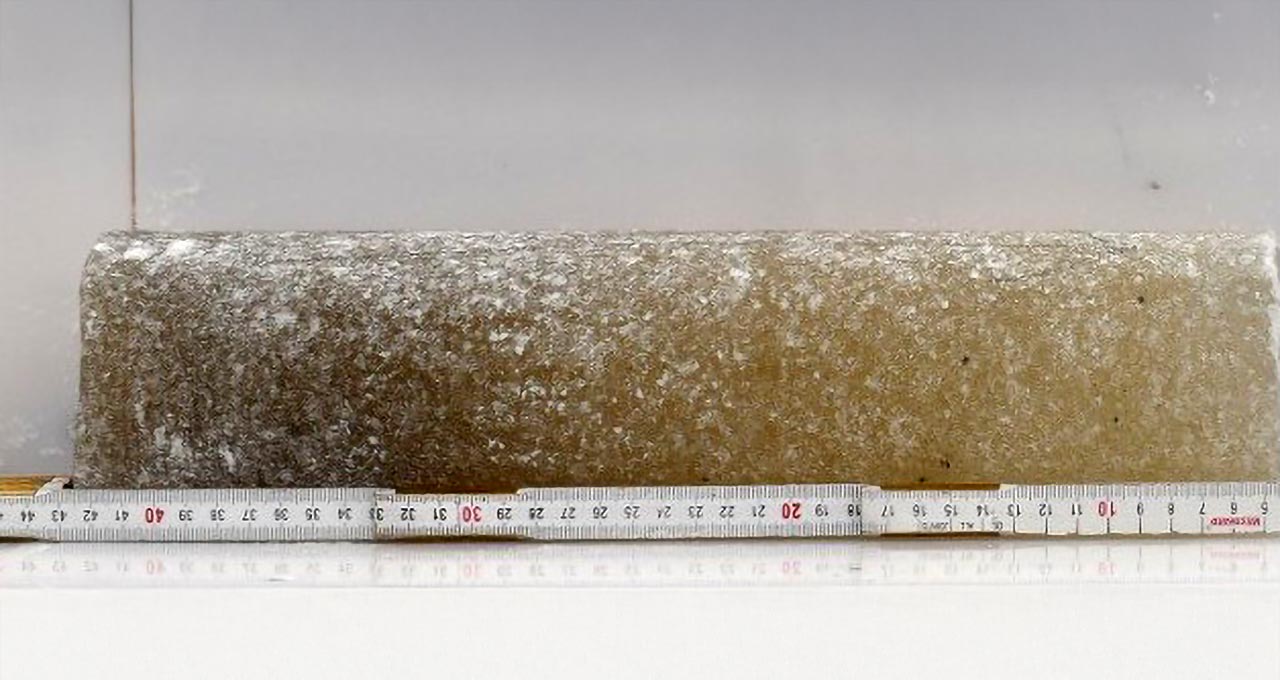
A U.S. research team has found 6-million-year-old ice in East Antarctica, the oldest ever directly dated.
The air sealed inside it preserves a snapshot of a much warmer ancient Earth, offering rare insight into natural climate change over deep time.
Discovery of Earth’s Oldest Ice and Air
In a remarkable scientific breakthrough, researchers from the United States have uncovered the oldest directly dated ice and air ever found on Earth. The discovery was made in the Allan Hills region of East Antarctica, an area known for its ancient, slow-moving ice.
The newly analyzed samples, estimated to be about 6 million years old, contain tiny air bubbles that have remained sealed since they first formed. According to a study published on October 28 in the Proceedings of the National Academy of Sciences, these bubbles preserve a rare and direct record of Earth’s atmosphere and climate from a distant era.
The ice dates back to a time when the planet was significantly warmer than it is today and when sea levels were much higher. Geological evidence from that period paints a picture of a very different world, making these samples invaluable for understanding long-term climate change.
The research was led by Sarah Shackleton of the Woods Hole Oceanographic Institution and John Higgins of Princeton University. Both are members of the National Science Foundation’s Center for Oldest Ice Exploration (COLDEX), a collaboration of 15 U.S. institutions coordinated by Oregon State University.
Time Machines in Ice: Traveling Deep Into Earth’s Past
“Ice cores are like time machines that let scientists take a look at what our planet was like in the past,” said Shackleton, who has participated in many seasons of ice core drilling at Allan Hills. “The Allan Hills cores help us travel much further back than we imagined possible.”
Ed Brook, COLDEX Director and paleoclimatologist at Oregon State University, described this as the most important finding for the center so far. Established in 2021 by the NSF as a Science and Technology Center, COLDEX focuses on exploring the Antarctic ice sheet, which holds the largest collection of frozen water on the planet.
“We knew the ice was old in this region. Initially, we had hoped to find ice up to 3 million years old, or maybe a little older, but this discovery has far exceeded our expectations,” Brook said.
A Global Race to the Oldest Ice
COLDEX is part of a global effort among research groups to extend the ice core record well beyond its previous 800,000-year limit. A European team recently announced the recovery of a continuous ice core dating back 1.2 million years from deep within East Antarctica.
The COLDEX team, however, is focusing on a different approach. At a remote field site in the Allan Hills, scientists spend months drilling to depths of one to two hundred meters near the edge of the ice sheet. In this region, a unique combination of mountain terrain and ice flow brings extremely old ice closer to the surface, making it more accessible. By comparison, extracting a continuous core from the Antarctic interior can require drilling more than 2,000 meters down.
“We’re still working out the exact conditions that allow such ancient ice to survive so close to the surface,” said Shackleton. “Along with the topography, it’s likely a mix of strong winds and bitter cold. The wind blows away fresh snow, and the cold slows the ice to almost a standstill. That makes Allan Hills one of the best places in the world to find shallow old ice, and one of the toughest places to spend a field season.”
How Scientists Directly Date Ancient Ice
The trapped air in these new cores allows scientists to directly date the ice through careful measurements of an isotope of the noble gas argon. Direct dating means scientists measured things in the ice itself that indicate age rather than making an inference based on an associated feature or deposit.
Although the records from this old ice are not continuous, their antiquity is unprecedented, the researchers said. By dating many samples, Higgins explained, “the team has built up a library of what we call ‘climate snapshots’ roughly six times older than any previously reported ice core data, complementing the more detailed younger data from cores in the interior of Antarctica.”
Tracing Antarctica’s Long Cooling Trend
Temperature records from measurements of oxygen isotopes in the ice reveal that this area experienced a gradual, long-term cooling of about 12 degrees Celsius, approximately 22 degrees Fahrenheit. This is the first direct measure of the amount of cooling in Antarctica over the last 6 million years.
Ongoing research into these ice cores seeks to reconstruct levels of atmospheric greenhouse gases and ocean heat content, which have important implications for understanding the causes of natural climate change.
The Next Chapter in Deep-Time Exploration
A COLDEX team will be heading to the Allan Hills in the coming months for more drilling, with the potential for obtaining more detailed snapshots and even older ice, Brook said.
“Given the spectacularly old ice we have discovered at Allan Hills, we also have designed a comprehensive longer-term new study of this region to try to extend the records even further in time, which we hope to conduct between 2026 and 2031,” he said.
Reference: “Miocene and Pliocene ice and air from the Allan Hills blue ice area, East Antarctica” by S. Shackleton, V. Hishamunda, L. Davidge, E. Brook, J. Marks Peterson, A. Carter, S. Aarons, A. Kurbatov, D. Introne, Y. Yan, I. M. Nesbitt, C. Buizert, E. J. Steig, A. J. Schauer, J. Morgan, P. D. Neff, J. A. Epifanio, J. Severinghaus, M. Bender and J. A. Higgins, 28 October 2025, Proceedings of the National Academy of Sciences.
DOI: 10.1073/pnas.2502681122
The study brought together a large team of researchers from across the United States and beyond. Co-authors include Julia Marks Peterson, Christo Buizert, and Jenna Epifanio from Oregon State University; Valens Hishamunda, Austin Carter, and Michael Bender from Princeton University; Lindsey Davidge, Eric Steig, and Andrew Schauer from the University of Washington; Sarah Aarons, Jacob Morgan, and Jeff Severinghaus from the Scripps Institution of Oceanography at the University of California, San Diego; Andrei V. Kurbatov and Douglas Introne from the University of Maine; Yuzhen Yan from Tongji University; and Peter Neff from the University of Minnesota.
The Center for Oldest Ice Exploration (COLDEX) receives funding and organizational support from several sources, including the National Science Foundation’s Office of Polar Programs, the Science and Technology Center Program at the NSF Office of Integrative Activities, and Oregon State University. Field operations in Antarctica are carried out through the U.S. Antarctic Program and supported by NSF funding. The NSF U.S. Ice Drilling Program provides drilling technology and expertise, while the NSF Ice Core Facility in Denver, Colorado, manages the long-term storage and preservation of the ice samples.
Never miss a breakthrough: Join the SciTechDaily newsletter.
Follow us on Google and Google News.
6 Comments
Since all through the time of life history, up until a scant couple of million ago, the atmospheric carbon was 0.2%, where there is absolutely zero real danger to life from a changing climate – other than if we halve the present 0.04% carbon to 0.02% from which all plant life will collapse.
In other, should be perfectly clear words: We’re hanging on, by our very fingernails, to failing carbon atmosphere. If trees could talk, they’d grab you by your collars.
The only ones that don’t know humans are the stupidest animal – are humans.
The headline says this information rewrites what we know about climate change implying that what we knew before was wrong. The author never does say what was wrong. I’m accusing the author of implying a bald-faced lie. You’re trying to say the science was wrong about climate change and this information proves it in the back door manner. I question your integrity is a journalist.
The headline says this information rewrites what we know about climate change implying that what we knew before was wrong. The author never does say what was wrong. I’m accusing the author of implying a bald-faced lie. You’re trying to say the science was wrong about climate change and this information proves it in a back door manner. I question your integrity as a journalist.
Cummon….”12 degrees Celsius, approximately 22 degrees Fahrenheit.”
WHO in the sciences need to know the conversion? Don’t use Fahrenheit.
Referring to temperature change, not temperature. ‘experienced a gradual, long-term cooling of about 12 degrees Celsius, approximately 22 degrees Fahrenheit’
Next thing we know and you will be telling everyone that we shouldn’t use feet or miles. All standards, be they English or metric, are arbitrary and their utility comes from familiarity. This website is located in America and probably the majority of the readership is in America. Thus, they are most familiar with the official units of measurement. It is pretentious to act as though you know what is best for 337, 079, 040+ people.