
Close Menu
    Facebook X (Twitter) Instagram
    SciTechDaily
    • Biology
    • Chemistry
    • Earth
    • Health
    • Physics
    • Science
    • Space
    • Technology
    Facebook X (Twitter) Pinterest YouTube RSS
    SciTechDaily
    Home»Earth»Arctic Boreal Vulnerability Experiment Shows Arctic Carbon Cycle is Speeding Up
    Earth

    Arctic Boreal Vulnerability Experiment Shows Arctic Carbon Cycle is Speeding Up

    By Esprit Smith, Jet Propulsion LaboratoryAugust 6, 2018No Comments3 Mins Read
    Facebook Twitter Pinterest Telegram LinkedIn WhatsApp Email Reddit
    Share
    Facebook Twitter LinkedIn Pinterest Telegram Email Reddit
    Arctic Carbon Cycle is Speeding Up
    Changes observed in vegetation, permafrost, and coastal erosion at the Yukon’s Qikiqtaruk-Herschel Island Territorial Park (Image from 1987). Credit: Isla Myers-Smith/University of Edinburgh

    When people think of the Arctic, snow, ice and polar bears come to mind. Trees? Not so much. At least not yet.

    A new NASA-led study using data from the Arctic Boreal Vulnerability Experiment (ABoVE) shows that carbon in Alaska’s North Slope tundra ecosystems spends about 13 percent less time locked in frozen soil than it did 40 years ago. In other words, the carbon cycle there is speeding up — and is now at a pace more characteristic of a North American boreal forest than of the icy Arctic. 

    “Warming temperatures mean that essentially we have one ecosystem — the tundra — developing some of the characteristics of a different ecosystem — a boreal forest,” said study co-author Anthony Bloom of NASA’s Jet Propulsion Laboratory in Pasadena, California. “While various factors regulate how fast this transformation will continue to occur, studies using Landsat and MODIS satellite imagery with field measurements over the past decades have observed a northward migration of shrubs and trees.”
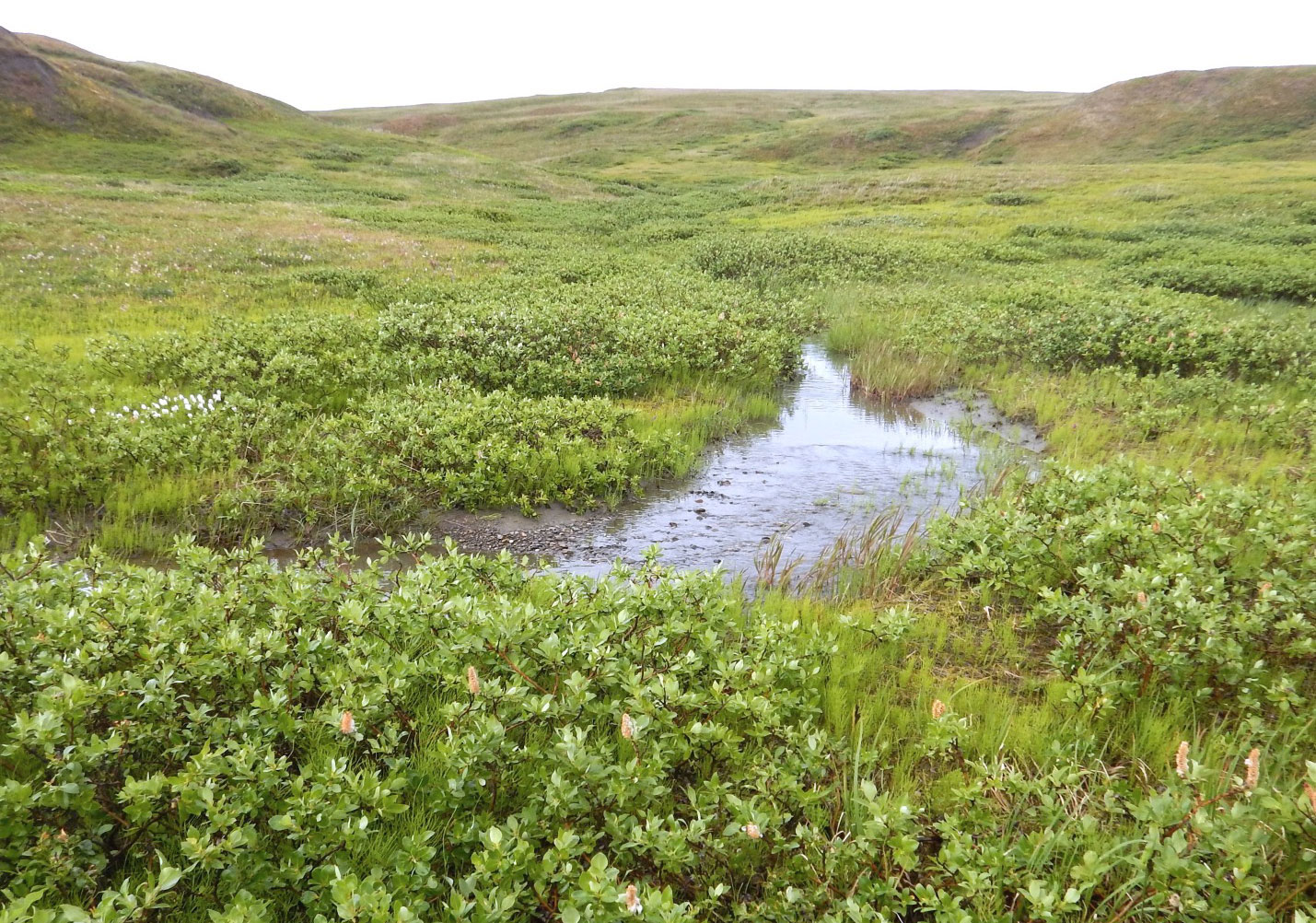
    The Arctic Carbon Cycle is Speeding Up
    Changes observed in vegetation, permafrost, and coastal erosion at the Yukon’s Qikiqtaruk-Herschel Island Territorial Park (Image from 2017). Credit: Isla Myers-Smith/University of Edinburgh

    And it’s not just about the trees. The Arctic carbon cycle is a delicate balance of carbon being released into the atmosphere and carbon being removed from the atmosphere. Disruptions to this balance have implications well beyond the Arctic.

    During Arctic summer, warmer temperatures thaw the uppermost layers of permafrost, allowing microbes to break down previously frozen organic matter. This process releases carbon dioxide into the atmosphere. Plant growth also increases during this period – and plants remove carbon dioxide from the atmosphere through photosynthesis. But as temperatures increase, the amount of time carbon is stored in the Arctic soil decreases.

    “The balance between these two dynamics will determine whether Arctic ecosystems will ultimately remove or add atmospheric carbon dioxide in the future climate. Our study finds that the latter is more likely,” said lead author and former JPL postdoctoral researcher Sujong Jeong of Seoul National University. “We anticipate that residence time of Arctic carbon will lead to faster and more pronounced seasonal and long-term changes in global atmospheric carbon dioxide.”

    The team combined data from more than 40 years of carbon dioxide surface measurements from NOAA’s Barrow, Alaska Observatory with a standard ecosystem carbon balance model to determine the rate at which carbon is moving in and out of Alaska’s North Slope. Models alone previously indicated an increase in the speed of the carbon cycle, but the addition of long-term satellite, airborne and surface data to the equation shows that those models were underestimating just how significant the increase was.

    The study, titled “Accelerating Rates of Arctic Carbon Cycling Revealed by Long-Term Atmospheric CO2 Measurements” was recently published in the journal Science Advances.

    Reference: “Accelerating rates of Arctic carbon cycling revealed by long-term atmospheric CO2 measurements” by Su-Jong Jeong, A. Anthony Bloom, David Schimel, Colm Sweeney, Nicholas C. Parazoo, David Medvigy, Gabriela Schaepman-Strub, Chunmiao Zheng, Christopher R. Schwalm, Deborah N. Huntzinger, Anna M. Michalak and Charles E. Miller, 11 September 2018, Scientific Reports.
    DOI: 10.1126/sciadv.aao1167

    Never miss a breakthrough: Join the SciTechDaily newsletter.
    Follow us on Google and Google News.

    Arctic Arctic Boreal Vulnerability Experiment Climate Science Earth Science
    Share. Facebook Twitter Pinterest LinkedIn Email Reddit

    Related Articles

    Warmer Water Now Reaches Deep Into The Arctic Interior

    Arctic Sea Ice Loss is Impacting Atlantic Ocean Water Circulation System

    New Study Shows Warmer Temperatures May Increase Emissions of Carbon Dioxide from Alaskan Tundra

    NASA Shows Arctic Sea Ice Is Losing Its Bulwark Against Warming Summers

    Yale Scientists Solve the Problem of Sea Ice Thickness Distribution

    2015 Arctic Sea Ice Maximum Annual Extent is the Lowest on Record

    Study Reveals Oceanic Carbon Release Helped End the Ice Age

    NASA Satellites Show Arctic Ocean is Absorbing More of the Sun’s Energy

    New ScienceCast Video: The Cloudy Future of Arctic Sea Ice

    Leave A Reply Cancel Reply

    • Facebook
    • Twitter
    • Pinterest
    • YouTube

    Don't Miss a Discovery

    Subscribe for the Latest in Science & Tech!

    Trending News

    Largest-Ever Study Finds Medicinal Cannabis Ineffective for Anxiety, Depression, PTSD

    250-Million-Year-Old Egg Solves One of Evolution’s Biggest Mysteries

    Living With Roommates Might Be Changing Your Gut Microbiome Without You Knowing

    Century-Old Cleaning Chemical Linked to 500% Increased Risk of Parkinson’s Disease

    What if Your Memories Never Happened? Physicists Take a New Look at the Boltzmann Brain Paradox

    One of the Universe’s Largest Stars May Be Getting Ready To Explode

    Scientists Discover Enzyme That Could Supercharge Ozempic-Like Weight Loss Drugs

    Popular Sweetener Linked to DNA Damage – “It’s Something You Should Not Be Eating”

    Follow SciTechDaily
    • Facebook
    • Twitter
    • YouTube
    • Pinterest
    • Newsletter
    • RSS
    SciTech News
    • Biology News
    • Chemistry News
    • Earth News
    • Health News
    • Physics News
    • Science News
    • Space News
    • Technology News
    Recent Posts
    • A Cosmic Crash Turned This Nearby Galaxy Into Chaos
    • This Alien Solar System Doesn’t Follow the Rules – and Scientists Are Intrigued
    • What Did Prehistoric Europeans Eat? Scientists Uncover Surprising Answers
    • Scientists Say This Overlooked Organ Could Hold the Key to Longer Life
    • Want Less Stress? Landmark Study Points to a Simple Habit
    Copyright © 1998 - 2026 SciTechDaily. All Rights Reserved.
    • Science News
    • About
    • Contact
    • Editorial Board
    • Privacy Policy
    • Terms of Use

    Type above and press Enter to search. Press Esc to cancel.