

As civilizations advance, they may need to migrate across the galaxy, and some researchers speculate they could use their own stars as massive engines.
New research explores the possibility of a binary stellar engine, particularly spider pulsars, as potential propulsion systems. By carefully manipulating these systems, a highly advanced extraterrestrial species could harness their energy to travel between stars.
The Need for Stellar Migration
At some point, every advanced civilization might need to leave its home star behind. As stars age, their habitable zones — the regions where conditions are right for life — shift and eventually become uninhabitable. If long-lived technological civilizations are possible in our Universe, interstellar migration would eventually become a necessity.
Could extraterrestrial intelligences (ETIs) use stars themselves as engines to facilitate such migrations?
A stellar engine, broadly speaking, harnesses a star’s energy to perform work. A basic analogy is solar panels, which convert the Sun’s radiation into electricity for human use. On a much larger scale, however, a stellar engine could theoretically generate thrust to move the star itself. A civilization capable of such a feat would rank as a Type II civilization on the Kardashev Scale — a framework for measuring a civilization’s technological advancement based on its energy consumption.
While this concept may sound far-fetched, it raises intriguing possibilities. If an ETI survives long enough to achieve such technological mastery, it might become capable of stellar propulsion.
The idea of stellar engines originated with science fiction author Olaf Stapledon, who envisioned advanced civilizations manipulating stars. Later, astronomer Fritz Zwicky expanded on this idea, speculating about using advanced technology to turn stars into spacecraft. Decades later, in 1988, physicist Leonid Shkadov developed the first detailed model of a stellar engine, known as the Shkadov Thruster. These ideas, once rooted in fiction, continue to inspire scientific exploration.
The Spider Stellar Engine: A New Approach
In new research, Clement Vidal, from Vrije Universiteit in Brussels, Belgium, examines how an advanced civilization could use a binary star as a stellar engine. The paper is titled “The Spider Stellar Engine: a Fully Steerable Extraterrestrial Design?”
“Since about half the stars in our galaxy are in binary systems where life might develop too, we introduce a model of a binary stellar engine,” Vidal writes. “We apply the model to candidate systems, spider pulsars, which are binary stars composed of one millisecond pulsar and a very low-mass companion star that is heavily irradiated by the pulsar wind.”
A Focus on Technosignatures
Vidal is concerned with stellar engine technosignatures. Research has focused on hypervelocity stars as potential stellar engine technosignatures because they’re easily observable. Other researchers have also proposed other stellar engine concepts, but according to Vidal, they’re “poorly linked to observable technosignatures. ”
Vidal’s main goal in this work is to determine what types of technosignatures a binary stellar engine would emit. He discusses what potential signatures might be emitted by acceleration, deceleration, steering, and maneuvers such as gravitational assists or captures. However, unlike some other researchers, he focuses on a specific type of binary system: spider pulsars, which are a subclass of binary millisecond pulsars.
Understanding Spider Pulsars
Pulsars are what remains of some massive stars. At the end of their lives, some massive stars collapse to form neutron stars. When these neutron stars spin rapidly, they produce beams of radiation from their poles. If the radiation is aimed at Earth, then we can observe the pulses of energy. These pulses have exquisitely precise timing, and astronomers use them to determine cosmic distances.
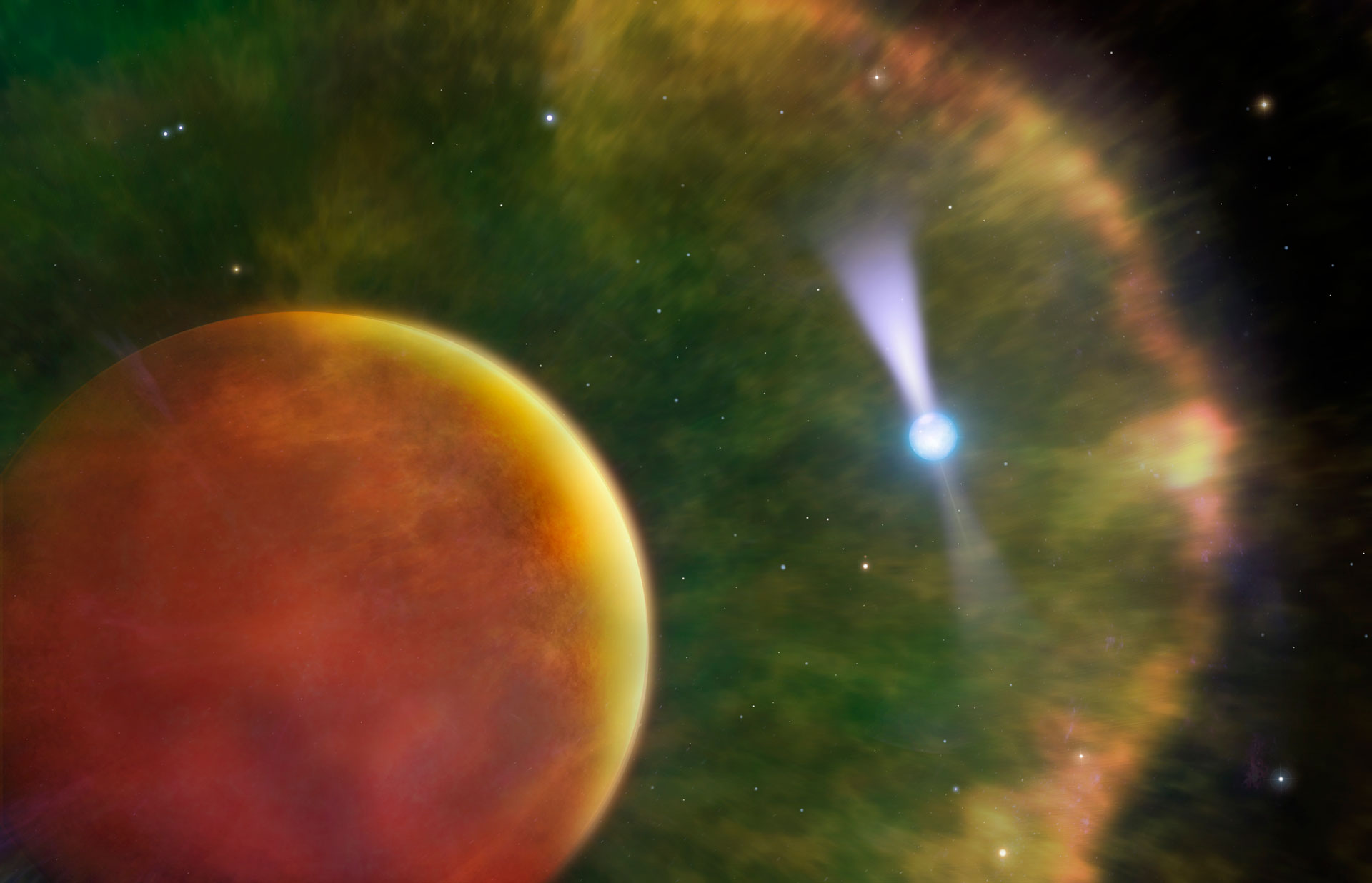
A spider pulsar is a pulsar with a companion, usually a red dwarf, a brown dwarf, or even a planetary-mass object. They’re called spider pulsars because it’s as if the pulsar spins a web of powerful beams of radiation that strips away the companion’s mass, eventually destroying it.
The Mechanics of a Binary Stellar Engine
Vidal’s paper describes the payload as a pulsar with about 1.8 solar masses and the propellant as its low-mass companion star with between 0.01 and 0.7 solar masses.
In essence, the gravitationally bound binary system is the vehicle, and the smaller companion star is the propellant. The spider pulsar generates thrust by expelling propellant out of the gravitational system, and the propellant is the matter stripped from the companion.
The binary pair orbits a common center of gravity. The idea behind this binary stellar engine (BSE) is that as they orbit, the pulsar’s radiation strikes the companion or propellant star. A close binary is more effective because the closer the pulsar is to the propellant, the more thrust is generated. The assumption is that a Type II civilization would have the technology to moderate this thrust to serve their purposes by timing the radiation and heating the outer layers of the propellant star with X-ray or gamma radiation.
To decelerate, the BSE would produce active thrust in the opposite direction of travel. It could also use a passive magnetic sail deployed from the pulsar to transfer momentum to the interstellar medium.
The BSE steers by selectively evaporating the star during different orbital phases. “To choose a direction, it suffices to evaporate the companion star once per orbit, at a specific orbital phase, in order to create consistent thrust in one direction,” Vidal explains.

Could We Detect a Binary Stellar Engine?
These various maneuvers and manipulations with the BSE would emit technosignatures. Have astronomers observed any candidate BSEs in the Milky Way? Possibly.
“Could our galaxy host a kind of fully steerable binary stellar engine that we proposed? This is a plausible hypothesis in the context of the stellivore hypothesis, which reinterprets some observed accreting binary stars as advanced civilizations feeding on stars,” Vidal writes.
A stellivore is a hypothesized type of civilization first proposed by Vidal that has the technology to consume its home star via accretion. They use the star’s energy to sustain their existence. Vidal writes that rather than consume the energy, they could use it to migrate to a more favorable location in the galaxy.
“For most of its time, a stellivore civilization would eat its home star via accretion. However, energy is never eternal, and instead of eating its star until the end and dying, a stellivore civilization would use its low-mass companion star as fuel not to be accreted but to be evaporated in order to create thrust and travel towards a nearby star,” Vidal explains.
Spider Pulsars as Possible Stellar Engines
This brings us to spider pulsars. Rather than accreting material, a spider pulsar appears to be evaporating its propellant companion.
There are two types of spider pulsars: Black Widows and Redblacks. The distinction is in the mass of the companion. In a black widow (BW), the companion is less than 0.1 stellar masses. In a redblack, the companion is between 0.1 and 0.7 stellar masses. Spider pulsars are different from other pulsar binaries because they evaporate their companions rather than accrete them. When pulsars accrete too much material, they can form black holes. Spider pulsars don’t tempt the same fate. Vidal calls these spider stellar engines (SSEs) rather than binary stellar engines (BSEs).

Potential Real-World Examples
Previous researchers have studied the original BW, and Vidal writes, “… the 3D motion of the system appears to be nearly aligned with the spin axis of the MSP.” This fits in with the SSE interpretation because this perfect alignment is necessary to produce maximum thrust. A stellivore civilization would have a destination in mind, and Vidal says that he’s found a potential destination for the original Black Widow pulsar. He says that the pulsar will reach this target star in about 420 years while also acknowledging the uncertainty in this determination.
PSR J1959+2048, the original BW, also modulates itself, which could be interpreted as steering. However, it also displays other characteristics and moderation that call into question the ‘steering’ interpretation.
Implications and Future Possibilities
Ultimately, Vidal’s SSE may have a shorter duty cycle than other proposed stellar engines, limiting its usefulness. However, it has advantages in steering over others. “Transposing it on a smaller scale, it might also be an inspirational design for advanced propulsion solutions, or for planetary defence purposes such
as deflecting asteroids,” Vidal writes.
The idea may seem preposterous to some, but that’s incidental. Many ideas in history seemed preposterous until they weren’t.
Vidal isn’t claiming that we’re seeing the technosignatures of stellar engines. He’s arguing that it’s worth pursuing the idea of observing them. He sees these candidates and predictions of what their signals might look like as clues and as starting points for further investigation.
“Spider pulsars thus offer observable stellar engine technosignature candidates, with decades of data, active studies that discover, model and monitor these dazzling systems,” he concludes.
Adapted from an article originally published on Universe Today.
Never miss a breakthrough: Join the SciTechDaily newsletter.
Follow us on Google and Google News.
2 Comments
No.
I second the motion.