
Osaka University scientists created an AI model that estimates biological age through hormone analysis, linking stress to accelerated aging.
We all know someone who seems to defy aging, people who look younger than their peers despite being the same age. What’s their secret? Scientists at Osaka University in Japan may have found a way to quantify this difference. By incorporating hormone (steroid) metabolism pathways into an AI-driven model, they have developed a system to estimate a person’s biological age—a measure of how well their body has aged rather than simply counting the years since birth.
This method requires only five drops of blood to analyze 22 key steroids and their interactions, providing a more precise assessment of overall health. Published in Science Advances, the team’s study represents a major step toward personalized health management, enabling earlier detection of age-related risks and more targeted interventions.
Unlocking the Body’s Aging Signature
Aging isn’t just about the number of years we’ve lived—it’s shaped by genetics, lifestyle, and environmental factors. Traditional methods for estimating biological age rely on broad biomarkers, such as DNA methylation or protein levels, but these approaches often overlook the intricate hormonal networks that regulate the body’s internal balance.
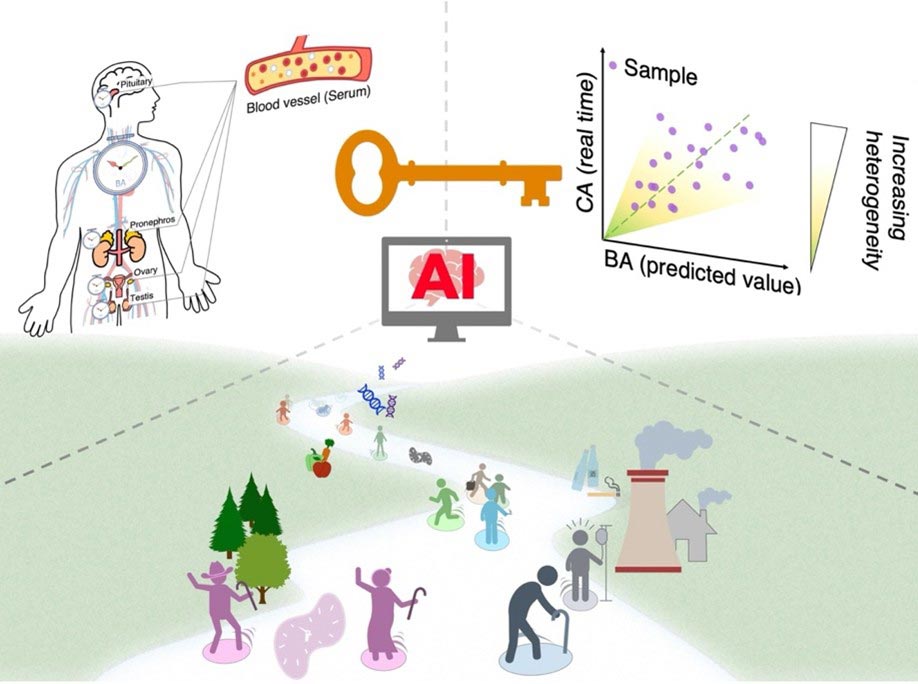
Top Right: The AI-predicted biological age (BA) shows a general correlation with chronological age (CA), but individual differences widen over time.
Bottom: Using the metaphor of a “river widening as it flows downstream,” the illustration visualizes how biological age evolves with the passage of time. Credit: Zi Wang
“Our bodies rely on hormones to maintain homeostasis, so we thought, why not use these as key indicators of aging?” says Dr. Qiuyi Wang, co-first author of the study. To test this idea, the research team focused on steroid hormones, which play a crucial role in metabolism, immune function, and stress response.
A New AI-Powered Model
The team developed a deep neural network (DNN) model that incorporates steroid metabolism pathways, making it the first AI model to explicitly account for the interactions between different steroid molecules. Instead of looking at absolute steroid levels—which can vary widely between individuals—the model examines steroid ratios, providing a more personalized and accurate assessment of biological age.
“Our approach reduces the noise caused by individual steroid level differences and allows the model to focus on meaningful patterns,” explains Dr. Zi Wang, co-first and corresponding author of this work. The model was trained on blood samples from hundreds of individuals, revealing that biological age differences tend to widen as people get older—an effect the researchers liken to a river widening as it flows downstream.
Key Insights and Implications
One of the study’s most striking findings involves cortisol, a steroid hormone commonly associated with stress. The researchers found that when cortisol levels doubled, biological age increased by approximately 1.5 times. This suggests that chronic stress could accelerate aging at a biochemical level, reinforcing the importance of stress management in maintaining long-term health.
“Stress is often discussed in general terms, but our findings provide concrete evidence that it has a measurable impact on biological aging,” says Professor Toshifumi Takao, a corresponding author and an expert in analytical chemistry and mass spectrometry.
The researchers believe this AI-powered biological age model could pave the way for more personalized health monitoring. Future applications may include early disease detection, customized wellness programs, and even lifestyle recommendations tailored to slow down aging.
Looking Ahead
While the study represents a significant step forward, the team acknowledges that biological aging is a complex process influenced by many factors beyond hormones. “This is just the beginning,” says Dr. Z. Wang. “By expanding our dataset and incorporating additional biological markers, we hope to refine the model further and unlock deeper insights into the mechanisms of aging.”
With ongoing advancements in AI and biomedical research, the dream of accurately measuring—and even slowing—biological aging is becoming increasingly feasible. For now, though, the ability to assess one’s “aging speed” with a simple blood test could mark a game-changing development in preventive healthcare.
Reference: “Biological age prediction using a DNN model based on pathways of steroidogenesis” by Qiuyi Wang, Zi Wang, Kenji Mizuguchi and Toshifumi Takao, 14 March 2025, Science Advances.
DOI: 10.1126/sciadv.adt2624
Never miss a breakthrough: Join the SciTechDaily newsletter.
Follow us on Google and Google News.
2 Comments
The AI wants our blood now?
The concept of “biological age” is a misleading one. The implication is that healthy people should have certain chemical markers in their blood that change over time in a predictable way for everyone at about the same age. So if you have these markers because of, for example, a bad diet and stressful job, it will seem like you are older because your biochemical markers are more like an older person’s. However, if you stop your stress and eat healthier, your chemical markers will change and resemble a younger person’s. Does this mean you reversed aging? No! It means you reversed a disease-causing process with a lifestyle change. Associating this with aging is just a way to sell anti-aging treatments. “With ongoing advancements in AI and biomedical research, the dream of accurately measuring—and even slowing—biological aging is becoming increasingly feasible.” That’s the sales pitch.