
Close Menu
    Facebook X (Twitter) Instagram
    SciTechDaily
    • Biology
    • Chemistry
    • Earth
    • Health
    • Physics
    • Science
    • Space
    • Technology
    Facebook X (Twitter) Pinterest YouTube RSS
    SciTechDaily
    Home»Space»“Astounding” – Astronomers Reveal Hidden Monster Black Hole Lurking in Our Galactic Backyard
    Space

    “Astounding” – Astronomers Reveal Hidden Monster Black Hole Lurking in Our Galactic Backyard

    By Harvard-Smithsonian Center for AstrophysicsApril 2, 20253 Comments5 Mins Read
    Facebook Twitter Pinterest Telegram LinkedIn WhatsApp Email Reddit
    Share
    Facebook Twitter LinkedIn Pinterest Telegram Email Reddit
    Astronomy Black Hole Astrophysics Art Illustration
    Astronomers have discovered a hidden supermassive black hole in the Large Magellanic Cloud by tracing hypervelocity stars ejected from it using Gaia satellite data. (Artist’s concept.) Credit: SciTechDaily.com

    Astronomers have discovered strong evidence of a supermassive black hole in the Large Magellanic Cloud, a satellite galaxy of the Milky Way.

    Astronomers have found compelling evidence for the closest known supermassive black hole outside the Milky Way. This enormous black hole resides in the Large Magellanic Cloud (LMC), one of our galaxy’s nearest neighbors.

    The discovery was made by precisely tracking the motion of 21 stars located on the outskirts of the Milky Way. These stars are moving so rapidly that they will eventually escape the gravitational pull of the Milky Way and any nearby galaxies. Such stars are known as “hypervelocity” stars.

    By analyzing their trajectories, much like forensic scientists tracing a bullet’s path, researchers were able to determine their origins. About half of the stars were found to have been ejected by the supermassive black hole at the center of the Milky Way. The rest, however, appear to have been flung out by a different source: a previously undetected supermassive black hole in the Large Magellanic Cloud.

    “It is astounding to realize that we have another supermassive black hole just down the block, cosmically speaking,” said Jesse Han of the Center for Astrophysics | Harvard & Smithsonian (CfA), who led the new study. “Black holes are so stealthy that this one has been practically under our noses this whole time.”

    Leveraging Data from Gaia

    The researchers found this secretive black hole by using data from the European Space Agency’s Gaia mission, a satellite that has tracked more than a billion stars throughout the Milky Way with unprecedented accuracy. They also used an improved understanding of the LMC’s orbit around the Milky Way recently obtained by other researchers.

    “We knew that these hypervelocity stars had existed for a while, but Gaia has given us the data we need to figure out where they actually come from,” said co-author Kareem El-Badry of Caltech in Pasadena, California. “By combining these data with our new theoretical models for how these stars travel, we made this remarkable discovery.”
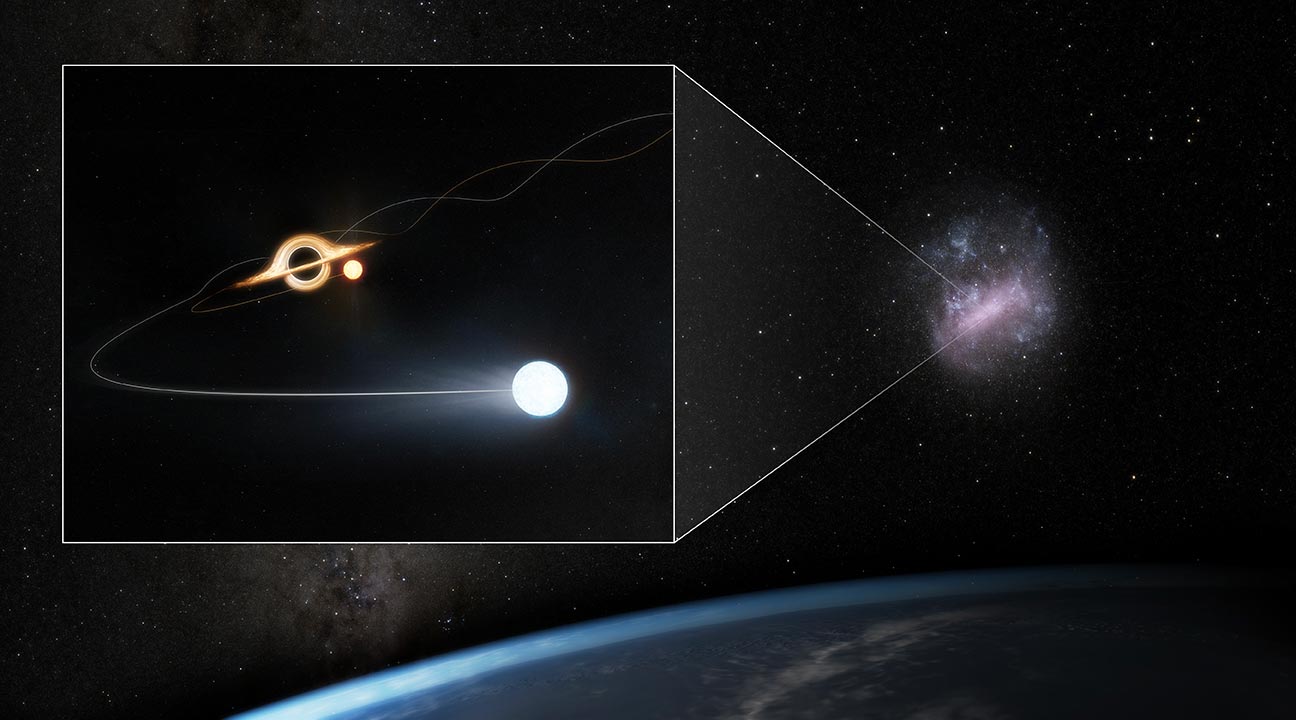
    Artist’s Impression of a Hypervelocity Star Ejected From the Large Magellanic Cloud
    Artist’s impression of a hypervelocity star ejected from the Large Magellanic Cloud (shown on right). When a binary star system ventures too close to a supermassive black hole, the intense gravitational forces tear the pair apart. One star is captured into a tight orbit around the black hole, while the other is flung outward at extreme velocities—often exceeding millions of miles per hour—becoming a hypervelocity star. The inset illustration depicts this process: the original binary’s orbital path is shown as interwoven lines, with one star being captured by the black hole (near the center of the inset) while the other is ejected into space (lower right). Credit: CfA/Melissa Weiss

    Hypervelocity stars are created when a double-star system ventures too close to a supermassive black hole. The intense gravitational pull from the black hole rips the two stars apart, capturing one star into a close orbit around it. Meanwhile, the other orphaned star is jettisoned away at speeds exceeding several million miles per hour — and a hypervelocity star is born.

    A significant piece of the team’s research was a prediction by their theoretical model that a supermassive black hole in the LMC would create a cluster of hypervelocity stars in one corner of the Milky Way because of how the LMC moves around the Milky Way. The stars ejected along the direction of the LMC’s motion should receive an extra boost in speed. Indeed, their data revealed the existence of such a cluster.

    Ruling Out Other Explanations

    The team found that the properties of the hypervelocity stars cannot be explained by other mechanisms, such as stars being ejected when their companions undergo a supernova explosion, or stars being ejected by a mechanism like that described above for a double star system, but without a supermassive black hole being involved.

    “The only explanation we can come up with for this data is the existence of a monster black hole in our galaxy next door,” said co-author Scott Lucchini, also of CfA. “So in our cosmic neighborhood, it’s not just the Milky Way’s supermassive black hole evicting stars from its galaxy.”

    Using the speeds of the stars and the relative number of ones ejected by the LMC and Milky Way supermassive black holes, the team determined that the mass of the LMC black hole is about 600,000 times the mass of the Sun. For comparison, the supermassive black hole in the Milky Way has about 4 million solar masses. Elsewhere in the Universe, there are supermassive black holes with billions of times more mass than the Sun.

    Reference: “Hypervelocity Stars Trace a Supermassive Black Hole in the Large Magellanic Cloud” by Jiwon Jesse Han, Kareem El-Badry, Scott Lucchini, Lars Hernquist, Warren Brown, Nico Garavito-Camargo, Charlie Conroy and Re’em Sari, 28 March 2025, The Astrophysical Journal.
    DOI: 10.3847/1538-4357/adb967

    Never miss a breakthrough: Join the SciTechDaily newsletter.
    Follow us on Google and Google News.

    Astronomy Astrophysics Black Hole Harvard-Smithsonian Center for Astrophysics Large Magellanic Cloud Popular
    Share. Facebook Twitter Pinterest LinkedIn Email Reddit

    Related Articles

    NASA’s Black Hole Orrery – Spectacular Visualization of 22 X-Ray Binary Systems That Host Black Holes

    Scientists Have Spotted the Farthest Galaxy Ever – It May Be Home to the Oldest Stars in the Universe

    Astronomers Spy Quartet of Enormous Cavities From Giant Black Holes

    Astronomers Use “X-Ray Magnifying Glass” To Enhance View of Distant Black Holes

    Astronomers Spot Unusual, Enormous Rings Around a Black Hole

    Telescopes Unite in Unprecedented Observations of Famous Black Hole Across the Entire Electromagnetic Spectrum

    Massive X-ray Jet – Extending for 160,000 Light-Years – Spied From Supermassive Black Hole in Early Universe

    Astronomers Detect a Supermassive Black Hole on the Move – Unusual Motion Thus Far Unexplained

    Stranger Than Fiction: The Monster in the Middle of the Milky Way Is…Spinning Slowly?

    3 Comments

    1. Syed Muhammad Umar on April 2, 2025 6:55 pm

      Interesting information

      Reply
    2. Shrinivasacharya on April 2, 2025 11:15 pm

      Ok

      Reply
    Leave A Reply Cancel Reply

    • Facebook
    • Twitter
    • Pinterest
    • YouTube

    Don't Miss a Discovery

    Subscribe for the Latest in Science & Tech!

    Trending News

    Your Blood Pressure Reading Could Be Wrong Because of One Simple Mistake

    Astronomers Stunned by Ancient Galaxy With No Spin

    Physicists May Be on the Verge of Discovering “New Physics” at CERN

    Scientists Solve 320-Million-Year Mystery of Reptile Skin Armor

    Scientists Say This Daily Walking Habit May Be the Secret to Keeping Weight Off After Dieting

    New Therapy Rewires the Brain To Restore Joy in Depression Patients

    Giant Squid Detected off Western Australia in Stunning Deep-Sea Discovery

    Popular Sugar-Free Sweetener Linked to Liver Disease, Study Warns

    Follow SciTechDaily
    • Facebook
    • Twitter
    • YouTube
    • Pinterest
    • Newsletter
    • RSS
    SciTech News
    • Biology News
    • Chemistry News
    • Earth News
    • Health News
    • Physics News
    • Science News
    • Space News
    • Technology News
    Recent Posts
    • A Crucial Atlantic Current Is Weakening and Weather Could Change Worldwide
    • Scientists Stunned As Volcano Removes Methane From the Air
    • Scientists Discover Signs Africa May Be Splitting Apart Beneath Zambia
    • New Stroke Study Challenges Decades-Old Medical Beliefs
    • These Simple Plant Foods Are Linked to Lower Blood Pressure
    Copyright © 1998 - 2026 SciTechDaily. All Rights Reserved.
    • Science News
    • About
    • Contact
    • Editorial Board
    • Privacy Policy
    • Terms of Use

    Type above and press Enter to search. Press Esc to cancel.