
Close Menu
    Facebook X (Twitter) Instagram
    SciTechDaily
    • Biology
    • Chemistry
    • Earth
    • Health
    • Physics
    • Science
    • Space
    • Technology
    Facebook X (Twitter) Pinterest YouTube RSS
    SciTechDaily
    Home»Space»Astronomers Discover a Hypervelocity Globular Cluster
    Space

    Astronomers Discover a Hypervelocity Globular Cluster

    By Harvard-Smithsonian Center for AstrophysicsMay 1, 2014No Comments4 Mins Read
    Facebook Twitter Pinterest Telegram LinkedIn WhatsApp Email Reddit
    Share
    Facebook Twitter LinkedIn Pinterest Telegram Email Reddit
    Astronomers Discover a Runaway Star Cluster
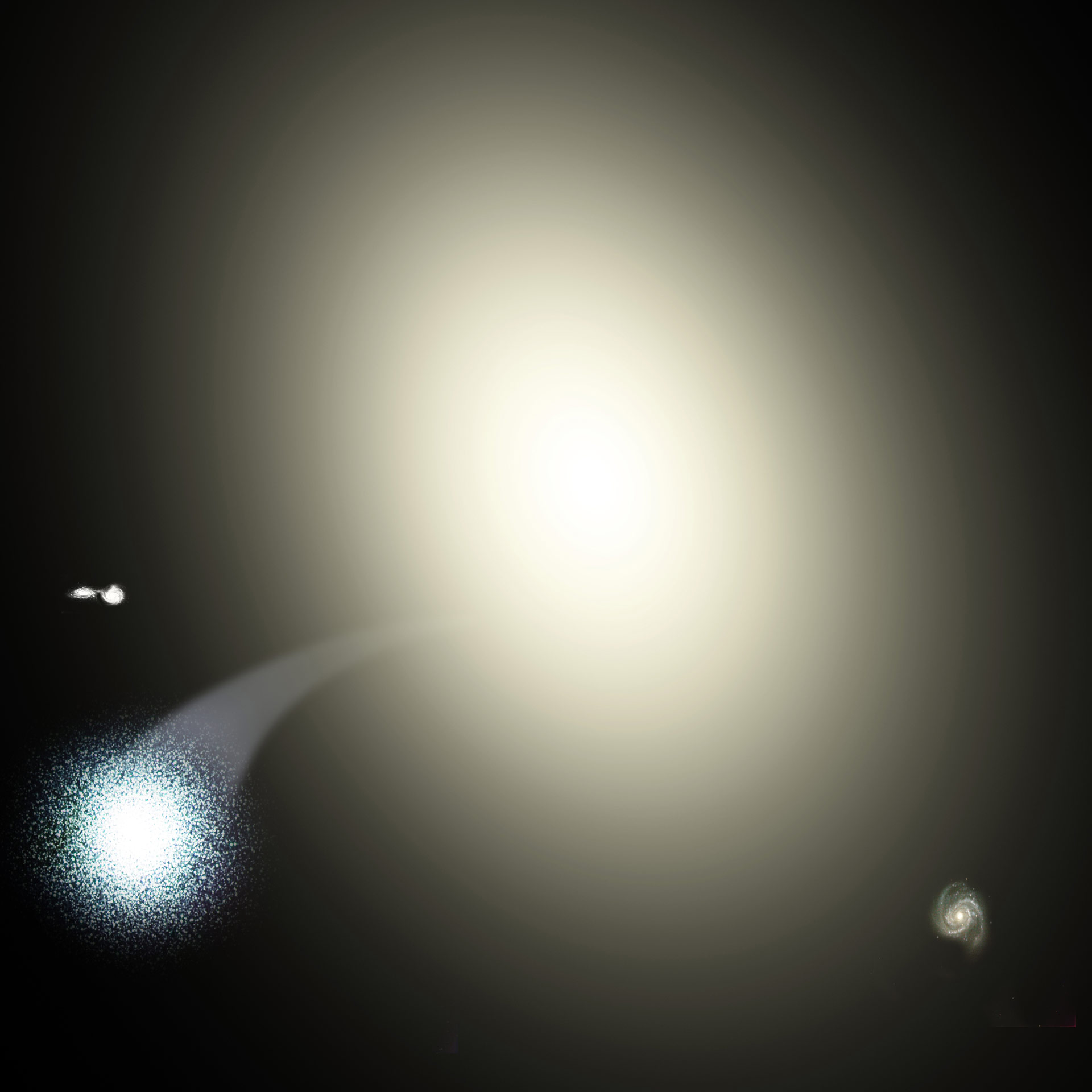
    This artist’s illustration shows the hypervelocity star cluster HVGC-1 escaping from the supergiant elliptical galaxy M87. HVGC-1 is the first runaway star cluster discovered by astronomers. It is fated to drift through intergalactic space. Credit: David A. Aguilar (CfA)

    Astronomers from the Harvard-Smithsonian Center for Astrophysics have discovered a runaway star cluster that is moving at more than two million miles per hour.

    Cambridge, Massachusetts – The galaxy known as M87 has a fastball that would be the envy of any baseball pitcher. It has thrown an entire star cluster toward us at more than two million miles per hour. The newly discovered cluster, which astronomers named HVGC-1, is now on a fast journey to nowhere. Its fate: to drift through the void between the galaxies for all time.

    “Astronomers have found runaway stars before, but this is the first time we’ve found a runaway star cluster,” says Nelson Caldwell of the Harvard-Smithsonian Center for Astrophysics. Caldwell is the lead author on the study, which will be published in The Astrophysical Journal Letters.

    The “HVGC” in HVGC-1 stands for hypervelocity globular cluster. Globular clusters are relics of the early universe. These groupings usually contain thousands of stars crammed into a ball a few dozen light-years across. The Milky Way galaxy is home to about 150 globular clusters. The giant elliptical galaxy M87, in contrast, holds thousands.

    It took a stroke of luck to find HVGC-1. The discovery team has spent years studying the space around M87. They first sorted targets by color to separate stars and galaxies from globular clusters. Then they used the Hectospec instrument on the MMT Telescope in Arizona to examine hundreds of globular clusters in detail.

    A computer automatically analyzed the data and calculated the speed of every cluster. Any oddities were examined by hand. Most of those turned out to be glitches, but HVGC-1 was different. Its surprisingly high velocity was real.
    Astronomers Discover Runaway Star Cluster HVGC-1
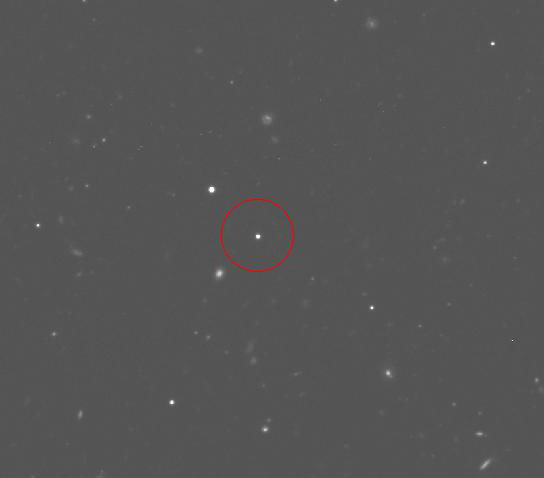
    The runaway star cluster HVGC-1 (circled) in a photo from the Canada-France-Hawaii Telescope (CFHT). The cluster is zooming toward us at a speed of more than two million miles per hour. Credit: CFHT

    “We didn’t expect to find anything moving that fast,” says Jay Strader of Michigan State University, a co-author on the study.

    How did HVGC-1 get ejected at such a high speed? Astronomers aren’t sure but say that one scenario depends on M87 having a pair of supermassive black holes at its core. The star cluster wandered too close to those black holes. Many of its outer stars were plucked off, but the dense core of the cluster remained intact. The two black holes then acted like a slingshot, flinging the cluster away at tremendous speed.

    HVGC-1 is moving so fast that it is doomed to escape M87 altogether. In fact, it may have already left the galaxy and be sailing out into intergalactic space.

    Background

    M87, the source of the hypervelocity cluster HVGC-1, is a king among galaxies. This supergiant elliptical galaxy weighs as much as 6 trillion Suns, making it one of the most massive galaxies in the nearby universe.

    The discovery of HVGC-1 suggests that the core of M87 holds not one but two supermassive black holes. This must be the result of a long-ago collision between two galaxies, which merged to form a single giant galaxy. The same fate awaits our own Milky Way, which will collide with the Andromeda galaxy in a few billion years to create an elliptical galaxy that astronomers have dubbed Milkomeda.

    Headquartered in Cambridge, Massachusetts, the Harvard-Smithsonian Center for Astrophysics (CfA) is a joint collaboration between the Smithsonian Astrophysical Observatory and the Harvard College Observatory. CfA scientists, organized into six research divisions, study the origin, evolution, and ultimate fate of the universe.

    Reference: “A Globular Cluster Toward M87 with a Radial Velocity < -1000 km/s: The First Hypervelocity Cluster” by Nelson Caldwell, Jay Strader, Aaron J. Romanowsky, Jean P. Brodie, Ben Moore, Jurg Diemand and Davide Martizzi, 6 May 2014, The Astrophysical Journal Letters.
    DOI: 10.1088/2041-8205/787/1/L11


    Never miss a breakthrough: Join the SciTechDaily newsletter.
    Follow us on Google and Google News.

    Astronomy Astrophysics Harvard-Smithsonian Center for Astrophysics Popular
    Share. Facebook Twitter Pinterest LinkedIn Email Reddit

    Related Articles

    Astronomers Detect a Supermassive Black Hole on the Move – Unusual Motion Thus Far Unexplained

    Intriguing Remains of a Rare Stellar Explosion Discovered in Milky Way Center

    Four Exoplanets – Including a Super-Earth Planet – Discovered by High School Students

    Astronomers Discover First Cloudless, Jupiter-Like Planet – “Smoking Gun Evidence”

    Chandra Studies Extraordinary Magnetar: Fastest Spinning and Possibly the Youngest Magnetar Known

    Growing Interest in Limited Moon Resources Could Cause Tension

    First Habitable-Zone, Earth-Sized Exoplanet Discovered With Planet-Hunter TESS

    Stranger Than Fiction: The Monster in the Middle of the Milky Way Is…Spinning Slowly?

    The Evolving Volatile Chemistry of Protoplanetary Disks

    Leave A Reply Cancel Reply

    • Facebook
    • Twitter
    • Pinterest
    • YouTube

    Don't Miss a Discovery

    Subscribe for the Latest in Science & Tech!

    Trending News

    289-Million-Year-Old Reptile Mummy Reveals Origin of Human Breathing System

    New Brain Discovery Challenges Long-Held Theory of Teenage Brain Development

    Scientists Discover Plants “Scream” – We Just Couldn’t Hear Them Until Now

    Scientists Discover a Surprising Reason Intermittent Fasting Extends Life

    This Simple Fruit Wash Could Make Produce Safer and Last Days Longer

    Scientists Say Adding This Unusual Seafood to Your Diet Could Reverse Signs of Aging

    Scientists Say a Hidden Structure May Exist Inside Earth’s Core

    Doctors Surprised by the Power of a Simple Drug Against Colon Cancer

    Follow SciTechDaily
    • Facebook
    • Twitter
    • YouTube
    • Pinterest
    • Newsletter
    • RSS
    SciTech News
    • Biology News
    • Chemistry News
    • Earth News
    • Health News
    • Physics News
    • Science News
    • Space News
    • Technology News
    Recent Posts
    • Scientists Propose Radical New Way To Detect Alien Life – Without Traditional Biosignatures
    • Scientists Just Discovered Light Can Actually Slow Plant Growth
    • Scientists Finally Solved One of Water’s Biggest Mysteries
    • 7,000-Year-Old DNA Rewrites the Story of the “Neolithic Revolution”
    • Missing Medieval Relic of Legendary English King Found After Being Missing for 40 Years
    Copyright © 1998 - 2026 SciTechDaily. All Rights Reserved.
    • Science News
    • About
    • Contact
    • Editorial Board
    • Privacy Policy
    • Terms of Use

    Type above and press Enter to search. Press Esc to cancel.