
Close Menu
    Facebook X (Twitter) Instagram
    SciTechDaily
    • Biology
    • Chemistry
    • Earth
    • Health
    • Physics
    • Science
    • Space
    • Technology
    Facebook X (Twitter) Pinterest YouTube RSS
    SciTechDaily
    Home»Space»Astronomers Discover Radio Phoenix Close to the Moment of Its Formation
    Space

    Astronomers Discover Radio Phoenix Close to the Moment of Its Formation

    By Harvard-Smithsonian Center for AstrophysicsApril 28, 20151 Comment3 Mins Read
    Facebook Twitter Pinterest Telegram LinkedIn WhatsApp Email Reddit
    Share
    Facebook Twitter LinkedIn Pinterest Telegram Email Reddit
    Abell 1033 Birth of a Radio Phoenix
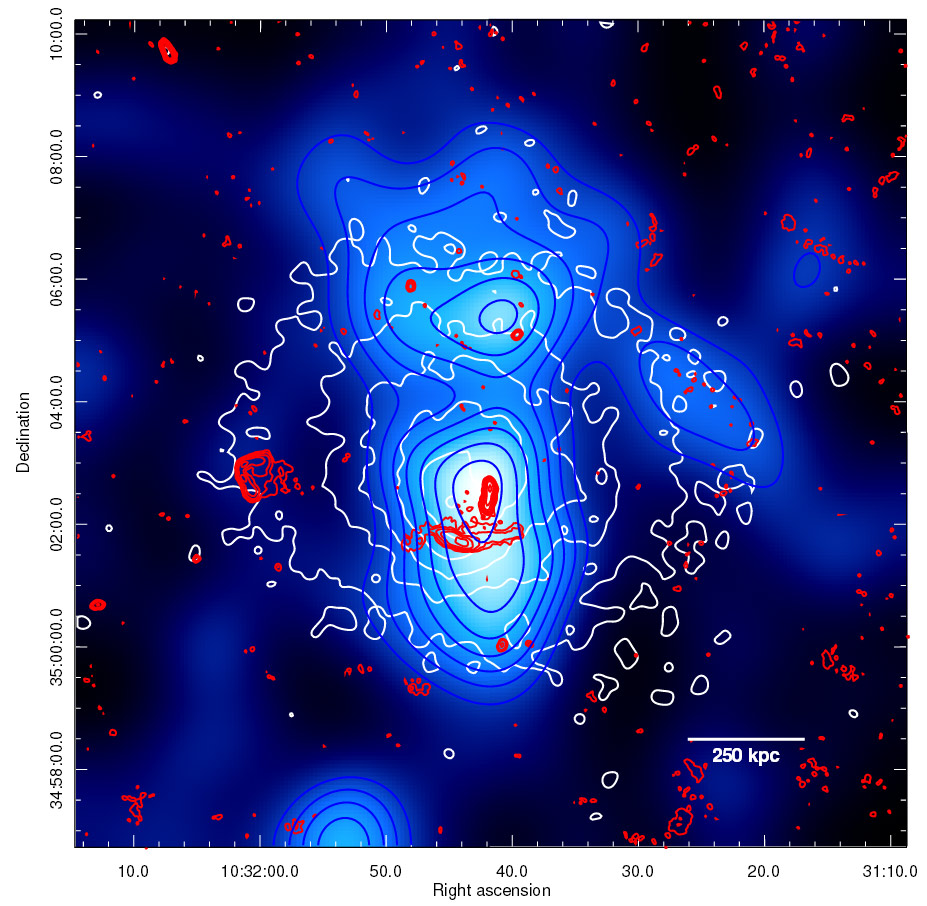
    A false-color X-ray image of the galaxy cluster Abell 1033. The white contours help identify the X-ray flux levels, and the red contours trace the radio emission. The elongated red structure in the lower center is a radio phoenix: fossil gas that has been reheated by shocks from a nearby galaxy merger (obscured in this view). Credit: Chandra, VLA

    Using data from the Chandra X-ray Observatory, the Westerbork Synthesis Radio Telescope, the Very Large Array and the optical Sloan Digital Sky Survey, astronomers have spotted a radio source with the emission and charged particle characteristics of a radio phoenix.

    Abell 1033 is a cluster of over 350 galaxies located about 1.7 billion light-years away. Collisions between galaxies in clusters are common events, and each merger heats and shocks the nearby gas. The rapidly moving, ionized gas then radiates intensely at radio wavelengths. There are three types of radio sources found in these clusters. The first, called radio relics, are found in the outskirts of galaxies and have radiation signatures characteristic of shocked material over large scales. The second type, called radio haloes, are centrally located in the cluster and are probably the result of large turbulent motions set up during collisions.

    A radio phoenix is the third type of cluster radio source, and is much less well-studied. After the initial effects of a collision have died down and the gas has cooled, the radio emission subsides. But a subsequent merger nearby can produce a strong shock wave, and if that passes through the fossil material it can compress and re-energize it to emit in the radio again.

    CfA astronomers Georgiana Ogrean and Reinout van Weeren, with five colleagues, used data from the Chandra X-ray Observatory, the Westerbork Synthesis Radio Telescope, the Very Large Array and the optical Sloan Digital Sky Survey to study the Abell 1033 cluster and its family of galaxies. They discovered two subclusters in the source that seem to have recently collided; they were spotted from their X-ray emission. Close to this region, and to a galactic nucleus, the team spotted a radio source with the emission and charged particle characteristics of a radio phoenix. The scientists conclude that shocks from the recent merger have propagated into old gas, reinvigorating this fossil remnant to new life.

    Reference: “Abell 1033: birth of a radio phoenix” by F. de Gasperin, G. A. Ogrean, R. J. van Weeren, W. A. Dawson, M. Brüggen, A. Bonafede and A. Simionescu, 11 April 2015, MNRAS.
    DOI: 10.1093/mnras/stv129
    arXiv: 1501.00043


    Never miss a breakthrough: Join the SciTechDaily newsletter.
    Follow us on Google and Google News.

    Astronomy Astrophysics Chandra X-ray Observatory Harvard-Smithsonian Center for Astrophysics
    Share. Facebook Twitter Pinterest LinkedIn Email Reddit

    Related Articles

    Mega-Flares From Stars: 10 Million Times More Energetic Than the Most Powerful Flare Ever Observed on the Sun

    The Give and Take of Stellar Mega-Flares: By Studying Thousands of Young Stars, New Information Has Emerged

    Unprecedented New Panorama of the Center of Our Milky Way – Reveals Magnetized Threads Weaving Spectacular Galactic Tapestry

    How Habitable Are Planets That Orbit Red Dwarfs – The Most Common Type of Stars in the Galaxy?

    Fragments of Titanium Found Blasting Out of a Famous Supernova

    How Do the Most Massive Stars Explode? Bubbles With Titanium Trigger Titanic Explosions

    Massive X-ray Jet – Extending for 160,000 Light-Years – Spied From Supermassive Black Hole in Early Universe

    Chandra X-ray Observatory Studies Extraordinary Magnetar [Video]

    Chandra Studies Extraordinary Magnetar: Fastest Spinning and Possibly the Youngest Magnetar Known

    1 Comment

    1. tarzan on April 28, 2015 1:07 pm

      Green Valley fission not a merger.

      Reply
    Leave A Reply Cancel Reply

    • Facebook
    • Twitter
    • Pinterest
    • YouTube

    Don't Miss a Discovery

    Subscribe for the Latest in Science & Tech!

    Trending News

    Scientists Discover Bizarre 100-Million-Year-Old Insect With Giant Claws

    Scientists Discover “Good” Gut Microbes That Could Protect Against Autism and ADHD

    Scientists Reveal That Eating Almonds Every Day Could Transform Your Gut, Metabolism, and Appetite

    Scientists May Have Solved Two of Fusion Energy’s Biggest Problems at Once

    Scientists Discover Hidden “Switch” That Burns Fat and Could Treat Bone Disease

    After 50 Years of Mystery, Researchers Identify New Human Blood Group

    Beyond Pain Relief: Scientists Discover a Protein That Could Stop Osteoarthritis in Its Tracks

    Scientists Discover Why Alcohol Prevents the Liver From Healing, Even After You Quit

    Follow SciTechDaily
    • Facebook
    • Twitter
    • YouTube
    • Pinterest
    • Newsletter
    • RSS
    SciTech News
    • Biology News
    • Chemistry News
    • Earth News
    • Health News
    • Physics News
    • Science News
    • Space News
    • Technology News
    Recent Posts
    • Exercise Changes the Heart in a Way Researchers Never Expected
    • Scientists Warn Ultra-Processed Foods Could Be Hurting Your Brain
    • Your Liver May Be Filling With Plastic – and Scientists Are Alarmed
    • Goodbye Plastic? Scientists Create New Supermaterial That Could Transform Modern Manufacturing
    • Scientists Uncover Hidden Biological Differences Between Men and Women’s Immune Systems
    Copyright © 1998 - 2026 SciTechDaily. All Rights Reserved.
    • Science News
    • About
    • Contact
    • Editorial Board
    • Privacy Policy
    • Terms of Use

    Type above and press Enter to search. Press Esc to cancel.