
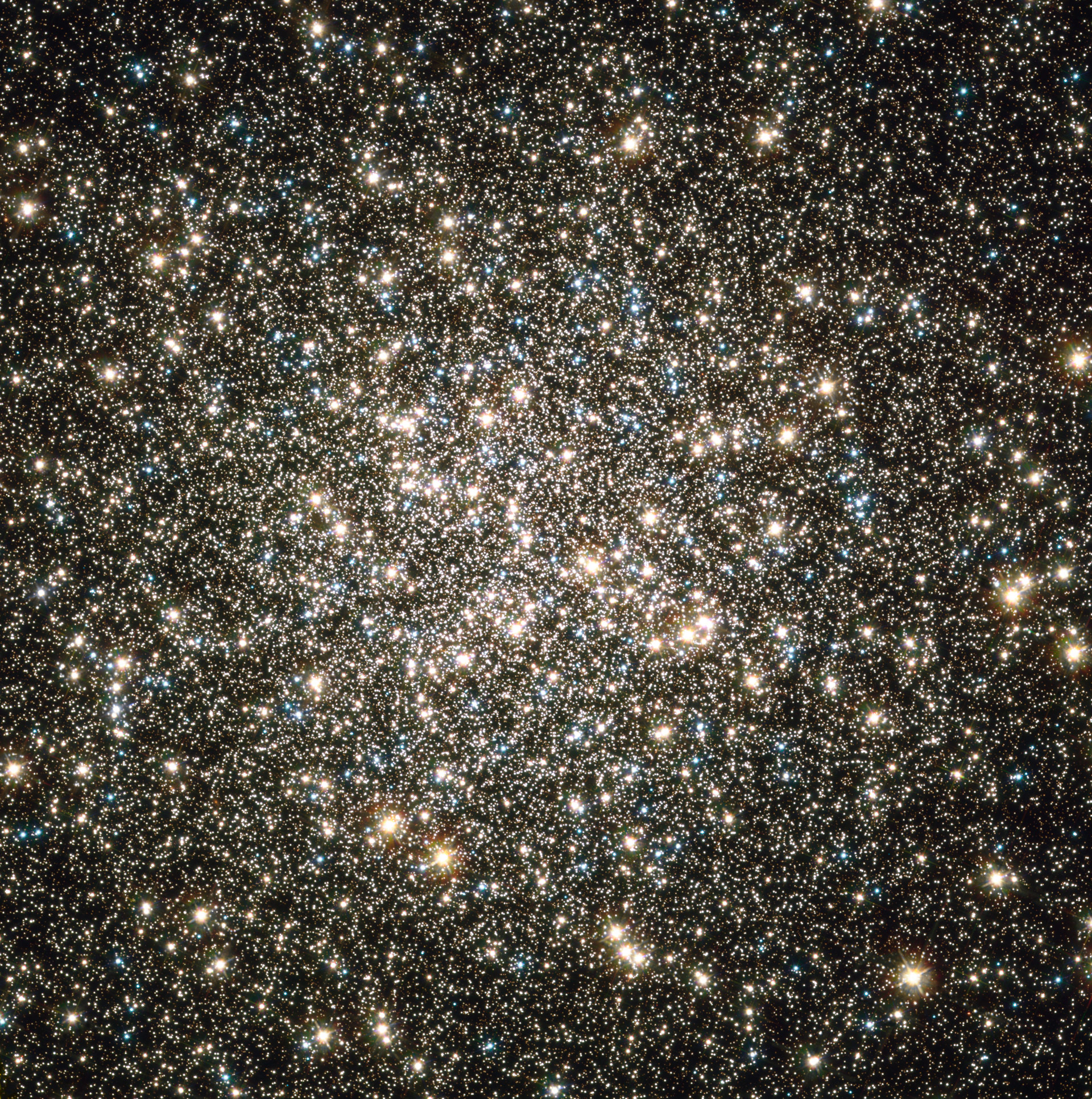
Using the new Integral Field Unit instrument VIRUS-W in conjunction with the 2.7-meter Harlan J. Smith Telescope, astronomers discovered that stars at the centers of globular clusters are rotating around a common axis.
Austin, Texas — Astronomers from The University of Texas at Austin and Germany’s Max Planck Institute for Extraterrestrial Physics (MPE) recently found a surprise when studying some of the oldest star clusters in our galaxy. The stars at the centers of these clusters are rotating around a common axis. It was previously thought any central rotation would have been long erased, leaving the central stars to random orbits. The work has been accepted for publication in the Astrophysical Journal Letters.
These “globular clusters” are ancient collections of up to a million old stars with simple chemical compositions, tightly bound together by gravity. Globular clusters orbit most galaxies, including our own Milky Way. Due to these clusters’ old age and fairly spherical shape, with a strong concentration of stars towards the center, they have historically been viewed as simple systems. However, new observations keep revealing surprising results.
The team, led by MPE’s Maximilian Fabricius and including Texas’ Eva Noyola, observed 11 globular clusters from The University of Texas at Austin’s McDonald Observatory with the Harlan J. Smith Telescope. They found that all of the clusters show this central rotation.
This result is “astonishing,” Fabricius says. “We did not expect this; originally we observed these globular clusters to measure their central velocity dispersions” — that is, the random motions of stars within a cluster.
Noyola adds that “Theory and numerical simulations of globular clusters indicate that any central rotation should be erased on relatively short timescales. Because these globular clusters were formed billions of years ago, we would expect that any rotation signature would have been eradicated by now. Even though previous measurements showed some rotation in a handful of systems, they only probed the motion of stars in the outer regions.”
The astronomers are about halfway through their project of studying 27 of the Milky Way’s approximately 150 globular clusters. Their findings raise interesting questions about the formation history and evolution of globular clusters. None of the current theoretical models predict such a ubiquitous and strong rotation.
However, it is important to note that the 11 globular clusters studied so far do not include any so-called “core-collapsed” globular clusters. Core-collapse is a process that might eradicate rotation. Future observations of the remaining 16 clusters the team plans to study will shed light on this and other questions, such as a possible correlation between rotation and the position of a globular cluster inside our galaxy.
The new measurements of these globular cluster cores were only possible with the help of the MPE-built instrument VIRUS-W, which was used in conjunction with the 2.7-meter Harlan J. Smith Telescope for this research. VIRUS-W allows the scientists to simultaneously measure more than 260 spectra in their field of view, determining the motion of stars to an accuracy of a few kilometers per second. That means that for a given globular cluster, one night at the Smith Telescope with an observing time of a few hours is enough to determine the velocity field at the core of a cluster.
The University of Texas at Austin McDonald Observatory near Fort Davis, Texas, hosts multiple telescopes undertaking a wide range of astronomical research under the darkest night skies of any professional observatory in the continental United States. McDonald is home to the consortium-run Hobby-Eberly Telescope (HET), one of the world’s largest, which is now being upgraded to begin the HET Dark Energy Experiment. An internationally known leader in astronomy education and outreach, McDonald Observatory is also pioneering the next generation of astronomical research as a founding partner of the Giant Magellan Telescope.
Reference: “Central rotations of Milky Way Globular Clusters” by Maximilian H. Fabricius, Eva Noyola, Surangkhana Rukdee, Roberto P. Saglia, Ralf Bender, Ulrich Hopp, Jens Thomas, Michael Opitsch and Michael J. Williams, 14 May 2014, The Astrophysical Journal Letters.
DOI: 10.1088/2041-8205/787/2/L26
Never miss a breakthrough: Join the SciTechDaily newsletter.
Follow us on Google and Google News.