

Scientists observing the Centaurus galaxy cluster made an exciting breakthrough by discovering powerful streams of hot gas swirling rapidly in its core. Using the cutting-edge XRISM satellite, they proved these flows were created by dramatic collisions between enormous galaxy clusters, causing gas within to slosh around energetically.
This discovery finally solves a decades-old cosmic mystery: how the gas at the heart of galaxy clusters stays incredibly hot despite constant energy loss. These insights offer a thrilling glimpse into the dramatic interactions shaping our ever-evolving universe.
Discovery of Hot Gas Flows in Galaxy Clusters
The XRISM collaboration has discovered flows of hot gas within the core of the Centaurus Cluster. Using advanced X-ray measurements from the XRISM satellite and comparing them with detailed numerical simulations, researchers confirmed that these gas movements are caused by collisions between galaxy clusters, resulting in gas “sloshing” within the clusters. This finding solves the longstanding mystery of how galaxy cluster cores remain hot and provides new insights into the ongoing evolution of our universe.

First Evidence of Cosmic Gas “Sloshing”
Astronomers have long theorized that powerful gravitational forces between galaxies and galaxy clusters — massive structures bound together primarily by dark matter — drive their growth through mergers and collisions. However, direct observational evidence has previously been lacking.
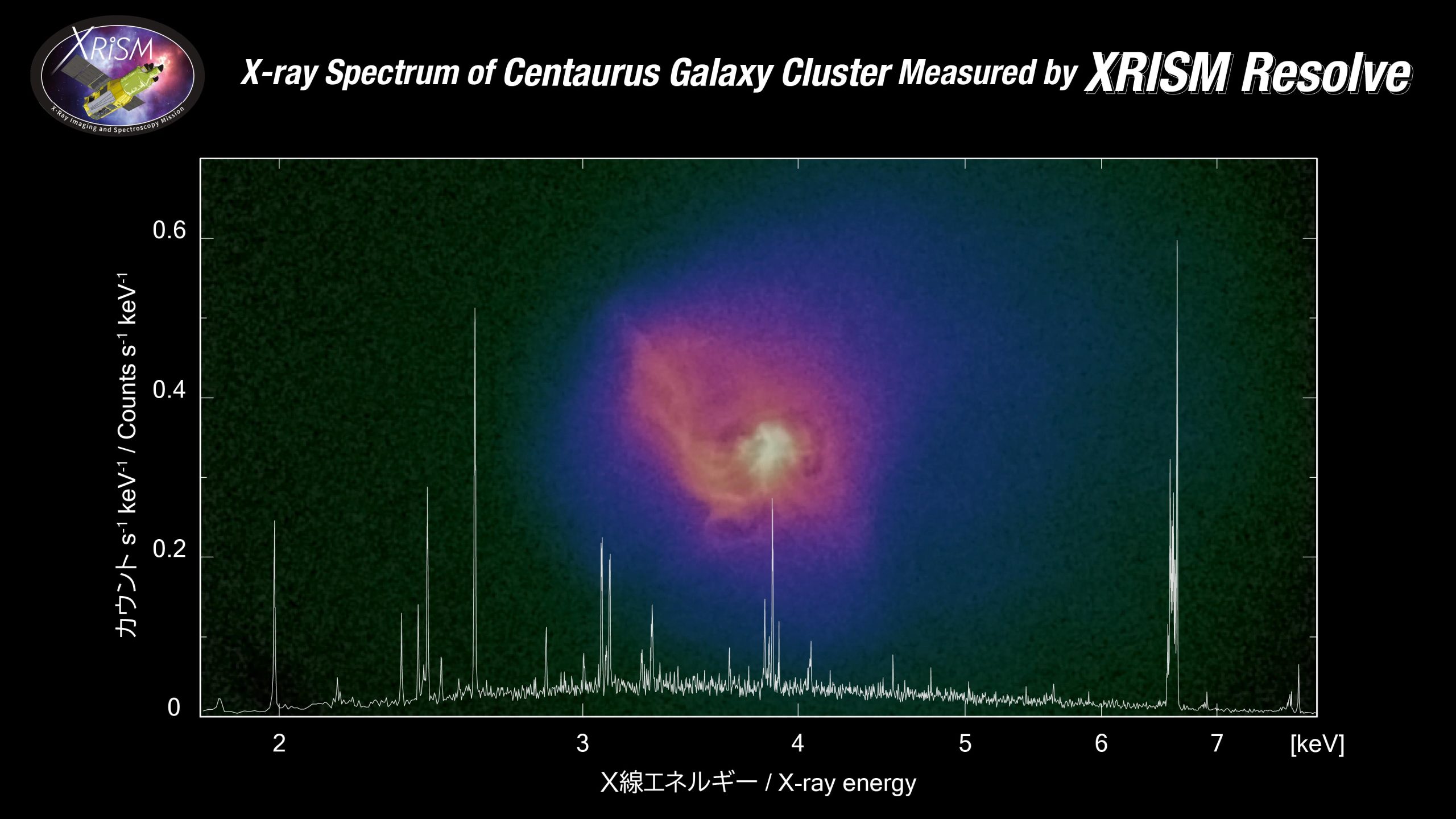
Now, the international XRISM (X-ray Imaging and Spectroscopy Mission) collaboration has provided this evidence. The team used the XRISM satellite, launched in 2023 by the Japan Aerospace Exploration Agency (JAXA), to study the Centaurus galaxy cluster. The satellite’s onboard instrument, called Resolve, offers unprecedented precision in X-ray spectroscopy, allowing astronomers to measure gas velocities accurately and confirm these groundbreaking results.
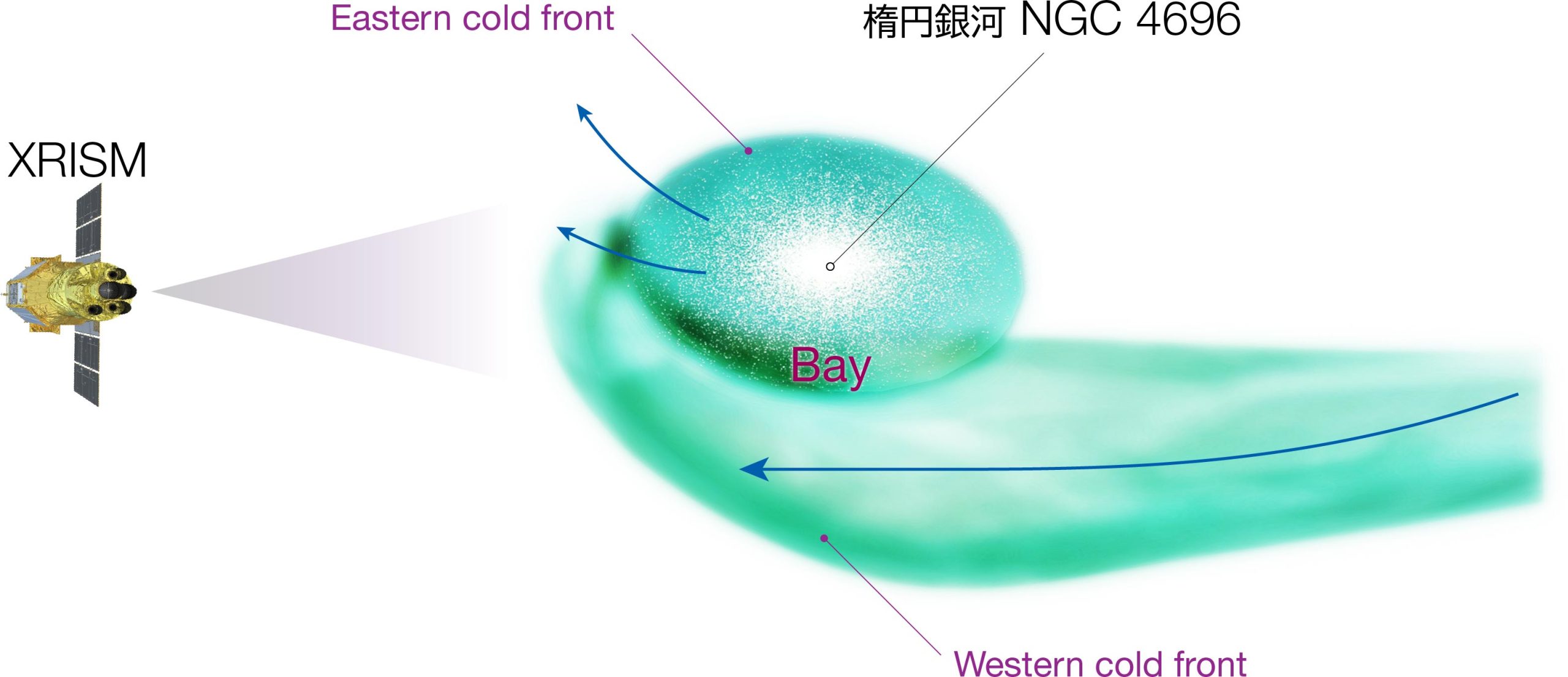
Looking at the core of the Centaurus Cluster, including the central galaxy NGC 4696, they discovered for the first time a bulk flow of hot gas traveling around 130 to 310 kilometers per second in the line-of-sight from Earth. They were also able to create a map of how the velocity varies at locations away from the center.
Making comparisons with simulations, a task team led by Professor Yutaka Fujita from Tokyo Metropolitan University and Associate Professor Kosuke Sato from the High Energy Accelerator Research Organization found that this is consistent with the “sloshing” of the hot gas, also known as the intracluster medium (ICM), caused by collisions with other galactic clusters. This is the first direct evidence for this kind of “sloshing,” validating a long-hypothesized picture of the evolution of the universe.
Solving the Mystery of Cluster Core Heating
It also solves a long-standing unsolved mystery for astronomers of how such bright X-ray emitting gas stays hot. Theoretically, such intense radiation should entail a loss of energy, leading to cooling of the gas; this is known as radiative cooling. The time scale over which this cooling should occur is shorter than the age of the cluster, but observations so far suggest that, somehow, the gas manages to stay hot. These new findings present an elegant solution to this problem. If the gas in the cluster core can “slosh,” involving vast bulk flows of gas to-and-fro around the center, energy can be transported to the core through a mixing process, keeping the gas hot and the emissions bright. The team’s breakthroughs have now been published in the scientific journal Nature.
These unprecedentedly precise measurements are a significant leap forward in our understanding of the formation and evolution of galactic clusters. With years still left in the XRISM mission, the world of astrophysics eagerly awaits more insights into the changing nature of the universe.
Explore Further: Scientists Just Solved a Cosmic Mystery: Why Galaxy Clusters Stay Hot
Reference: “The bulk motion of gas in the core of the Centaurus galaxy cluster” by XRISM collaboration, 12 February 2025, Nature.
DOI: 10.1038/s41586-024-08561-z
This work was supported by JSPS KAKENHI Grant Numbers JP22H00158, JP22H01268, JP22K03624, JP23H04899, JP21K13963, JP24K00638, JP24K17105, JP21K13958, JP21H01095, JP23K20850, JP24H00253, JP21K03615, JP24K00677, JP20K14491, JP23H00151, JP19K21884, JP20H01947, JP20KK0071, JP23K20239, JP24K00672, JP24K17104, JP24K17093, JP20K04009, JP21H04493, JP20H01946, JP23K13154, JP19K14762, JP20H05857 and JP23K03459, NASA (Grant Numbers 80NSSC23K0650, 80NSSC20K0733, 80NSSC18K0978, 80NSSC20K0883, 80NSSC20K0737, 80NSSC24K0678, 80NSSC18K1684 and 80NNSC22K1922), the National Science Foundation Award 2205918, the Science and Technology Facilities Council Grant ST/T000244/1, the Canadian Space Agency Grant 18XARMSTMA, the Kagoshima University Postdoctoral Research Program (KU-DREAM), the RIKEN SPDR Program, the Alfred P. Sloan Foundation through the Sloan Research Fellowship, the RIKEN Pioneering Project Evolution of Matter in the Universe (r-EMU), the Rikkyo University Special Fund for Research (Rikkyo SFR), and the GAČR EXPRO (Grant Number 21-13491X). Part of this work was performed under the auspices of the US Department of Energy by Lawrence Livermore National Laboratory under contract DE-AC52-07NA27344. The material is based on work supported by NASA under award number 80GSFC21M0002. This work was also supported by the JSPS Core-to-Core Program (JPJSCCA20220002). The material is also based on work supported by the Strategic Research Center of Saitama University.
Never miss a breakthrough: Join the SciTechDaily newsletter.
Follow us on Google and Google News.