
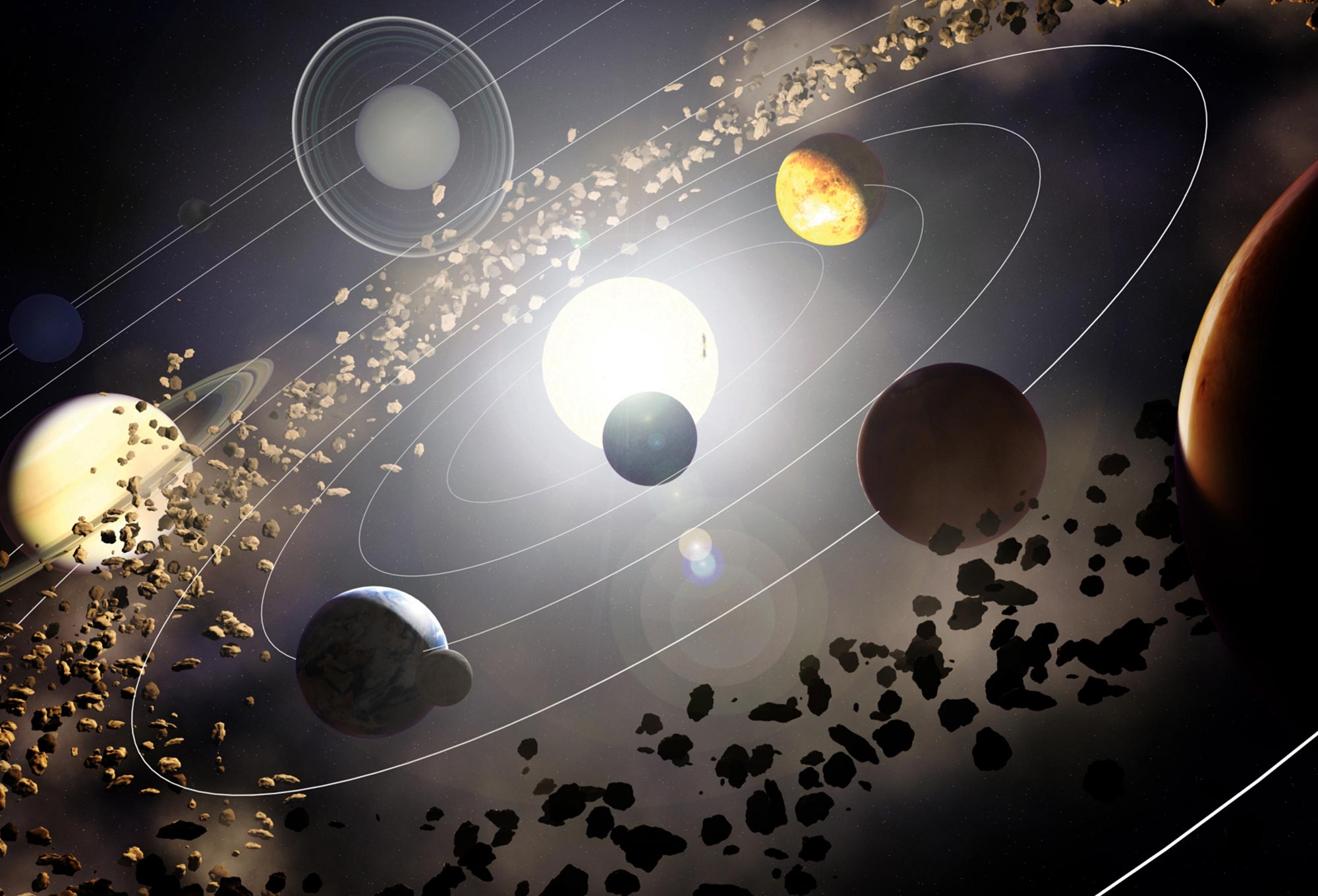
A new model has been developed to simulate interstellar activity within our solar system and the nearby Alpha Centauri system.
Interstellar material has been found within our solar system, but scientists are still working to determine its origin and how it arrived here.
A recent study from Western University, led by astrophysicists Cole Gregg and Paul Wiegert, points to Alpha Centauri, the star system closest to our own, as a promising source. The research outlines compelling reasons why Alpha Centauri is a key candidate for further investigation.
The study was published on March 6 in The Planetary Science Journal.
What Are Interstellar Objects?
Interstellar objects are astronomical material, like asteroids or comets, not gravitationally bound to a star. They can come from other solar systems and be thrown into interstellar space by collisions or be slingshotted by a planet or star’s gravity.
Credit: Western University
Gregg, a PhD candidate in physics and astronomy, developed a computer model to study our solar system, Alpha Centauri and the interstellar activity – the movement of gas, dust, and other space materials – between the two, side by side within our galaxy. Using the physics governing our single-sun solar system, he simulated interstellar activity in Alpha Centauri, a solar system with three suns.
How Alpha Centauri Might Send Objects Our Way
“We know from our own solar system that giant planets bring a little bit of chaos to space. They can perturb orbits and give a little bit of extra boost to the velocities of objects, which is all they need to leave the gravitational pull of the sun,” said Gregg. “For this model, we assumed Alpha Centauri acts similarly to our solar system. We simulated various ejection velocity scenarios to estimate how many comets and asteroids might be leaving the Alpha Centauri system.”
If Gregg and Wiegert are correct and Alpha Centauri does indeed eject material at a rate comparable to our own solar system, they estimate (charting speed and direction) about one million interstellar objects larger than 100 meters in diameter with origins from this triple-star system are currently within the Oort Cloud (the shell of icy objects, mostly comets, that surrounds our solar system).

This number will continue to climb as Alpha Centauri moves closer to our solar system, with its closest approach expected in approximately 28,000 years in the future.
“Assuming Alpha Centauri is ejecting material, which it should be, there are plenty of reasons to expect some of that material is making its way to us,” said Wiegert, a physics and astronomy professor who has discovered more than 80 minor planets, including asteroids and other near-Earth objects.
Western scientist Robert Weryk discovered the first-ever confirmed interstellar object ʻOumuamua’ using the Pan-STARRS telescope at Haleakalā Observatory, Hawaii, on Oct. 19, 2017.
ʻOumuamua’ is a small, red interstellar object estimated to be between 100 and 1,000 meters long, with its width and thickness both estimated between 35 and 167 meters.
Cause for concern?
The new interstellar activity model also projects as many as 10 meteors originating from Alpha Centauri may be entering Earth’s atmosphere every year. These hypothetical meteors would be no greater than 100 micrometers in size and would cause no concern on Earth.

“If our models are right, there is no cause for alarm, because even though these things are probably in our solar system, they’re just a tiny, tiny fraction of all the asteroids and other objects that are out there,” said Wiegert.
In fact, according to the model, only about one in a trillion meteors that hit Earth might be from Alpha Centauri.
“Throughout the history of astronomy, every time we look at a system, we think of it as a closed system. First, we thought Earth was the center of everything and then we found out we’re part of the bigger solar system. Then we discovered we’re part of the Milky Way Galaxy,” said Gregg. “The galaxy isn’t a collection of all these individual star systems, rather they should be studied as an interconnected system, one that shares all of this interstellar material among the stars.”
Reference: “A Case Study of Interstellar Material Delivery: α Centauri” by Cole R. Gregg and Paul A. Wiegert, 6 March 2025, The Planetary Science Journal.
DOI: 10.3847/PSJ/adb1e9
Never miss a breakthrough: Join the SciTechDaily newsletter.
Follow us on Google and Google News.
2 Comments
This is amazing!
I love and look forward to your articles.
Can’t make energy and can’t destroy it.
The human body has enough energy to light a light bulb. Interconnected.
Higher power!
I refer to the higher power as God’s energy within.
One question I’ve long had for my meteor studying friends is have they found a meteorite from outside the solar system. The rough answer is “probably not.” It would be difficult to tell if a meteorite was much older than our solar system. The radioactive decays we use for clocks run down after a while so you can’t easily judge the age of something very old.
On the other hand, there is a robust community studying small grains that are extrasolar. Mostly they look at silicon carbide but there are other candidates. Amazing and wonderful research. After finding a small grains (micron sized) they study the trace isotopes to try to figure out which star was the source of the grain. Really awesome.