
Close Menu
    Facebook X (Twitter) Instagram
    SciTechDaily
    • Biology
    • Chemistry
    • Earth
    • Health
    • Physics
    • Science
    • Space
    • Technology
    Facebook X (Twitter) Pinterest YouTube RSS
    SciTechDaily
    Home»Physics»ATLAS Experiment Observes the Decay Signature of the Higgs Boson
    Physics

    ATLAS Experiment Observes the Decay Signature of the Higgs Boson

    By Prof. Dr. Siegfried Bethke, Max Planck InstituteSeptember 2, 20181 Comment3 Mins Read
    Facebook Twitter Pinterest Telegram LinkedIn WhatsApp Email Reddit
    Share
    Facebook Twitter LinkedIn Pinterest Telegram Email Reddit
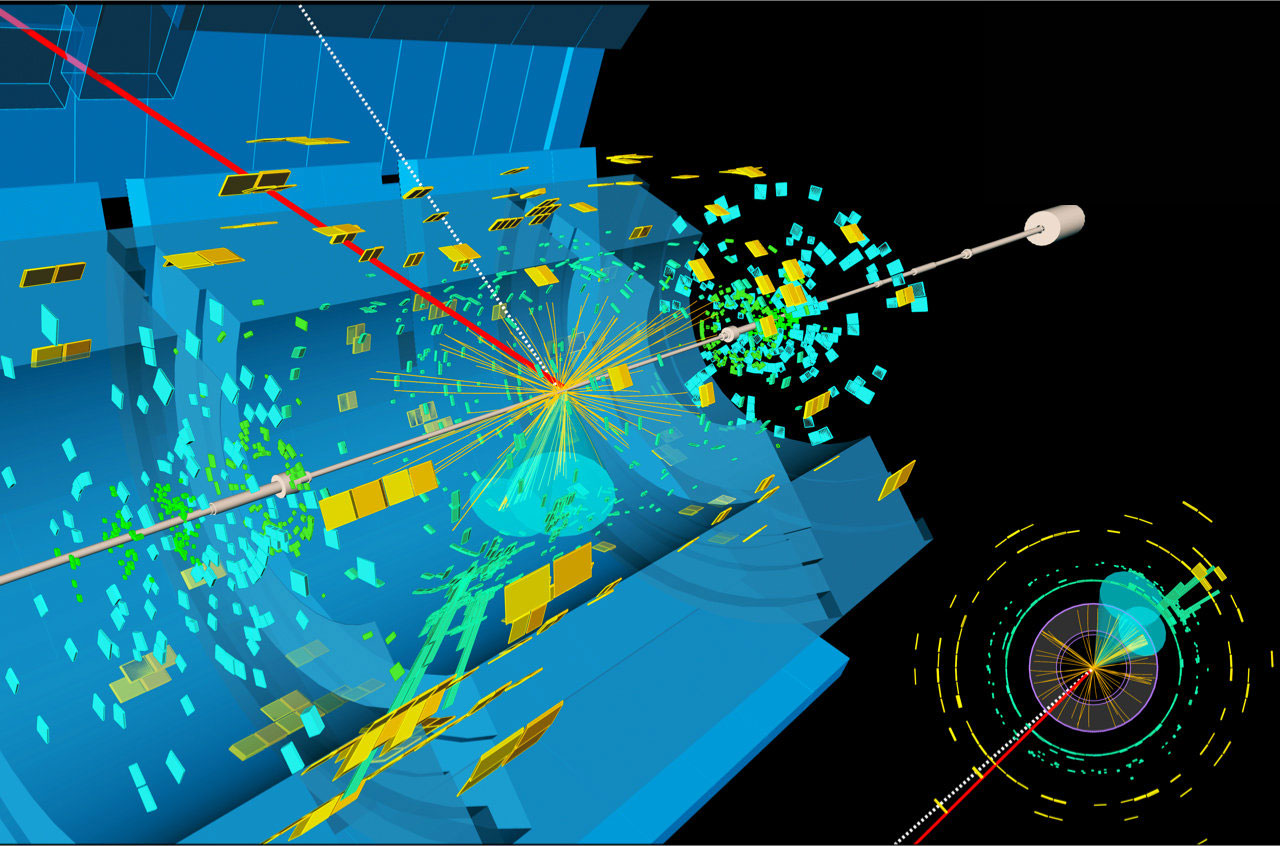
    Decay Signature of the Higgs Boson
    A candidate event display for the production of a Higgs boson decaying to two b-quarks (blue cones), in association with a W boson decaying to a muon (red) and a neutrino. © ATLAS/CERN

    The ATLAS Collaboration at CERN’s Large Hadron Collider (LHC) has – at long last – observed the Higgs boson decaying into a pair of bottom (b) quarks. This elusive interaction is predicted to make up almost 60 percent of the Higgs boson decays and is thus primarily responsible for the Higgs natural width. Yet it took over six years after the 2012 discovery of the Higgs boson to accomplish this observation.

    This observation is among the most demanding analyses carried out by ATLAS so far. Siegfried Bethke, Director at the Max Planck Institute of Physics and former Chairman of the ATLAS Collaboration Board, explains why: “The LHC employs very high energies to force protons into collision. These collisions produce huge amounts of b quarks. It’s an enormous challenge to separate the quarks that Higgs boson decays generate from all the others in this sea of b quarks – it’s even worse than trying to find a needle in the famous haystack!”

    The analysis teams therefore focused on specific signatures, above all the production of a Higgs boson in conjunction with a W or Z boson, the photon’s heavy associates, which together convey the electroweak force between the original building blocks of matter. This produced a particularly clear signal – an approach that proved to be very successful.

    “ATLAS is proud to announce the observation of this important and challenging Higgs boson decay,” says Karl Jakobs, ATLAS Spokesperson. “While the result is certainly a confirmation of the Standard Model, it is equally a triumph for our analysis teams. During the early preparations of the LHC, there were doubts on whether this observation could be achieved. Our success is thanks to the excellent performance of the LHC and the ATLAS detector, and the application of highly sophisticated analysis techniques to our large dataset.”

    The ATLAS Collaboration first presented a preliminary result of this observation (http://atlas.cern/updates/physics-briefing/higgs-observed-decaying-b-quarks) on 9 July at the 2018 International Conference on High-Energy Physics (ICHEP) in Seoul. Today, in a seminar together with the CMS, ATLAS presented results which have been submitted for publication to Physics Letters B. They were achieved and utilized machine learning technology and new analysis techniques to reach a significance of 5.4 standard deviations. Physicists consider five standard deviations the significance threshold past which they claim a discovery.

    These observations mark a new milestone in the study of the Higgs boson, complementing recent results on the production and decay mechanisms of this elementary particle (https://www.mpp.mpg.de/en/what-s-new/news/detail/wissenschaftler-beobachten-kopplung-des-higgs-bosons-an-top-quarks/ as well as http://atlas.cern/updates/physics-briefing/higgs-couples-heaviest-lepton).

    ATLAS transitions from observations to precise measurements of its properties. “We now have the opportunity to study the Higgs boson in unprecedented detail and will be able to further challenge the Standard Model of particle physics,” concludes Karl Jakobs.

    Never miss a breakthrough: Join the SciTechDaily newsletter.
    Follow us on Google and Google News.

    CERN Higgs Boson Large Hadron Collider Max Planck Institute Particle Physics
    Share. Facebook Twitter Pinterest LinkedIn Email Reddit

    Related Articles

    The Higgs Boson Mystery: When Nature Defies Expectations

    Homing In on the Higgs Boson’s Interaction With the Charm Quark at the Large Hadron Collider

    Large Hadron Collider: Could the Higgs Boson Decay Into Dark Matter?

    Large Hadron Collider Detects Evidence of a Rare Higgs Boson Process: God Particle Decaying Into a Pair of Muons

    New Results Indicate That Particle Discovered at LHC Is a Higgs Boson

    CERN to Announce the Latest Results from ATLAS and CMS

    Discussing the Search for the Higgs Particle

    More Data of Elusive Higgs Boson from Defunct US Tevatron Collider

    Higgs Boson Signals Gain Strength at Large Hadron Collider

    1 Comment

    1. Madanagopal.V.C. on November 2, 2018 12:26 pm

      Decay signature of Higgs Boson can only be found but not Higgs separately as it is omnipresent including Dark Matter. HigGs boson decays instantly but not thoroughly. The components of decayed Higgs only are all matter anti matter Dark Matter and energy. Madanagopal.

      Reply
    Leave A Reply Cancel Reply

    • Facebook
    • Twitter
    • Pinterest
    • YouTube

    Don't Miss a Discovery

    Subscribe for the Latest in Science & Tech!

    Trending News

    Artificial Sweeteners May Harm Future Generations, Study Suggests

    Splashdown! NASA Artemis II Returns From Record-Breaking Moon Mission

    What If Consciousness Exists Beyond Your Brain

    Scientists Finally Crack the 100-Million-Year Evolutionary Mystery of Squid and Cuttlefish

    Beyond “Safe Levels”: Study Challenges What We Know About Pesticides and Cancer

    Researchers Have Found a Dietary Compound That Increases Longevity

    Scientists Baffled by Bizarre “Living Fossil” From 275 Million Years Ago

    Your IQ at 23 Could Predict Your Wealth at 27, Study Finds

    Follow SciTechDaily
    • Facebook
    • Twitter
    • YouTube
    • Pinterest
    • Newsletter
    • RSS
    SciTech News
    • Biology News
    • Chemistry News
    • Earth News
    • Health News
    • Physics News
    • Science News
    • Space News
    • Technology News
    Recent Posts
    • What if Dark Matter Has Two Forms? Bold New Hypothesis Could Explain a Cosmic Mystery
    • Researchers Expose Hidden Chemistry of “Ore-Forming” Elements in Biology
    • Geologists Reveal the Americas Collided Earlier Than We Thought
    • 20x Difference: Study Reveals True Source of Airborne Microplastics
    • Scientists Uncover Hidden Force Powering Yellowstone’s Supervolcano
    Copyright © 1998 - 2026 SciTechDaily. All Rights Reserved.
    • Science News
    • About
    • Contact
    • Editorial Board
    • Privacy Policy
    • Terms of Use

    Type above and press Enter to search. Press Esc to cancel.