
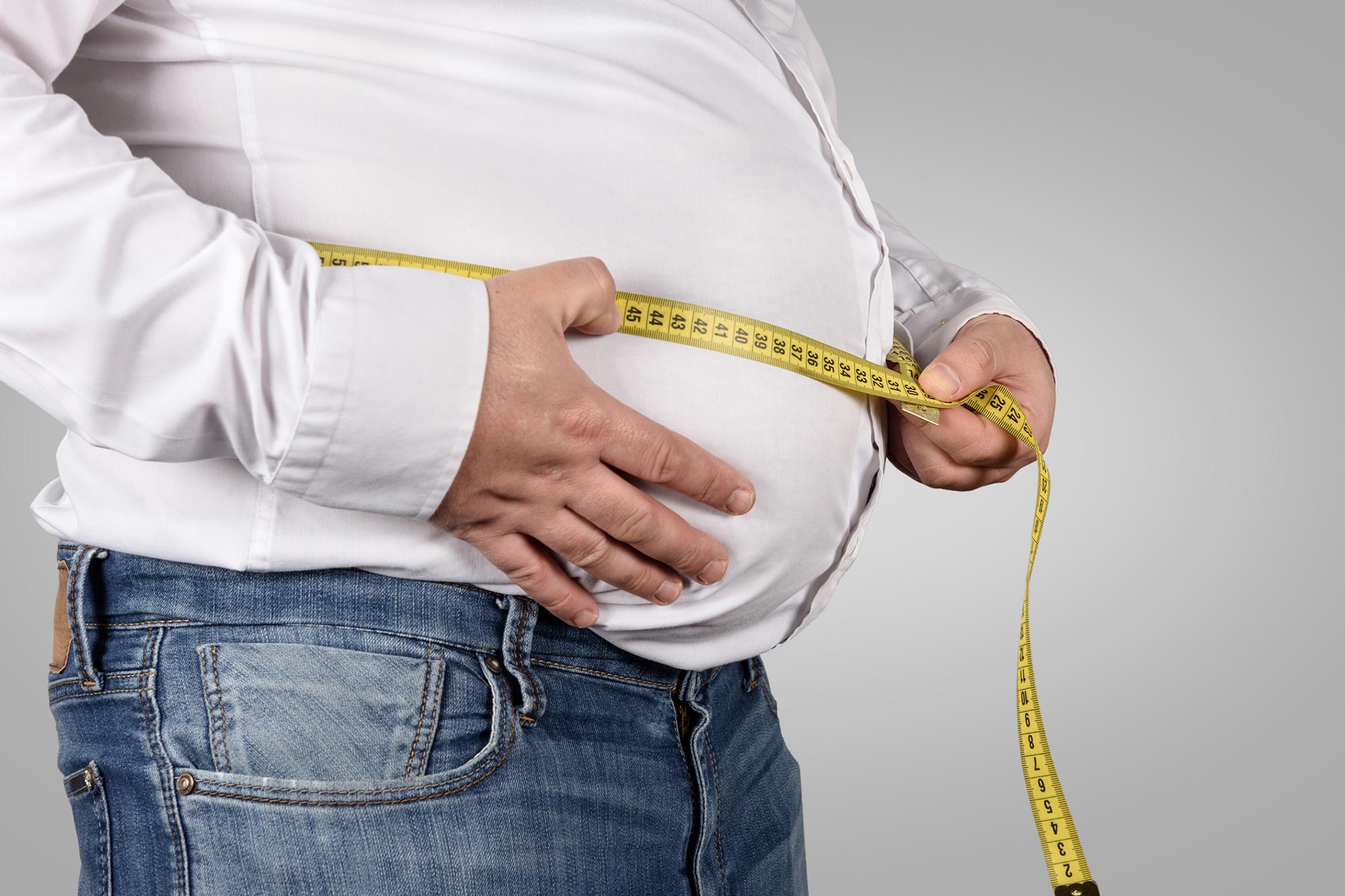
A study found that serving a dip with salty snacks significantly increases calorie intake.
On average, snacks contribute to around one-fourth of the daily caloric intake for many people. With nearly one-third of adults in the United States being overweight and over 40% experiencing obesity, according to the National Institutes of Health, the Penn State Sensory Evaluation Center is exploring ways for Americans to make healthier snacking choices.
The latest study conducted in the center, housed in the College of Agricultural Sciences, investigated how eating behavior changes when consumers are served a dip with a salty snack. The findings, available online now and to be published in the November issue of Food Quality and Preference, suggest that they eat more — a lot more. The chips and dip together yielded a 77% greater caloric intake, and a faster total eating rate compared to the just chips, no-dip control.
Study Findings on Chip and Dip Consumption
However, there was no difference in chip intake, pointed out study corresponding author John Hayes, professor of food science and director of the Penn State Sensory Evaluation Center.
“The most striking findings of our study is that people didn’t eat fewer chips when dip was available — they ate the same amount of chips, plus the dip,” he said. “This lack of compensation means that adding dip to chips can substantially increase overall energy intake without people realizing it.”
Intuitively, many people would guess that if we add something extra to a snack, like dip, people will compensate, and eat less of the main item, Hayes explained.
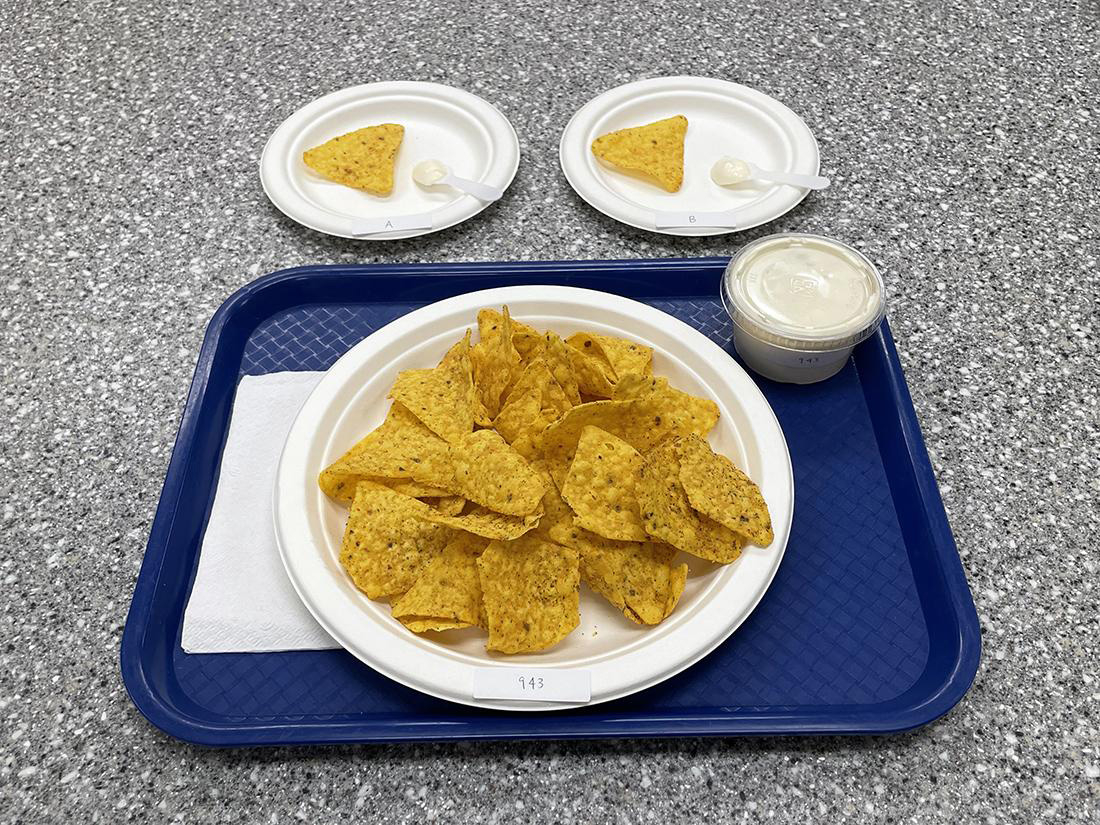
“But our research shows this is not the case with chips and dip,” he said. “Our participants consumed the same amount of chips regardless of whether dip was present, leading to much greater energy intake when dip was available.”
The study, which was led by research assistant Madeline Harper, who recently graduated from Penn State with a master’s degree in food science, assessed 46 adult participants. In two visits to the Sensory Evaluation Center, they were served 70 grams of ranch-flavored chips, or about 2.5 servings, with or without about a third of a cup of ranch dip. Participants ate as much as they wanted.
Their intake was measured, and all eating sessions were video recorded and annotated for a number of bites and active eating time. Researchers used that information to calculate measures of “eating microstructure,” including eating rate and bite size.
Impact of Dip on Snack Consumption
Harper suggested that the greater intake of the chips and dip snack was facilitated by a larger bite size resulting from dip inclusion. On average per eating session, participants consumed 345 calories of chips and dip compared to 195 calories of chips alone.
The study was novel, Harper noted, because little research has been conducted on the effect of external sources of oral lubrication like dips on oral processing of salty snacks.
“Clearly, it has an influence on food intake, especially while snacking,” she said. “However, in this chips-and-dip snack, the greater intake resulting from dip inclusion may have been facilitated by a larger total snack bite-size, as opposed to faster chip eating rate.”
Even though snacking is a major source of energy in the typical American diet, it remains understudied, Hayes said, adding that understanding eating behavior around snacking is crucial to address issues of overeating and obesity.
“This research opens up new avenues for exploring how the physical properties of foods can influence our eating behaviors and ultimately, our energy intake,” he said. “If we can slow people down, we can influence energy consumption without giving up the pleasure from food.”
Reference: “Serving a dip with a salty snack promotes energy intake” by Madeline M. Harper, Paige M. Cunningham and John E. Hayes, 26 June 2024, Food Quality and Preference.
DOI: 10.1016/j.foodqual.2024.105257
Paige Cunningham, postdoctoral scholar in the Department of Food Science and the Department of Nutritional Sciences at Penn State, contributed to the research.
The U.S. Department of Agriculture’s National Institute of Food and Agriculture supported this research.
Never miss a breakthrough: Join the SciTechDaily newsletter.
Follow us on Google and Google News.
1 Comment
Actually, people should not be eating chips. They are fried and are full of acrylamide, a carcinogen and nerve poison. Chips are some of the highest foods with acrylamide. People with nervous disorders are advised to avoid acrylamide. See my article, COOKED TO DEATH: How the acrylamide in food causes nerve damage and Long-COVID. https://www.academia.edu/87219890/COOKED_TO_DEATH_How_the_acrylamide_in_food_causes_nerve_damage_and_Long_COVID