
Close Menu
    Facebook X (Twitter) Instagram
    SciTechDaily
    • Biology
    • Chemistry
    • Earth
    • Health
    • Physics
    • Science
    • Space
    • Technology
    Facebook X (Twitter) Pinterest YouTube RSS
    SciTechDaily
    Home»Space»Why Binary Stars Are So Abundant
    Space

    Why Binary Stars Are So Abundant

    By Carnegie Institution for ScienceSeptember 24, 2014No Comments4 Mins Read
    Facebook Twitter Pinterest Telegram LinkedIn WhatsApp Email Reddit
    Share
    Facebook Twitter LinkedIn Pinterest Telegram Email Reddit
    New Models Show Most Stars Were Formed When Protostars Broke Up
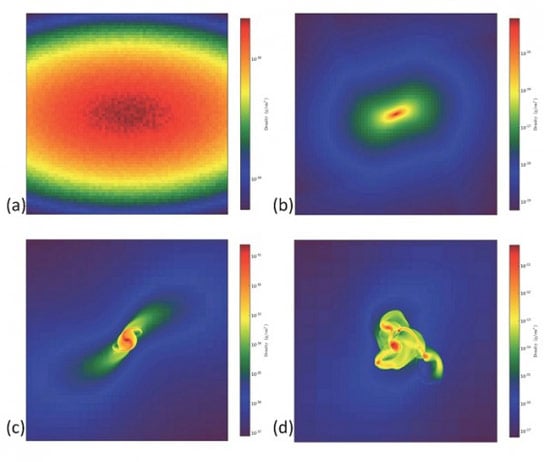
    These images show the distribution of density in the central plane of a three-dimensional model of a molecular cloud core from which stars are born. The model computes the cloud’s evolution over the free-fall timescale, which is how long it would take an object to collapse under its own gravity without any opposing forces interfering. The free-fall time is a common metric for measuring the timescale of astrophysical processes. In a) the free-fall time is 0.0, meaning this is the initial configuration of the cloud, and moving on the model shows the cloud core in various stages of collapse: b) a free-fall time of 1.40 or 66,080 years; c) a free-fall time of 1.51 or 71,272 years; and d) a free-fall time of 1.68 or 79,296 years. Collapse takes somewhat longer than a free-fall time in this model because of the presence of magnetic fields, which slow the collapse process, but are not strong enough to prevent the cloud from fragmenting into a multiple protostar system (d). For context, the region shown in a) and b) is about 0.21 light-years (or 2.0 x 10¹⁷ centimeters) across, while the region shown in c) and d) is about 0.02 light-years (or 2.0 x 1016 cm) across. Credit: Alan Boss

    New research from the Carnegie Institution for Science helps to explain why binary stars are so abundant.

    Washington, D.C. — New modeling studies from Carnegie’s Alan Boss demonstrate that most of the stars we see were formed when unstable clusters of newly formed protostars broke up. These protostars are born out of rotating clouds of dust and gas, which act as nurseries for star formation. Rare clusters of multiple protostars remain stable and mature into multi-star systems. The unstable ones will eject stars until they achieve stability and end up as single or binary stars. The work is published in The Astrophysical Journal.

    About two-thirds of all stars within 81 light-years (25 parsecs) of Earth are binary or part of multi-star systems. Younger star and protostar populations have a higher frequency of multi-star systems than older ones, an observation that ties in with Boss’ findings that many single-star systems start out as binary or multi-star systems from which stars are ejected to achieve stability.

    Protostar clusters are formed when the core of a molecular cloud collapses due to its own gravity and breaks up into pieces, a process called fragmentation. The physical forces involved in the collapse are subjects of great interest to scientists, because they can teach us about the life cycles of stars and how our own Sun may have been born. One force that affects collapse is the magnetic field that threads the clouds, potentially stifling the fragmentation process.

    Boss’ work shows that when a cloud collapses, the fragmentation process depends on the initial strength of the magnetic field, which acts against the gravity that causes the collapse. Above a certain magnetic field strength, single protostars are formed, while below it, the cloud fragments into multiple protostars. This second scenario is evidently commonplace, given the large number of binary and multi-star systems, although single stars can form by this mechanism as well through ejection from a cluster.

    “When we look up at the night sky,” Boss said, “the human eye is unable to see that binary stars are the rule, rather than the exception. These new calculations help to explain why binaries are so abundant.”

    Reference: “Collapse and Fragmentation of Magnetic Molecular Cloud Cores with the Enzo AMR MHD Code. II. Prolate and Oblate Cores” by Alan P. Boss and Sandra A. Keiser, 23 September 2014, The Astrophysical Journal.
    DOI: 10.1088/0004-637X/794/1/44
    arXiv: 1408.2479


    Never miss a breakthrough: Join the SciTechDaily newsletter.
    Follow us on Google and Google News.

    Astronomy Astrophysics Carnegie Institution for Science Protostar
    Share. Facebook Twitter Pinterest LinkedIn Email Reddit

    Related Articles

    JWST Reveals a “Forbidden” Planet With a Baffling Composition

    Alien Space Weather Stations Could Reveal What Makes Planets Livable

    Webb Telescope Spots “Impossible” Atmosphere Around Ancient Super-Earth

    Cosmic Feast: Massive Star Spotted Devouring Gas at an Astounding Rate

    “Teenage Galaxies” Unveiled: Webb Space Telescope’s Remarkable Glimpse Into the Early Universe

    Astronomers Discover Bizarre “Forbidden” Planet That Should Not Exist

    Cosmic Mistaken Identity: “Supernova” Is Actually Something Much Rarer

    Analyzing Meteorites To Track Down the Forces That Shaped Our Solar System’s Evolution

    Violent Stellar Flare From Sun’s Nearest Neighbor Breaks Record

    Leave A Reply Cancel Reply

    • Facebook
    • Twitter
    • Pinterest
    • YouTube

    Don't Miss a Discovery

    Subscribe for the Latest in Science & Tech!

    Trending News

    Popular Supplement Ingredient Linked to Shorter Lifespan in Men

    Scientists May Have Found a Way To Repair Nerve Damage in Multiple Sclerosis

    “Totally Unexpected” – Scientists Discover Pancreatic Cancer’s Fatal Addiction

    A Strange Quantum Effect May Explain One of Biology’s Greatest Mysteries

    James Webb Telescope Reveals the Universe’s Hidden Cosmic Web in Stunning Detail

    Scientists Identify Simple Supplement That Greatly Reduces Alzheimer’s Damage

    You May Have a Dangerous Type of Cholesterol Even if Your Tests Look Normal

    Your Blood Pressure Reading Could Be Wrong Because of One Simple Mistake

    Follow SciTechDaily
    • Facebook
    • Twitter
    • YouTube
    • Pinterest
    • Newsletter
    • RSS
    SciTech News
    • Biology News
    • Chemistry News
    • Earth News
    • Health News
    • Physics News
    • Science News
    • Space News
    • Technology News
    Recent Posts
    • Europe Just Unveiled a Serious Rival to SpaceX’s Starship
    • Scientists May Have Solved Two of Fusion Energy’s Biggest Problems at Once
    • Scientists Discover Hidden “Switch” That Burns Fat and Could Treat Bone Disease
    • Deadly Hantavirus Outbreak on Cruise Ship Sparks Global Health Alert
    • New Research Reveals Certain Fats Can Either Trigger or Suppress Cancer
    Copyright © 1998 - 2026 SciTechDaily. All Rights Reserved.
    • Science News
    • About
    • Contact
    • Editorial Board
    • Privacy Policy
    • Terms of Use

    Type above and press Enter to search. Press Esc to cancel.