
Researchers use lipid biomarkers to uncover how organisms survive in extreme ecosystems.
A surprising variety of life exists within the ocean floor, much of it made up of microbes, tiny organisms capable of surviving in some of the planet’s most extreme environments. These microscopic life forms can endure crushing pressures, intense salinity, extreme pH levels, and very limited nutrient availability.
Recently, a team of scientists discovered microbial life thriving inside two newly identified mud volcanoes with exceptionally high pH conditions. The study detailing their findings was published in Communications Earth & Environment.
Led by first author Palash Kumawat from the Geosciences Department at the University of Bremen, the researchers used lipid biomarker analysis to uncover how these microbes persist in such harsh conditions. The environment’s pH of 12 poses one of the toughest challenges ever recorded for deep-sea ecosystems. Detecting signs of life in these extreme settings required highly sensitive analytical techniques. Traditional DNA detection often fails when only a few living cells are present, prompting the team to rely instead on specialized trace analysis methods.
“But we were able to detect fats,” says first author Palash Kumawat, who is presently a PhD candidate in the Geosciences Department. “With the help of these biomarkers we were able to obtain insights into the survival strategies of methane- and sulfate-metabolizing microbes in this extreme environment.”
Uncovering Microbial Survival Strategies
Microbial communities in the deep ocean play a key role in processing carbon and sustaining the planet’s carbon cycle. In this newly studied ecosystem, however, the microbes rely on a very different energy source. Instead of drawing nutrients from the ocean above, they extract energy from minerals found within surrounding rocks and from gases such as carbon dioxide and hydrogen. Through these reactions, the microbes generate methane, an important greenhouse gas.
The chemical traces, or lipids, found within these organisms also reveal clues about their age and activity. When the cellular biomolecules remain intact, they indicate the presence of living or recently deceased microbes. When the molecules are degraded, they become geomolecules, signaling that the material originated from ancient, fossilized microbial communities.
According to Kumawat, the combination of isotopes and the lipid biomarkers indicates that multiple microbial communities now live in this inhospitable habitat and have lived there in the past.
“This distinction helps us when working in areas with extremely low biomass and nutrient deficiency.”
Insights Into the Origins of Life
Dr. Florence Schubotz, organic geochemist at MARUM – Center for Marine Environmental Sciences at the University of Bremen and co-author of the study, adds: “What is fascinating about these findings is that life under these extreme conditions, such as high pH and low organic carbon concentrations, is even possible. Until now, the presence of methane-producing microorganisms in this system has been presumed, but could not be directly confirmed. Furthermore, it is simply exciting to obtain insights into such a microbial habitat because we suspect that primordial life could have originated at precisely such sites.”
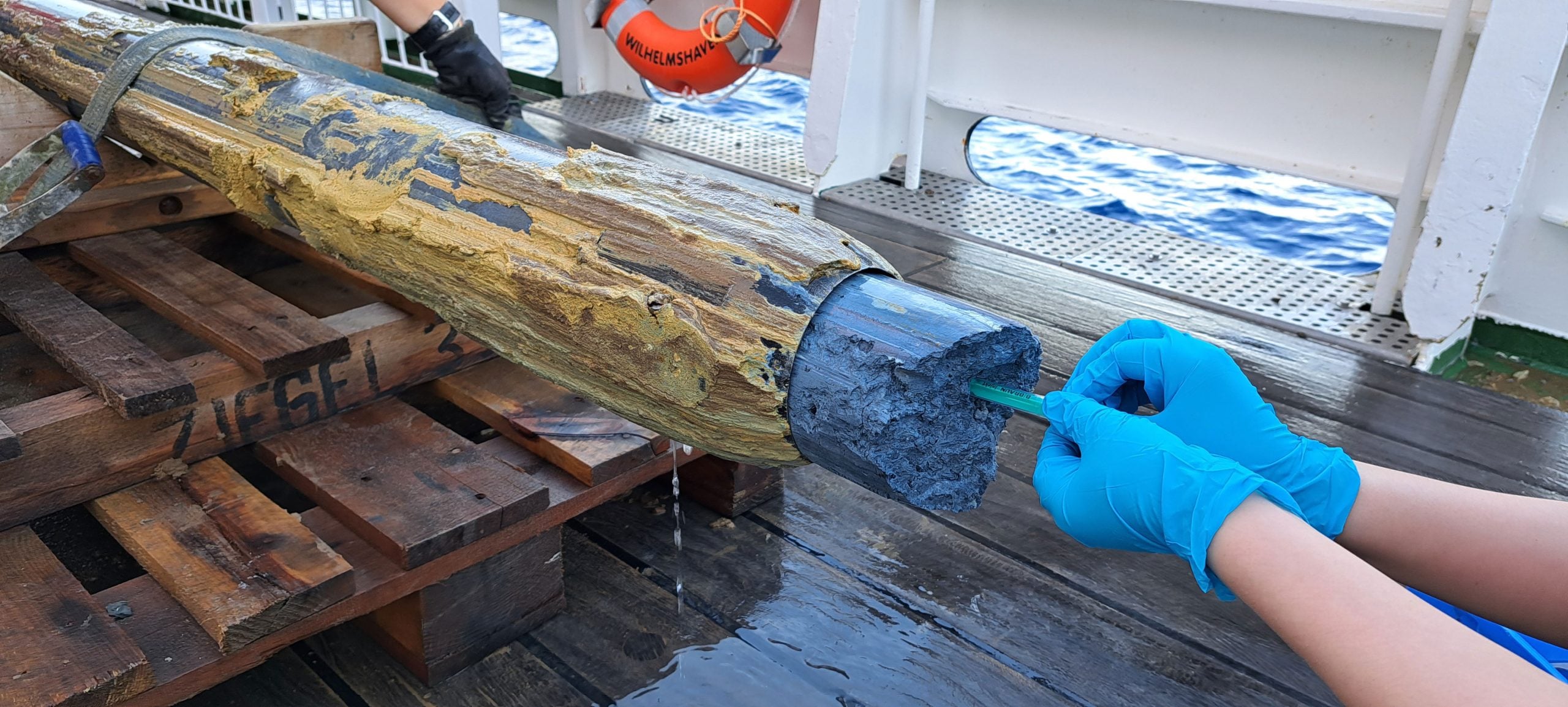
The samples for the study come from a sediment core that was retrieved by the Research Vessel Sonne in 2022 during Expedition SO 292/2. Not only were the scientists able to discover the previously unknown mud volcanoes of the Mariana forearc during this cruise, but also to sample them.
The samples were obtained as part of the Cluster of Excellence “The Ocean Floor – Earth’s Uncharted Interface.” Palash Kumawat and his colleagues are now planning to cultivate organisms in an incubator to find out more about their nutrient preferences in inhospitable environments.
Reference: “Biomarker evidence of a serpentinite chemosynthetic biosphere at the Mariana forearc” by Palash Kumawat, Elmar Albers, Wolfgang Bach, Frieder Klein, Walter Menapace, Christoph Vogt and Florence Schubotz, 13 August 2025, Communications Earth & Environment.
DOI: 10.1038/s43247-025-02667-6
Never miss a breakthrough: Join the SciTechDaily newsletter.
Follow us on Google and Google News.