
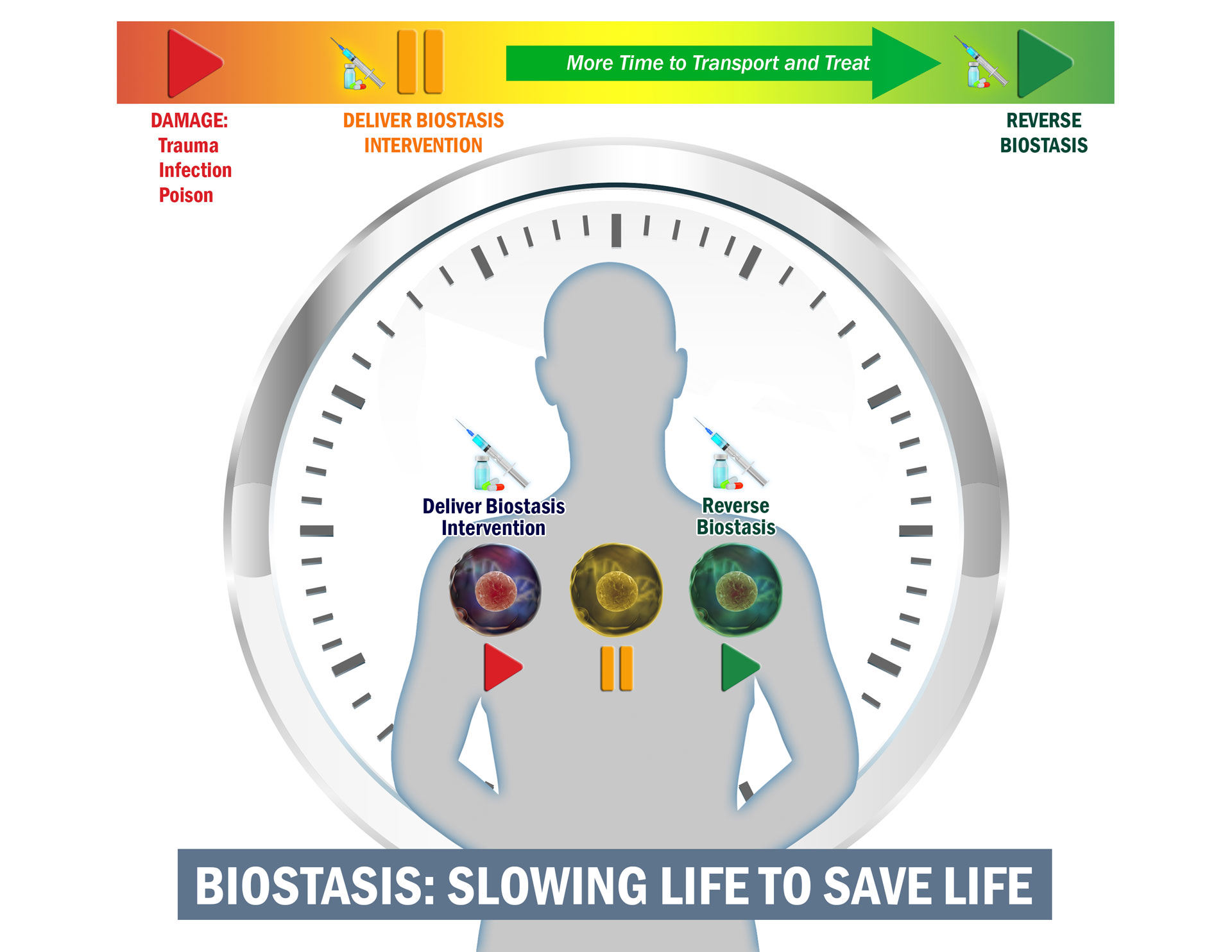
When a Service member suffers a traumatic injury or acute infection, the time from event to first medical treatment is usually the single most significant factor in determining the outcome between saving a life or not. First responders must act as quickly as possible, first to ensure a patient’s sheer survival and then to prevent permanent disability. The Department of Defense refers to this critical, initial window of time as the “golden hour,” but in many cases the opportunity to successfully intervene may extend much less than sixty minutes, which is why the military invests so heavily in moving casualties as rapidly as possible from the battlefield to suitable medical facilities. However, due to the realities of combat, there are often hard limits to the availability of rapid medical transport and care.
DARPA created the Biostasis program to develop new possibilities for extending the golden hour, not by improving logistics or battlefield care, but by going after time itself, at least how the body manages it. Biostasis will attempt to directly address the need for additional time in continuously operating biological systems faced with catastrophic, life-threatening events. The program will leverage molecular biology to develop new ways of controlling the speed at which living systems operate, and thus extend the window of time following a damaging event before a system collapses. Essentially, the concept aims to slow life to save life.
“At the molecular level, life is a set of continuous biochemical reactions, and a defining characteristic of these reactions is that they need a catalyst to occur at all,” said Tristan McClure-Begley, the Biostasis program manager. “Within a cell, these catalysts come in the form of proteins and large molecular machines that transform chemical and kinetic energy into biological processes. Our goal with Biostasis is to control those molecular machines and get them to all slow their roll at about the same rate so that we can slow down the entire system gracefully and avoid adverse consequences when the intervention is reversed or wears off.”
The program will pursue various approaches to slowing down biochemical processes in living cells. Ideally, these approaches will scale from simple biological treatments such as antibodies to more holistic treatments applicable to whole cells and tissues, eventually scaling all the way up to the level of a complete organism. Successful approaches will meet the conditions that the system be slowed across all measurable biological functions and that it does so with minimal damage to cellular processes when the system reverts and resumes normal speed.
“Our treatments need to hit every cellular process at close to the same rate, and with the same potency and efficacy,” McClure-Begley said. “We can’t focus treatments to interrupt just a subset of known critical processes.”
For example, cellular respiration is critical for many cellular processes, but those other processes do not shut down in tandem if respiration is blocked. The maladaptive responses from such an intervention would ultimately kill the cell.
Instead, DARPA is looking for biochemical approaches that control cellular energetics at the protein level. Proteins are the workhorses of cellular functions, and nature offers several examples of organisms that use proteins to help them survive extreme environmental conditions. Creatures such as tardigrades and wood frogs exhibit a capability known as “cryptobiosis,” a state where all metabolic processes appear to have stopped, yet life persists. In the case of tardigrades—microscopic invertebrates colloquially known as “water bears”—they can survive freezing, near-total dehydration, and extreme radiation. Wood frogs, meanwhile, can survive being frozen completely solid for days on end. And while the specific molecular mechanisms involved in these animals are very different, they share a common biochemical concept: they selectively stabilize their intracellular machinery.
“Nature is a source of inspiration,” McClure-Begley said. “If we can figure out the best ways to bolster other biological systems and make them less likely to enter a runaway downward spiral after being damaged, then we will have made a significant addition to the biology toolbox.”
Biostasis is initially aimed at generating proof-of-concept, benchtop technologies and testing their application in simple living systems for experimental validation. To support eventual transition to patients, DARPA will work with federal health and regulatory agencies as the program advances to develop a pathway for potential, future human medical use. By the end of the five-year, fundamental research program DARPA hopes to have multiple tools for reducing the risk of permanent damage or death following acute injury or infection.
Similar Biostasis technologies could also extend the shelf-life of blood products, biological reagents, and drugs by reducing reaction times. Early program research is aimed at identifying approaches that can be tested in simple biological systems such as enzyme complexes or cell lines. If this aspect of the program is successful, these technologies would help to reduce the Defense Department’s logistical burden of transporting biological products into the field.
DARPA will hold a Proposers Day webinar on March 20, 2018, at 12:30 PM EDT to provide more information about Biostasis and answer questions from potential proposers. For details of the event, including registration requirements, visit: https://go.usa.gov/xnzqE.
A full program description will be made available in a forthcoming Broad Agency Announcement.
Never miss a breakthrough: Join the SciTechDaily newsletter.
Follow us on Google and Google News.