
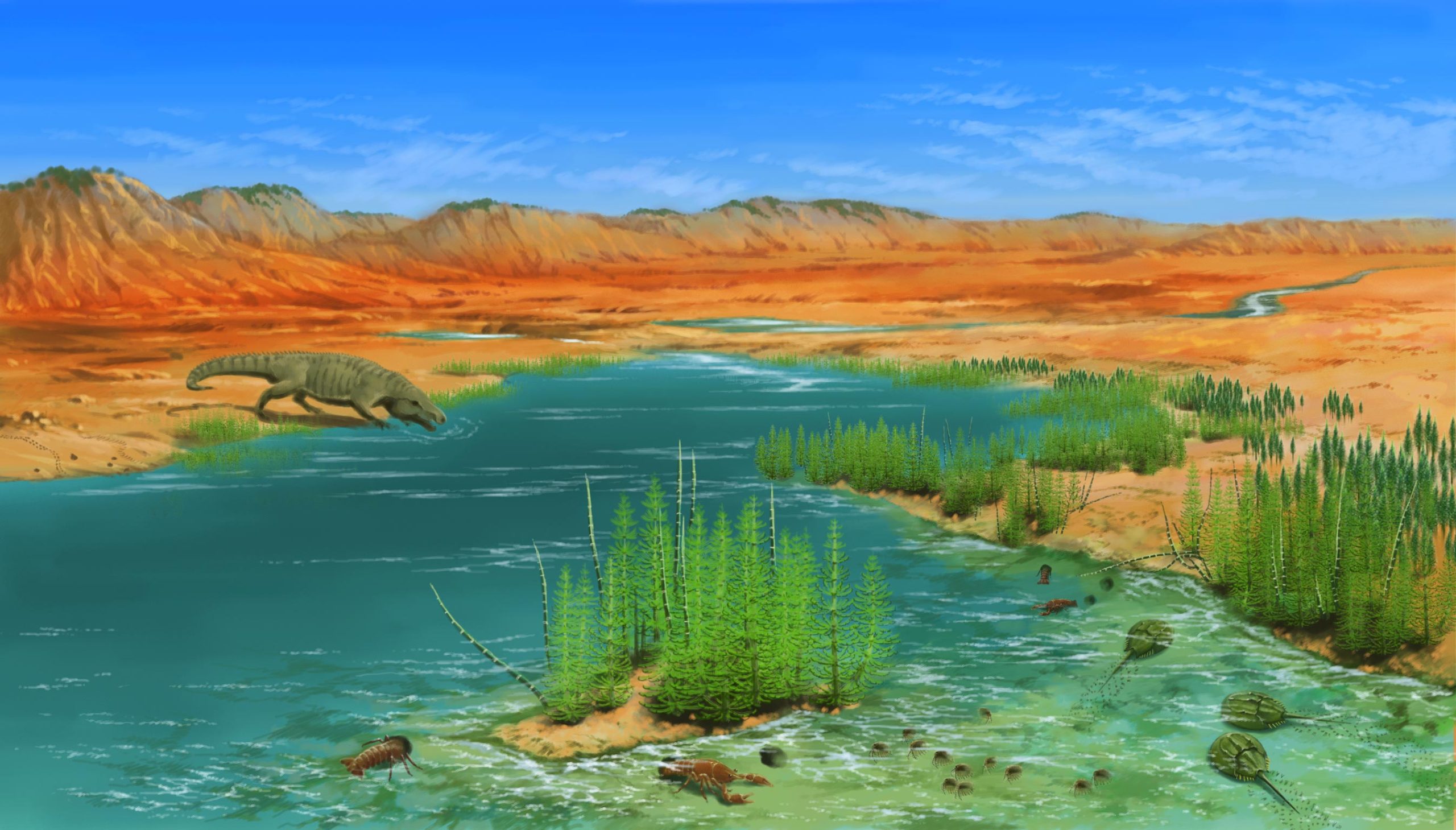
Fossil evidence from North China indicates that certain ecosystems may have rebounded within just two million years after the end-Permian mass extinction, significantly earlier than previously believed.
New research suggests that tropical riparian ecosystems—those along rivers and wetlands—recovered much faster than previously thought after the end-Permian mass extinction, which occurred approximately 252 million years ago.
Published on February 14 as a Reviewed Preprint in eLife, the study is recognized by editors as a significant contribution to understanding how land-based animal and plant life rebounded after the extinction event. The authors present compelling evidence that tropical riparian ecosystems experienced a rapid recovery following a brief period of extreme environmental conditions. Their conclusions are based on analyses of sediments, plant and animal fossils, and trace fossils from North China.
The end-Permian mass extinction, one of the most catastrophic events in Earth’s history, eliminated more than 80% of marine species and 70% of terrestrial species. This extinction was driven by severe environmental shifts, including global warming, ocean acidification, and prolonged droughts.
“Recovery in marine life after the end-Permian extinction has been extensively studied, but the timeline of ecosystem recovery in life on land is much less understood,” says lead author Dr Li Tian, Associate Researcher at the State Key Laboratory of Biogeology and Environmental Geology, China University of Geosciences, Wuhan, China. “Whereas it has long been theorized that low latitudinal land regions remained uninhabitable for an extended period of time, 7–10 million years after the extinction, our results suggest that some ecosystems were more adaptable than previously thought.”
Reconstructing Ecosystem Recovery
To reconstruct the timeline of ecosystem recovery on land, Tian and colleagues analyzed trace fossils (such as burrows and footprints), plant remains, and vertebrate fossils preserved in sedimentary rocks spanning the Early Triassic, which followed the end-Permian extinction around 252–247 million years ago. These fossils were obtained from lake and river deposits in the central North China Basin. The team used a combination of techniques such as biostratigraphy, ichnology (the study of trace fossils), sedimentology, and geochemical analyses.
Their studies suggest a harsh environment at the start of the Early Triassic period, with only sparse and simple life remaining. The fossils from this period indicate a monospecific community, meaning that only a single type of organism dominated, with little evidence of biodiversity. The fossils showed a notable reduction in organism size compared to before the end-Permian extinction – a common indicator of extreme environmental stress.
Signs of Early Recovery
However, fossils from the Spathian stage (around 249 million years ago) showed an increase in plant stems, root traces, and signs of burrowing activity, suggesting a more stable and structured environment. The team also discovered fossils of medium-sized carnivorous vertebrates, indicating that multi-level food webs had been established by this stage. The resurgence of burrowing behavior, which had largely disappeared after the extinction event, was a key finding. Burrowing behavior plays an important role in aerating sediment and cycling nutrients in riparian ecosystems and suggests that animals during this time adapted to environmental stresses by escaping underground.
The findings challenge the view that ecosystem recovery on land after the extinction lagged significantly behind marine life, revealing that some ecosystems were already stabilizing within a relatively short geological time frame.
The researchers note that further studies are needed to determine whether similar recoveries occurred in other land regions during the Early Triassic. Further evidence would help us to understand more about how life recovered from past mass extinctions and could offer valuable lessons about ecosystem resilience and adaptation in the face of modern climate change.
“Our study is the first to suggest that, contrary to past assumptions, life in tropical-subtropical riparian ecosystems rebounded relatively quickly after the end-Permian mass extinction,” concludes senior author Jinnan Tong, Principal Investigator at the State Key Laboratory of Biogeology and Environmental Geology, China University of Geosciences. “The fossil records we studied suggest that riparian zones played a crucial role in stabilising ecosystems after the extinction. Rivers and wetlands may have acted as refuges, providing more stable conditions that allowed life to rebound more quickly than drier, inland regions.”
Reference: “Rapid riparian ecosystem recovery in low-latitudinal North China following the end-Permian mass extinction” by Wenwei Guo, Li Tian, Daoliang Chu, Wenchao Shu, Michael J Benton, Jun Liu and Jinnan Tong, 14 February 2025, eLife.
DOI: 10.7554/eLife.104205.1
Never miss a breakthrough: Join the SciTechDaily newsletter.
Follow us on Google and Google News.