
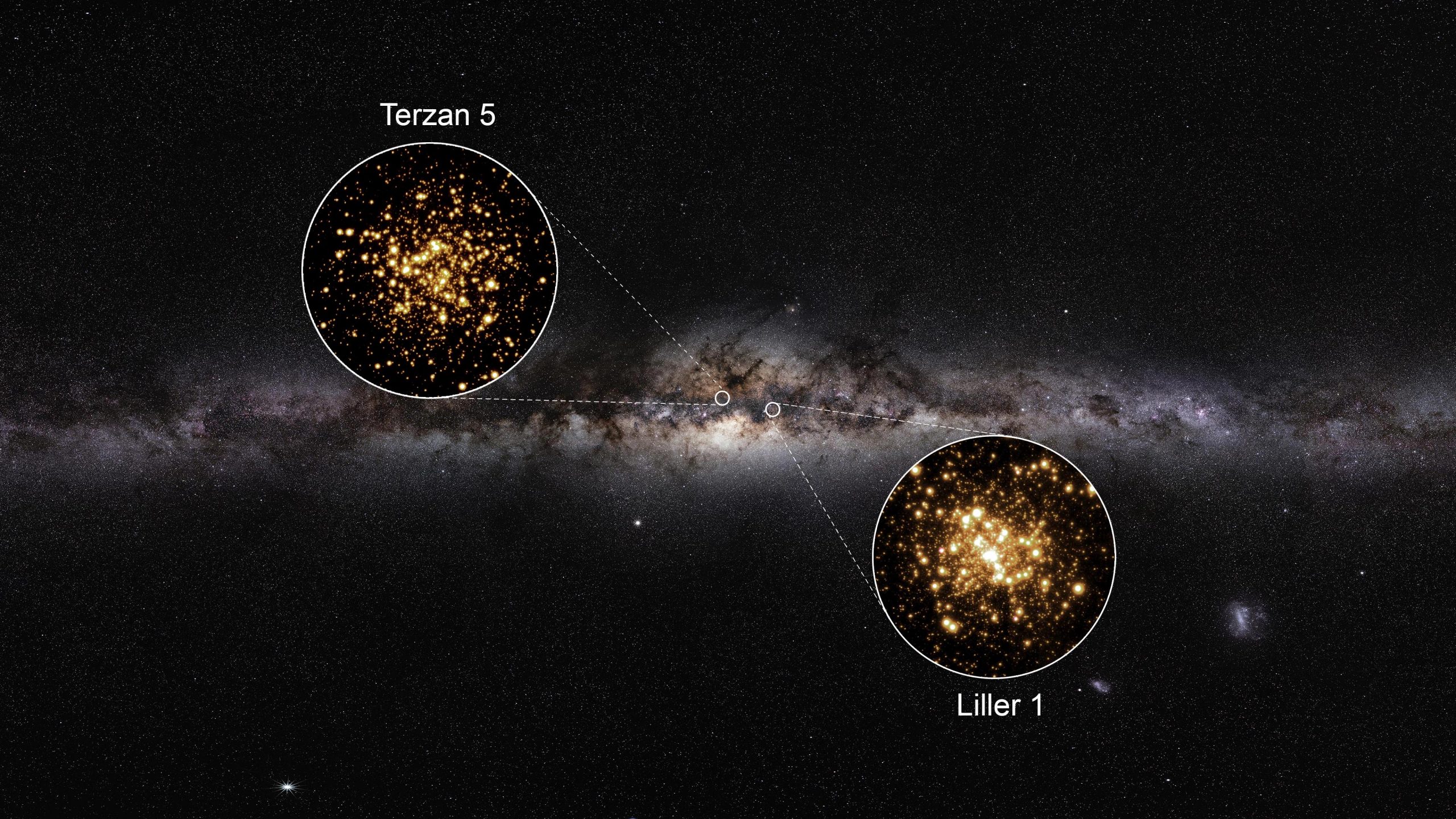
Just as archaeologists dig hoping to find traces of the past, an international group of astrophysicists managed to get into the thick cloud of dust around the center of the Milky Way (also known as the bulge) discovering primordial clumps of gas and stars never found before. They named this new class of stellar system “Bulge Fossil Fragments.” A research team led by Francesco Ferraro (Department of Physics and Astronomy “Augusto Righi” at the University of Bologna and member of the National Institute for Astrophysics – INAF) carried out a study published in Nature Astronomy.
Researchers found out about this new class while analyzing Liller 1. The latter is a stellar system in the Milky Way bulge that for more than 40 years has been classified as a “globular cluster,” i.e. a system composed of millions of same-aged stars (the Milky Way has at least 150 globular clusters). However, researchers observed Liller 1 closely and found out that its real identity is actually more fascinating than so far believed. Indeed, Liller 1 is a fossil fragment of one of the giant stellar clumps that, approximately 12 billion years ago, merged to form the central region (bulge) of the Milky Way.
“Our results clearly show that Liller 1 is not a globular cluster, but a much more complex object,” says Professor Francesco Ferraro, first author and coordinator of the study. “It is a stellar relic, a fossil finding that contains the history of the Milky Way formation.”
A Validating Result
The existence of “cosmic findings” had already been suggested when researchers discovered a similar object, Terzan 5, some years ago. Terzan 5 looked like a globular cluster within our galaxy bulge, but, at a closer analysis, its features were not consistent with those of other globular clusters.
However, an isolated case is just an intriguing anomaly. This is why Liller 1 is so important. Terzan 5 and Liller 1 shared features confirm the existence of a new class of stellar systems unidentified until today.
Fossil Fragments
Which are the feature of the Bulge Fossil Fragments? These objects are disguised as globular clusters, but are fundamentally different, if one looks at the age of the stars composing them. Two stellar populations are in these systems: one is as old as the Milky Way — it formed 12 billion years ago — and the other one is much younger. On the one hand, this shows that these stellar systems appeared during the Milky Way early stages of formation; on the other hand, it demonstrates that they are able to engender multiple events of stellar generation.
“The features of Liller 1 and Terzan 5 stellar populations suggest that both systems formed at the same time of the Milky Way,” explains one of the authors of the study, Barbara Lanzoni, Professor at the University of Bologna and INAF member. “Younger stellar populations are richer in iron and tend to cluster in the central areas of the bulge. Indeed, this is in line with a context of self-enrichment in which the gas ejected by older stars forms new ones.”
Beyond the Clouds
Getting to these findings was anything but easy. Liller 1 is located in one of the most obscured regions of our galaxy, where thick clouds of interstellar dust dim starlight making it up to 10,000 times fainter. The only way of getting through these clouds is infrared light. This is why researchers chose Gemini South to perform the inspection of Liller 1. Gemini South is a powerful telescope with a diameter of 8 meters able to compensate for the distortions in stellar images caused by the atmosphere of the Earth.
The sharpness of Gemini South images is unparalleled. Thanks to these incredible pictures, researchers could do a detailed preliminary analysis of Liller 1 stellar population. Despite this preliminary analysis, researchers had still some work to do to have a complete picture of the composition of this stellar system. Indeed, they needed to know if all the stars shown by those images belonged to Liller 1, or if some of them were simply in the same line of sight, but did not belong to it. They managed to solve this issue by resorting to further observations performed through the Hubble Space Telescope.
“After having combined the two sets of images, we removed the stars that did not belong to Liller 1 and finally had a clear and detailed picture of this stellar system,” says Cristina Pallanca, a researcher at the University of Bologna and INAF member who co-authored the study. “Our results surprised us: Liller 1 hosts at least two stellar populations with dramatically different ages, the oldest having formed about 12 billion years ago, the same time the Milky Way formed; the second one, much younger, having formed just 1-2 billion years ago.”
A discovery that is remarkably similar to what they found out about Terzan 5, which similarly hosts one stellar population as old as the Milky Way and a much younger one (4.5 billion years).
“The discovery that Liller 1 and Terzan 5 share very similar features allowed for the identification of a new class of stellar systems originated from some ancestors that were massive enough to retain the gas ejected by supernovas. What we observed are just some fragments of these massive structures,” adds Emanuele Dalessandro, a researcher at INAF – Space Science Observatory (OAS) in Bologna and co-author of the study.
This then confirmed the existence of the “Bulge Fossil Fragments,” i.e. stellar systems composed of the relics of massive primordial objects that, 12 billion years ago, gave birth to the Milky Way.
“The history of the Milky Way is written in these fossil remains. The latter are tokens of an age during which the Universe was very young, just 1 billion years old,” concludes professor Ferraro. “Now we need to go deeper. Thanks to the discovery of these fossil remains we can start reading the history of the Milky Way and maybe re-define our knowledge about the formation of the bulge.”
The Authors of the Study
“A new class of fossil fragments from the hierarchical assembly of the Galactic bulge” is the title of this study published in Nature Astronomy. The researchers involved in this study are Francesco R. Ferraro, Cristina Pallanca, Barbara Lanzoni, Chiara Crociati and Alessio Mucciarelli from the Department of Physics and Astronomy “Augusto Righi” of the University of Bologna and INAF. Emanuele Dalessandro and Livia Origlia from the INAF also participated in the study.
Moreover, R. Michael Rich (University of California, Los Angeles USA), Sara Saracino (Liverpool John Moores University, UK), Elena Valenti and Giacomo Beccari (European Southern Observatory, Germany), Douglas Geisler and Sandro Villanova (Universidad de Concepción, Cile), Francesco Mauro and Cristian Moni Bidin (Universidad Católica del Norte, Cile) took part in this research.
Reference: “A new class of fossil fragments from the hierarchical assembly of the Galactic bulge” by F. R. Ferraro, C. Pallanca, B. Lanzoni, C. Crociati, E. Dalessandro, L. Origlia, R. M. Rich, S. Saracino, A. Mucciarelli, E. Valenti, D. Geisler, F. Mauro, S. Villanova, C. Moni Bidin and G. Beccari, 14 December 2020, Nature Astronomy.
DOI: 10.1038/s41550-020-01267-y
Never miss a breakthrough: Join the SciTechDaily newsletter.
Follow us on Google and Google News.