
Novel geochemical dating techniques show that Norse people were in L’Anse aux Meadows exactly 1,000 years ago.
Since the 1960s, archaeologists have been gathering physical evidence that Norse people landed and settled for at least a few years in far northern Newfoundland, Canada, long before Columbus sailed to the Americas. At L’Anse aux Meadows, the Vikings constructed housing and workshops of timber and sod, and left behind food, tools, and bits of building material that scientists have been analyzing. But exactly when were they there? The latest answer comes from the Sun and its electromagnetic relationship to Earth.
Using clues from literature and history—such as tales of Vinland from Norse sagas—and from radiocarbon dating of wood and bone fragments, researchers previously estimated that the Vikings were frequent visitors or settlers at L’Anse aux Meadows between 970 and 1030 CE. Many researchers suggested they lived there three to ten years, with one team claiming it may have been as long as one hundred years.
Solar Storms as a Time Marker
In a new study published in October 2021, scientists found that the Vikings were in L’Anse aux Meadows in 1021, exactly 1000 years ago. Led by scientists from the University of Groningen and Parks Canada, the team used geochemical dating techniques to analyze wood fragments and nail down the precise year the trees were cut down near the site.
Earth is regularly bombarded by radiation from space, mostly from the Sun, including benign visible light and radio waves and less benign ultraviolet light and X-rays. (Much of it is absorbed, reflected, or refracted by our atmosphere.) The universe also pulses our planet with cosmic rays and other radiation, a phenomenon that creates carbon-14 when the energy collides with gases in our atmosphere. Sometimes the Sun also releases violent bursts of radiation that can make carbon-14 and beryllium.
Carbon-14 Spikes Reveal the Exact Year
Such an outburst helped Michael Dee, Margot Kuitems, and colleagues pinpoint the date of Viking life in Newfoundland to 1021. Other researchers previously found evidence of an extreme space weather event in late 992 and early 993 CE; historic records from Germany, Korea, and Iceland described vivid red auroras at middle latitudes that winter. (Auroras are usually provoked by solar storms.) The event created an increase in atmospheric carbon-14 on Earth, and such increases are absorbed into the tissues of trees as they grow. By studying gnarled wood fragments from L’Anse aux Meadows, Dee, and colleagues were able to spot the carbon-14 boost and then count tree rings in three separate samples. All three pieces of wood were cut from trees in 1021.
Whether the Vikings were in Newfoundland before or after 1021 is not certain, but the evidence says they were there for at least that year, cutting trees and building things. Today you can visit remnants of their stay, along with recreations of a forge, church, and other buildings, at L’Anse aux Meadows National Historic Park, a UNESCO World Heritage Site. It is the earliest known European settlement in the Americas, and it resembles similar Norse settlements from that era found in Iceland and Greenland. Archaeologists are also investigating evidence that Native American people lived in or passed through the L’Anse aux Meadows area about 5,000 years ago before the Vikings.
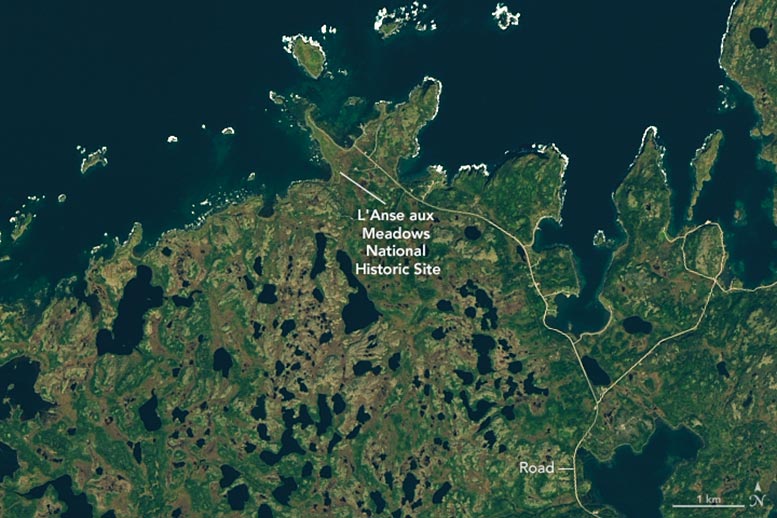
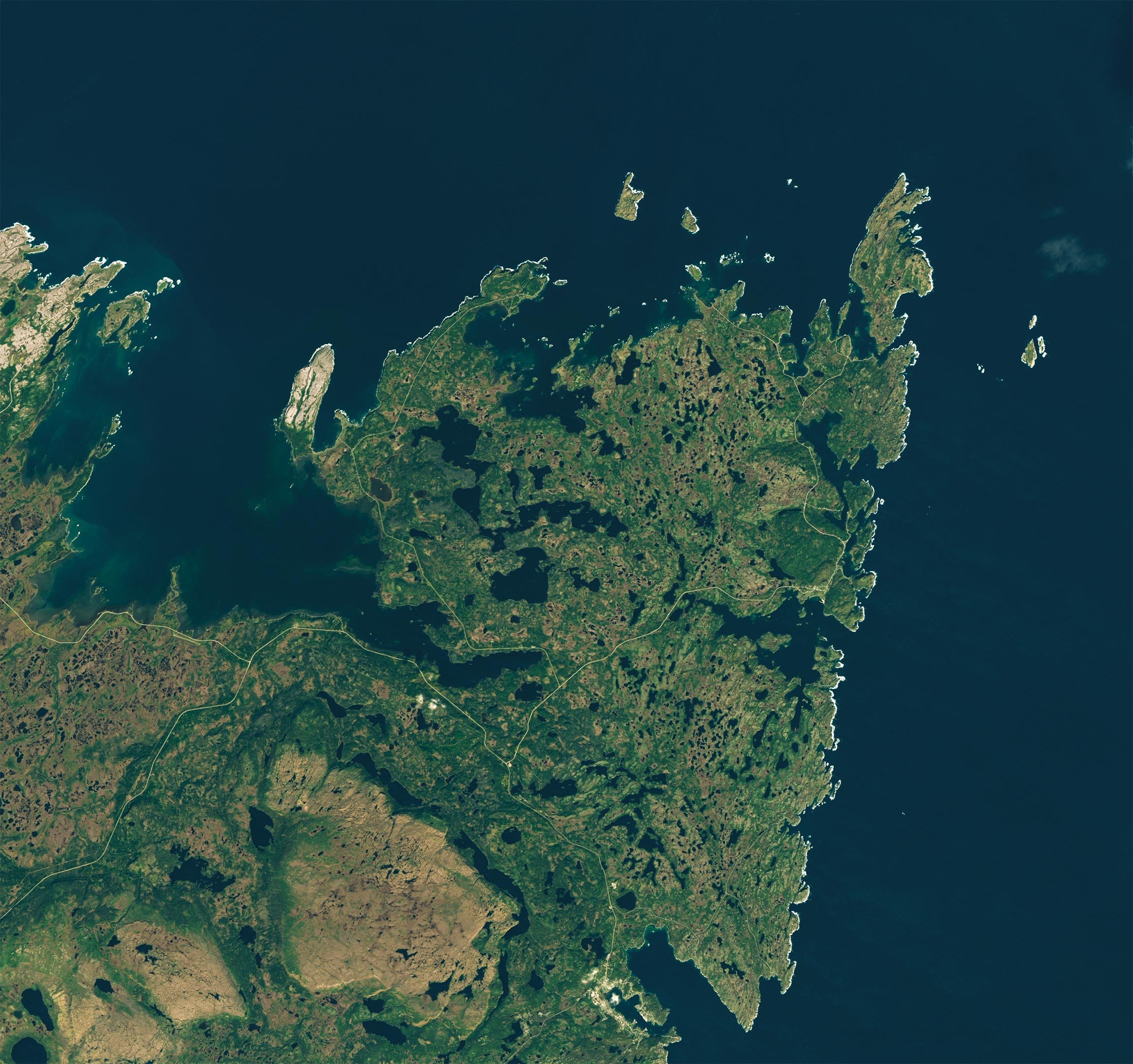
The Operational Land Imager (OLI) on Landsat 8 acquired these images of Newfoundland’s Great North Peninsula on October 7, 2021. The rugged coastline is lined with rocky cliffs and fjords, while the interior is rich in ponds, lakes, and bogs. L’Anse aux Meadows sits along the shore of Epaves Bay in the Strait of Belle Isle.
NASA Earth Observatory images by Lauren Dauphin, using Landsat data from the U.S. Geological Survey.
Never miss a breakthrough: Join the SciTechDaily newsletter.
Follow us on Google and Google News.